
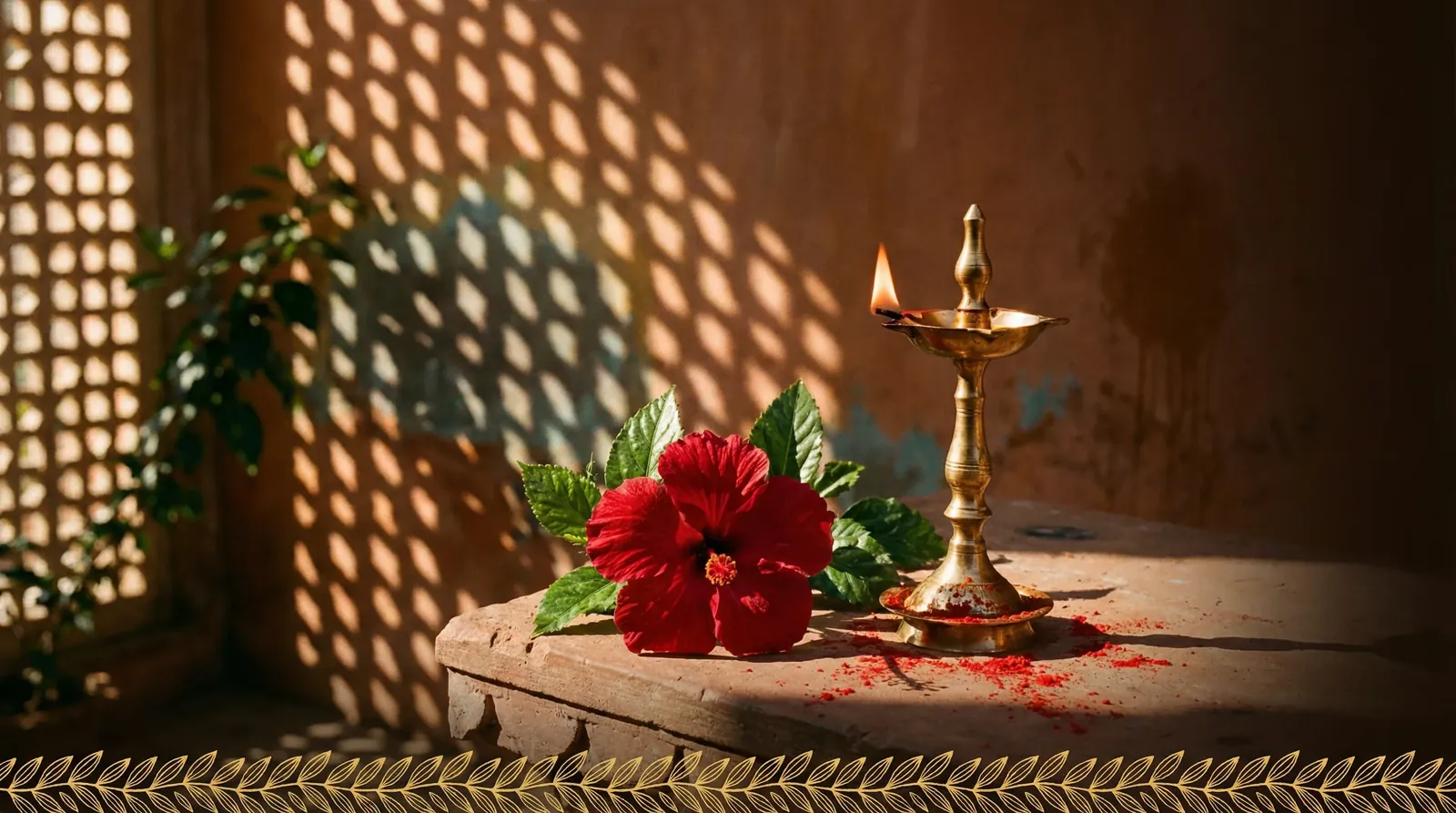
जवाHibiscus
for Durga and Kali
The deep red hibiscus, javā in Sanskrit and jaba in Bengali, belongs to the Goddess. It is offered in the worship of Devī everywhere, and in Bengal it is above all Kālī’s flower.12
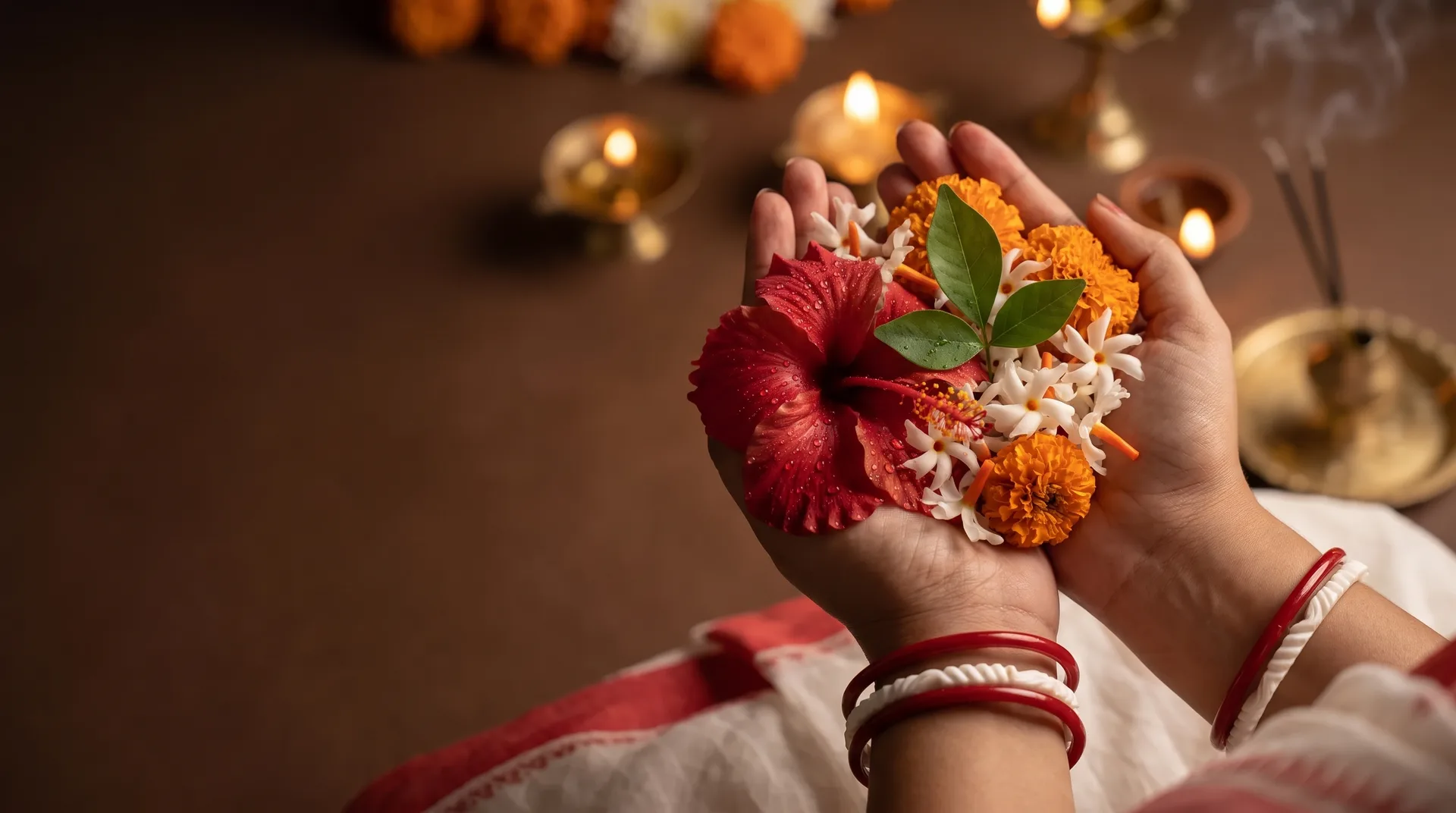
Pushpanjali (पुष्पाञ्जलि) means “a handful of flowers”: puṣpa is a flower, and añjali is the two hands cupped and joined in offering. The worshipper fills the cupped hands with flowers, recites a mantra, and lets the flowers fall at the deity’s feet. At Durga Puja it is offered in three rounds, each with its own verse.
The gesture is older than any verse said over it. Two palms meet at the edge and curve into a bowl, the añjali, the same gesture that salutes gods, teachers and ancestors.2 Fill that bowl with flowers and it becomes a pushpanjali.
Every deity has a flower it is known to love, and a few it is known to refuse. The mantra tells the god what is being given. The flower tells you which god is being addressed. This page gives both: what the words mean, what Bengal recites on Durga Ashtami, and which flower goes to whom.
Pushpanjali is also the name of the opening dance of a Bharatanāṭyam recital, in which the dancer offers flowers from cupped hands before the performance begins.1 It is the same gesture, carried onto a stage.
The words said over the flower
Puṣpaṃ samarpayāmi is two words. Puṣpam is a flower. Samarpayāmi is “I offer”, built from sam, completely, and arpayāmi, I hand over. So the sentence does not say “here is a flower”. It says “I give this flower away entirely.” In the plural, puṣpāṇi samarpayāmi, the hands are full: I offer flowers.
In a full pūjā the formula never stands alone. It is addressed to someone by name. In the sixteen-step worship of Gaṇapati, the flower step reads:
Mahāgaṇapati Ṣoḍaśopacāra Pūjā · the flower step4
ओं श्रीमहागणपतये नमः नानाविध परिमल पुष्पाणि समर्पयामि ।
oṃ śrīmahāgaṇapataye namaḥ nānāvidha parimala puṣpāṇi samarpayāmi
Om, salutation to the great Gaṇapati: I offer fragrant flowers of many kinds.
A full pūjā receives the deity as an honoured guest through sixteen services, the ṣoḍaśopacāra.3 The list varies a little from manual to manual. In the one below, flowers come tenth: after the guest has been seated, washed, dressed and anointed with sandal paste, and just before incense and the lamp.
The flower returns at the very end. The sixteenth service is mantrapuṣpa, a flower made of mantra: verses offered as if they were blossoms. The same Gaṇapati pūjā closes with ओं श्रीमहागणपतये नमः मन्त्रपुष्पं समर्पयामि ।, “I offer the flower of mantra”.4 Its flower verse even names the god’s own flowers: śamī, mandāra and dūrvā.4
A short daily pūjā keeps only five services: fragrant paste, flowers, incense, a flame and food.23 However much else is dropped, the flower stays. If you are building that kind of morning routine, our guide to a daily mantra practice shows where the offering sits in it.
Durga Puja · In Kolkata, Maha Ashtami is Monday 19 October 20269
On the mornings of Saptami, Ashtami and Navami, Bengal’s pandals fill before the priest is ready. Many of the people waiting have not eaten. The custom is to fast until the anjali has been offered, and to take the first food of the day only after it.7
The priest hands out flowers and bilva leaves. He recites a phrase, the crowd repeats it, and at the end of the verse every pair of cupped hands opens toward the Goddess’s feet. This happens three times, each round with its own verse.7,8 Ashtami is the morning people travel for. In Kolkata it falls on 19 October 2026, the same day as Kumari Puja and Sandhi Puja.9
The first round · Argalā Stotram, Durgā Saptaśatī8,10
जयन्ती मङ्गला काली भद्रकाली कपालिनी ।
दुर्गा शिवा क्षमा धात्री स्वाहा स्वधा नमोऽस्तु ते ॥
jayantī maṅgalā kālī bhadrakālī kapālinī durgā śivā kṣamā dhātrī svāhā svadhā namo’stu te
The Victorious, the Auspicious, Kālī, Bhadrakālī, the Bearer of the Skull; Durgā, Śivā, Forbearance, the Sustainer, Svāhā and Svadhā: salutation to you.
The second round8
The second verse calls her Mahiṣaghnī, slayer of the buffalo demon, and Cāmuṇḍā, and asks for long life, health and victory. We do not print it in Sanskrit here: we have not yet traced it to a published pūjā manual, and this page sets no verse without one.
The third round · Devī Māhātmya 11.10, Nārāyaṇī Stuti8,11
सर्वमङ्गलमाङ्गल्ये शिवे सर्वार्थसाधिके ।
शरण्ये त्र्यम्बके गौरि नारायणि नमोऽस्तु ते ॥
sarvamaṅgalamāṅgalye śive sarvārthasādhike śaraṇye tryambake gauri nārāyaṇi namo’stu te
Auspiciousness of all that is auspicious, Śivā, who brings every aim to fulfilment; refuge, three-eyed one, Gaurī: Nārāyaṇī, salutation to you.
The third round usually goes on through the next two verses of the same hymn, 11.11 and 11.12.8,11 After each verse comes a short dedication that names what is in the hands, sandal paste, flowers and the bilva leaf, and gives it all to Durgā. The flowers should land at her feet and nowhere else, and nobody should step on them afterwards.8
Durga Puja comes at the end of the nine nights of Navaratri and its nine mantras. Many families still offer the anjali side by side, children copying the words a beat behind their parents, the way chanting has always been passed down at home.
for Durga and Kali
The deep red hibiscus, javā in Sanskrit and jaba in Bengali, belongs to the Goddess. It is offered in the worship of Devī everywhere, and in Bengal it is above all Kālī’s flower.12
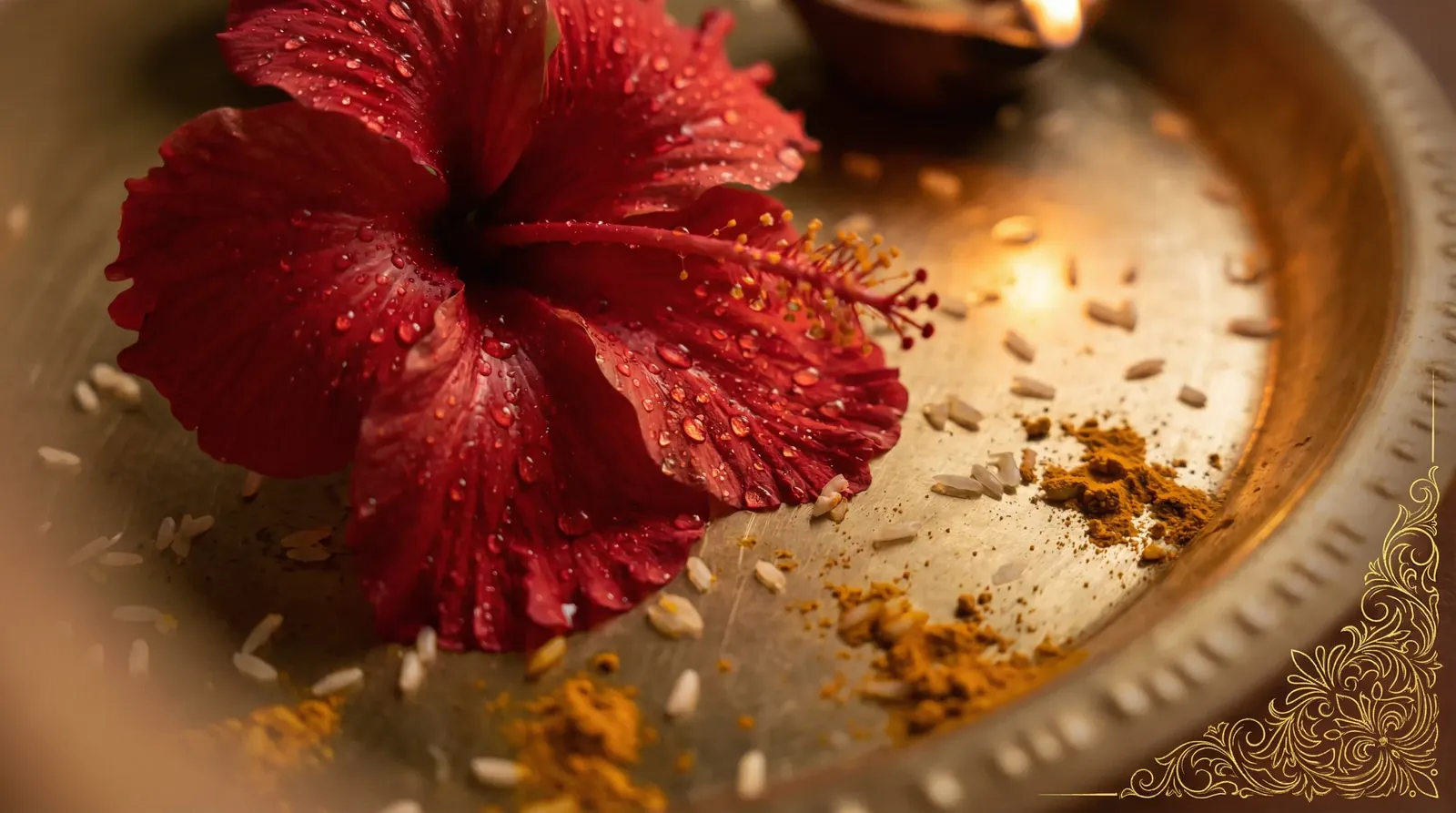
Why red
In her study of goddess worship in West Bengal, the scholar June McDaniel describes Kālī decorated in red hibiscus. Red flowers in general are held to be hers.13
At Durga Puja the hibiscus rarely travels alone. It shares the anjali with a green bilva leaf and the small white shiuli: red, white and green in one pair of hands.8,14
for Durga, in autumn
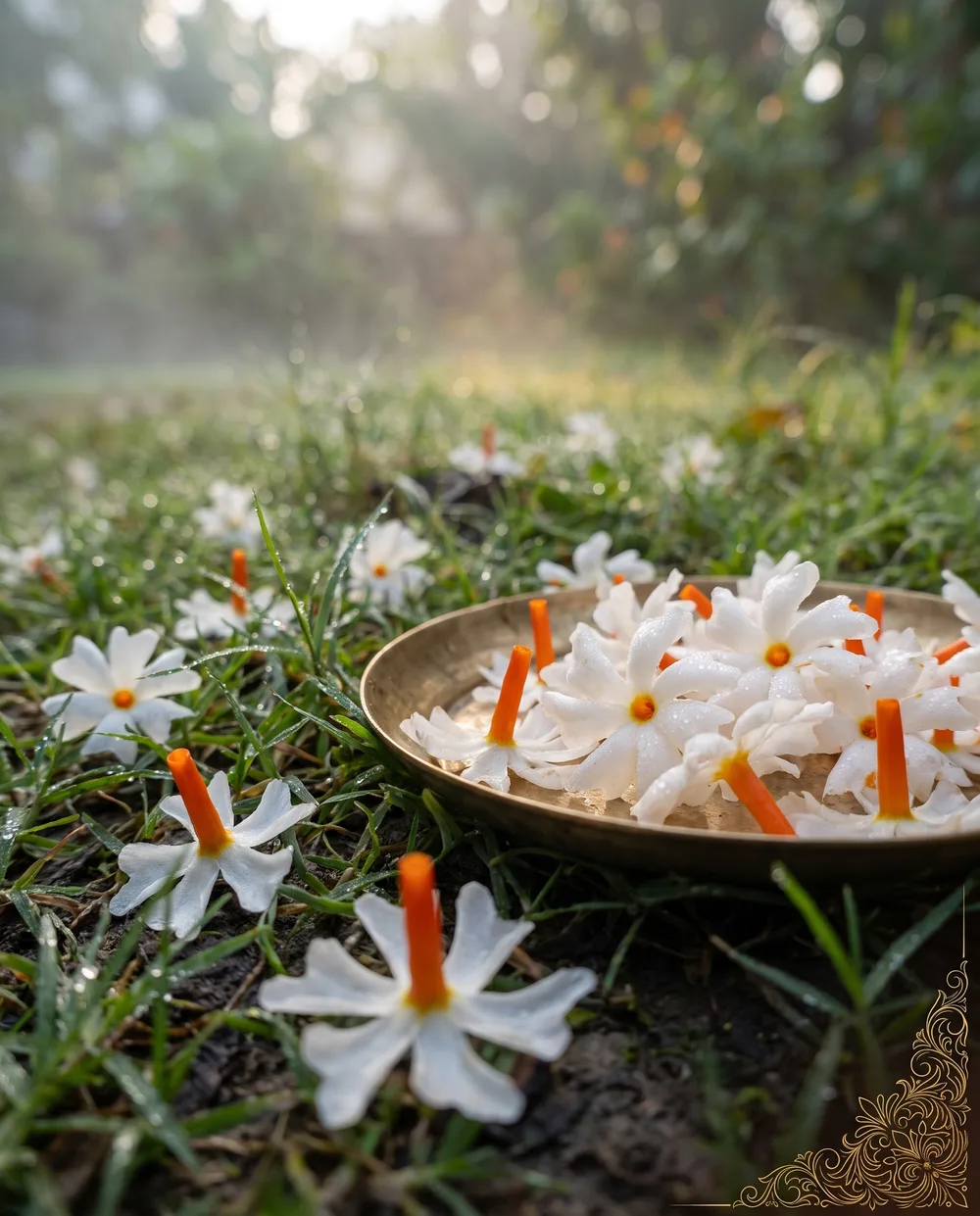
Shiuli (Nyctanthes arbor-tristis), the night-flowering jasmine, is the state flower of West Bengal. It blooms in the autumn, in time for Durga Puja, and is offered to the Goddess then; Durga Puja songs and poems are full of it.14
The tree lets its flowers go in the early morning, which is why its Latin name means “sad tree”. Its Sanskrit name, pārijāta, belongs to the tree that rose from the churning of the ocean and that Kṛṣṇa carried from Indra’s garden to Dvārakā.14
Shiuli is the answer most people want when they search for white flowers for pooja. Jasmine (jāti) is the other: the Skanda Purāṇa ranks it above every other flower in the worship of Viṣṇu.13
for Shiva
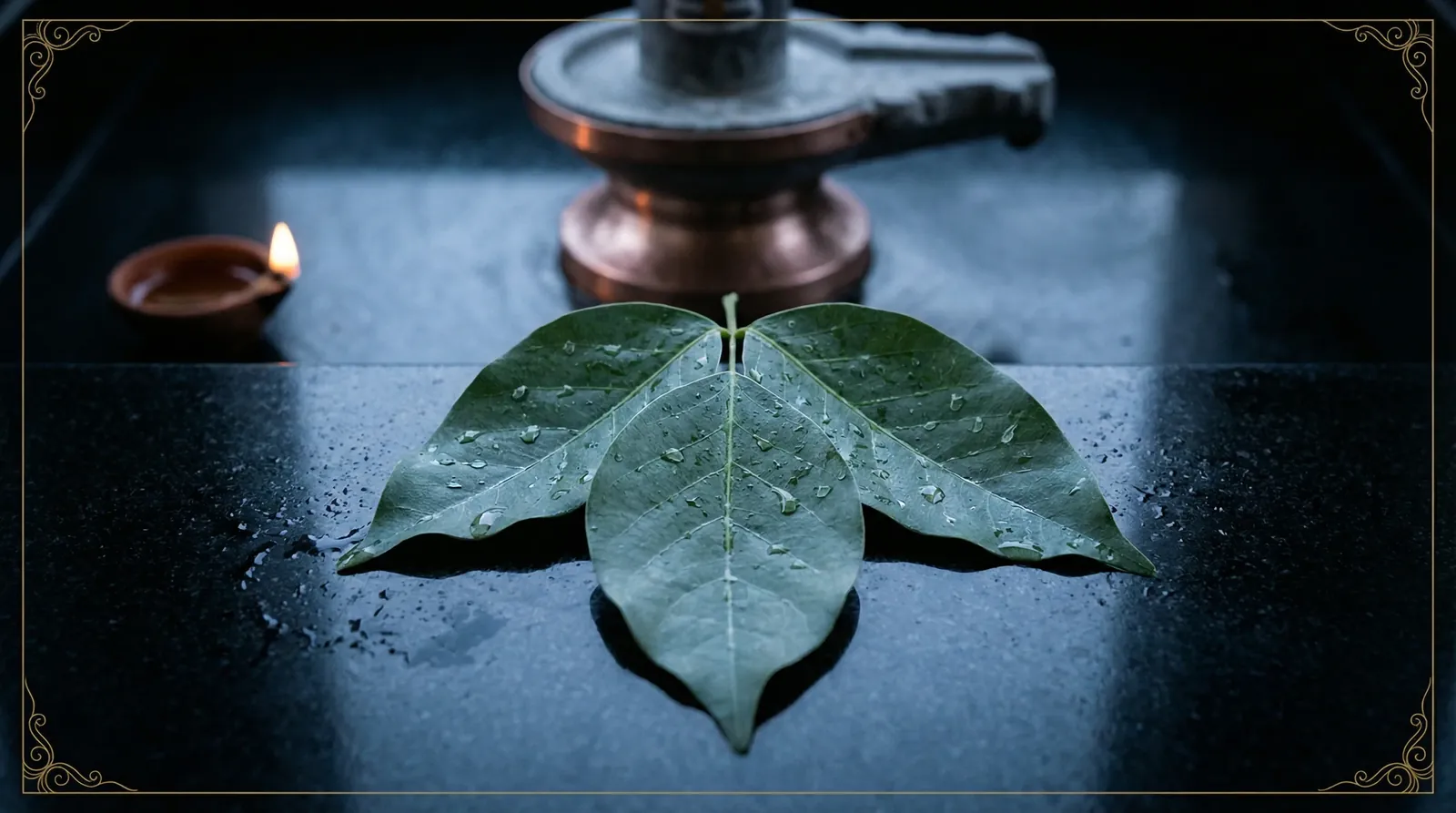
Śiva’s favourite offering is a leaf, not a flower. The bilva grows in threes, and the Bilvāṣṭakam finds that number everywhere: three leaflets, three guṇas, three eyes, three weapons, three lifetimes of sin.15
The hymn’s last verse reads the tree itself as the three gods: Brahmā at the root, Viṣṇu in the middle, Śiva at the tip.15 The ritual manuals add the reverse rule: the leaf that pleases Śiva is never offered to Sūrya.13 Our Lingashtakam guide follows the same god through eight verses.
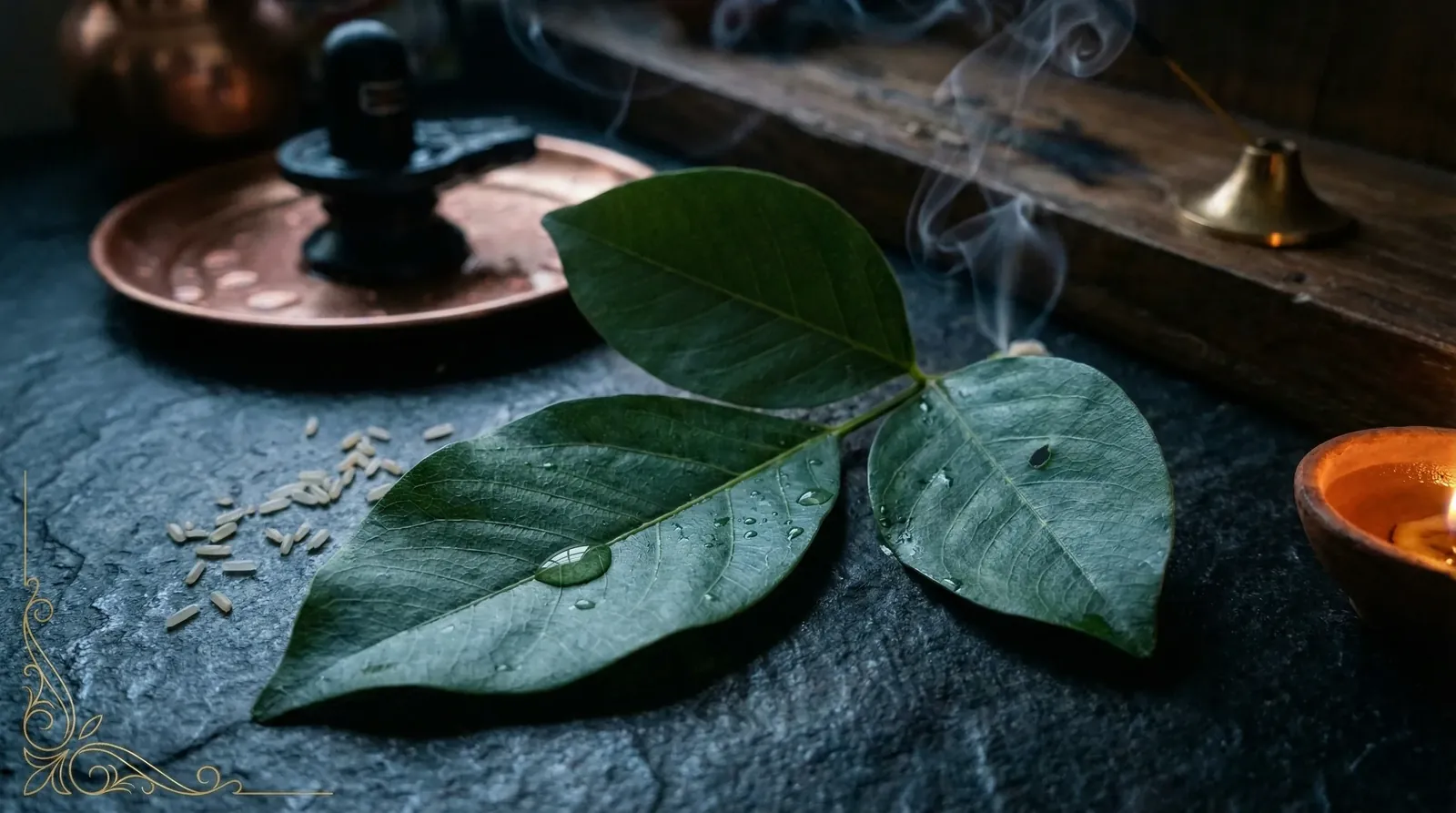
Bilvāṣṭakam · verse 115
त्रिदलं त्रिगुणाकारं त्रिनेत्रं च त्रियायुधम्।
त्रिजन्मपापसंहारं एकबिल्वं शिवार्पणम्॥
tridalaṃ triguṇākāraṃ trinetraṃ ca triyāyudham trijanmapāpasaṃhāraṃ ekabilvaṃ śivārpaṇam
Three-leaved, shaped as the three guṇas, three-eyed, bearing three weapons, destroying the sins of three births: one bilva leaf, offered to Śiva.
for Lakshmi
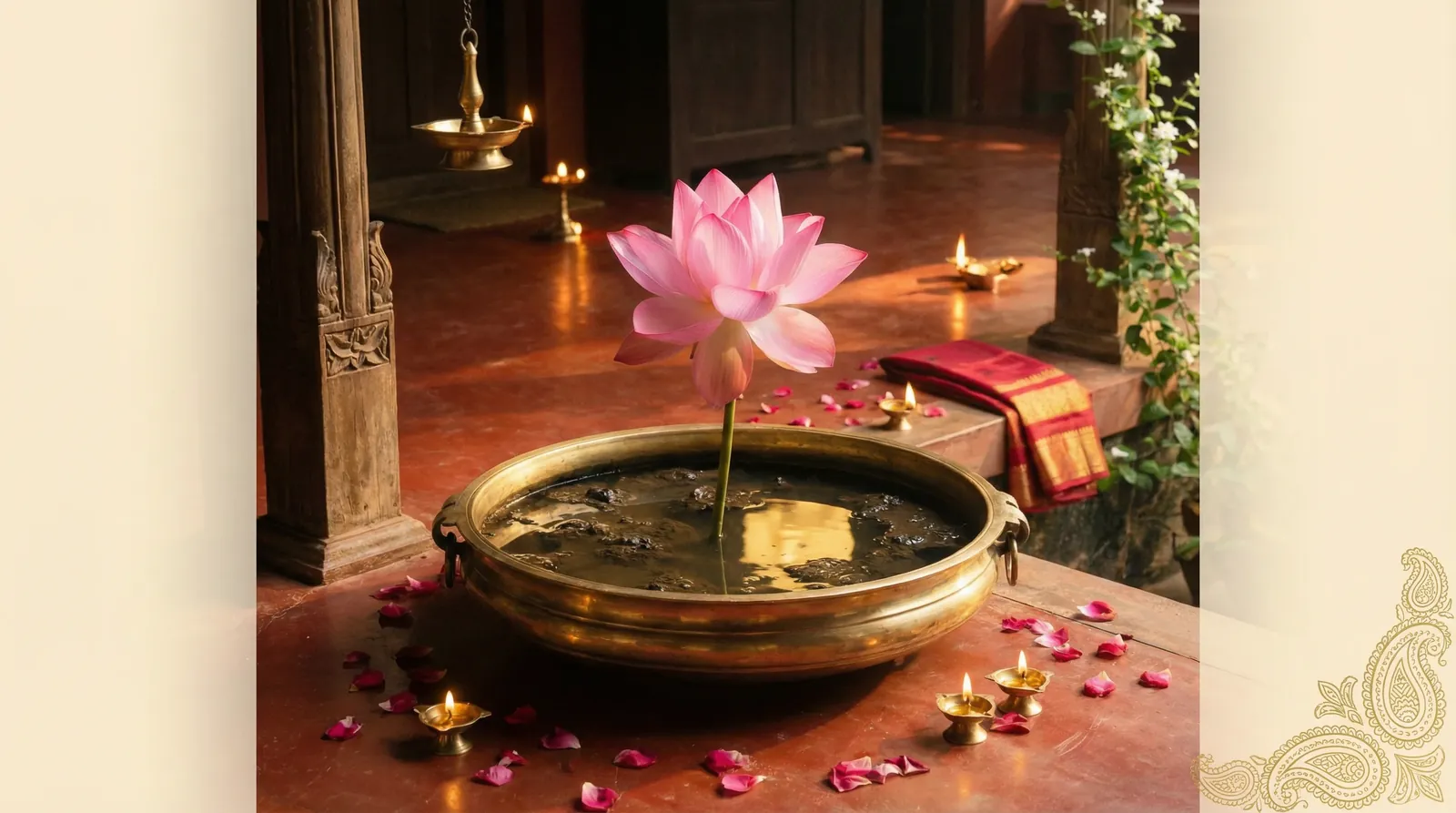
Lakṣmī sits on a lotus and holds another in her hand. The flower roots in mud and opens clean above the water, and that is what her devotees ask of her: abundance that stays unsoiled. On Diwali, the lotus is the flower families bring her.13
In Telugu homes, the Varalakshmi Vratam calls her in with a song at the door. Our guide to Raave Maa Intiki walks through it verse by verse.
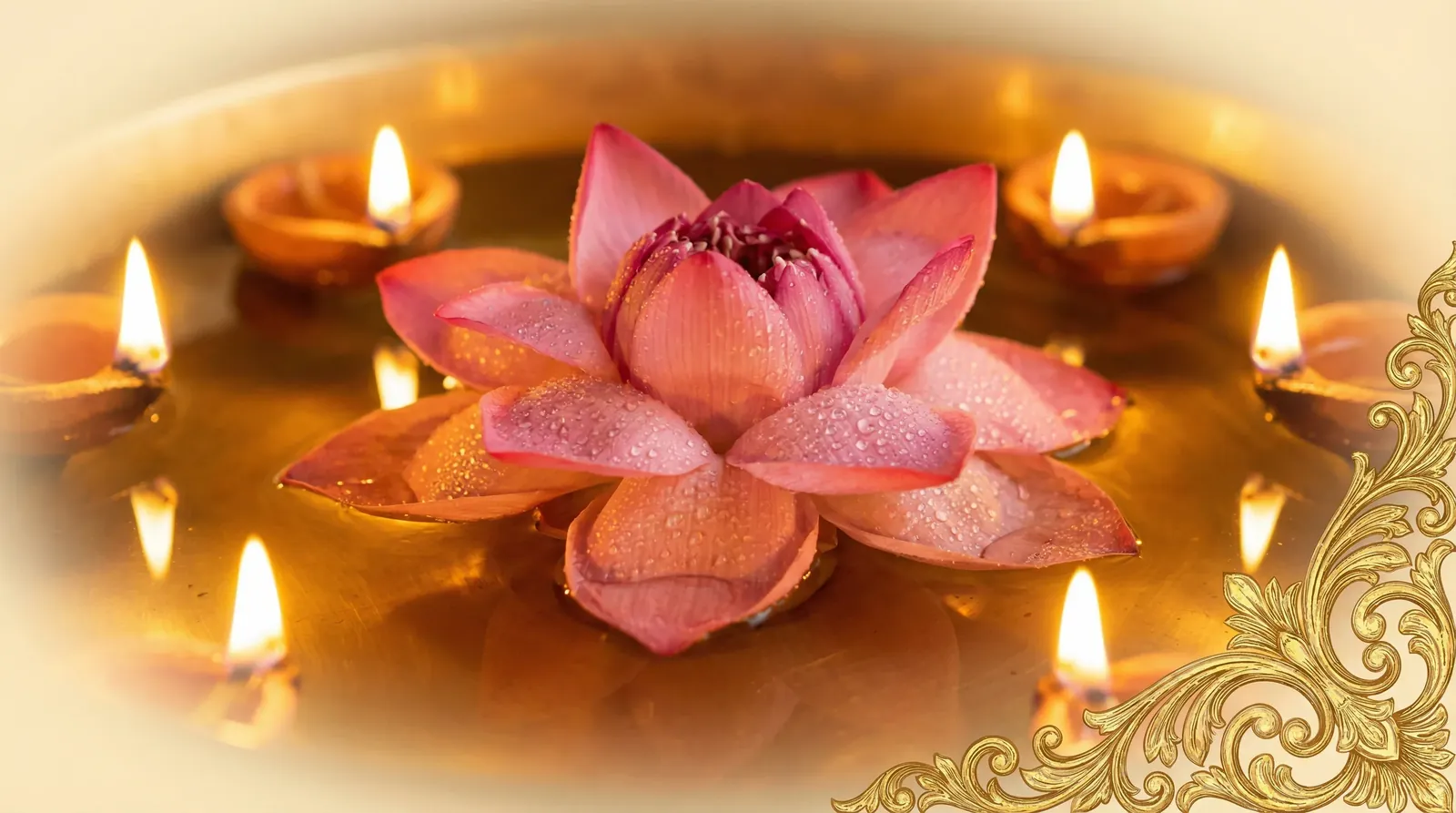
Mahālakṣmyaṣṭakam · verse 1, spoken by Indra16
नमस्तेऽस्तु महामाये श्रीपीठे सुरपूजिते ।
शङ्खचक्रगदाहस्ते महालक्ष्मि नमोऽस्तु ते ॥
namaste’stu mahāmāye śrīpīṭhe surapūjite śaṅkhacakragadāhaste mahālakṣmi namo’stu te
Salutation to you, Mahāmāyā, seated on the throne of Śrī, worshipped by the gods; conch, discus and mace in your hands: Mahālakṣmī, salutation to you.
often searched as “dhruva”
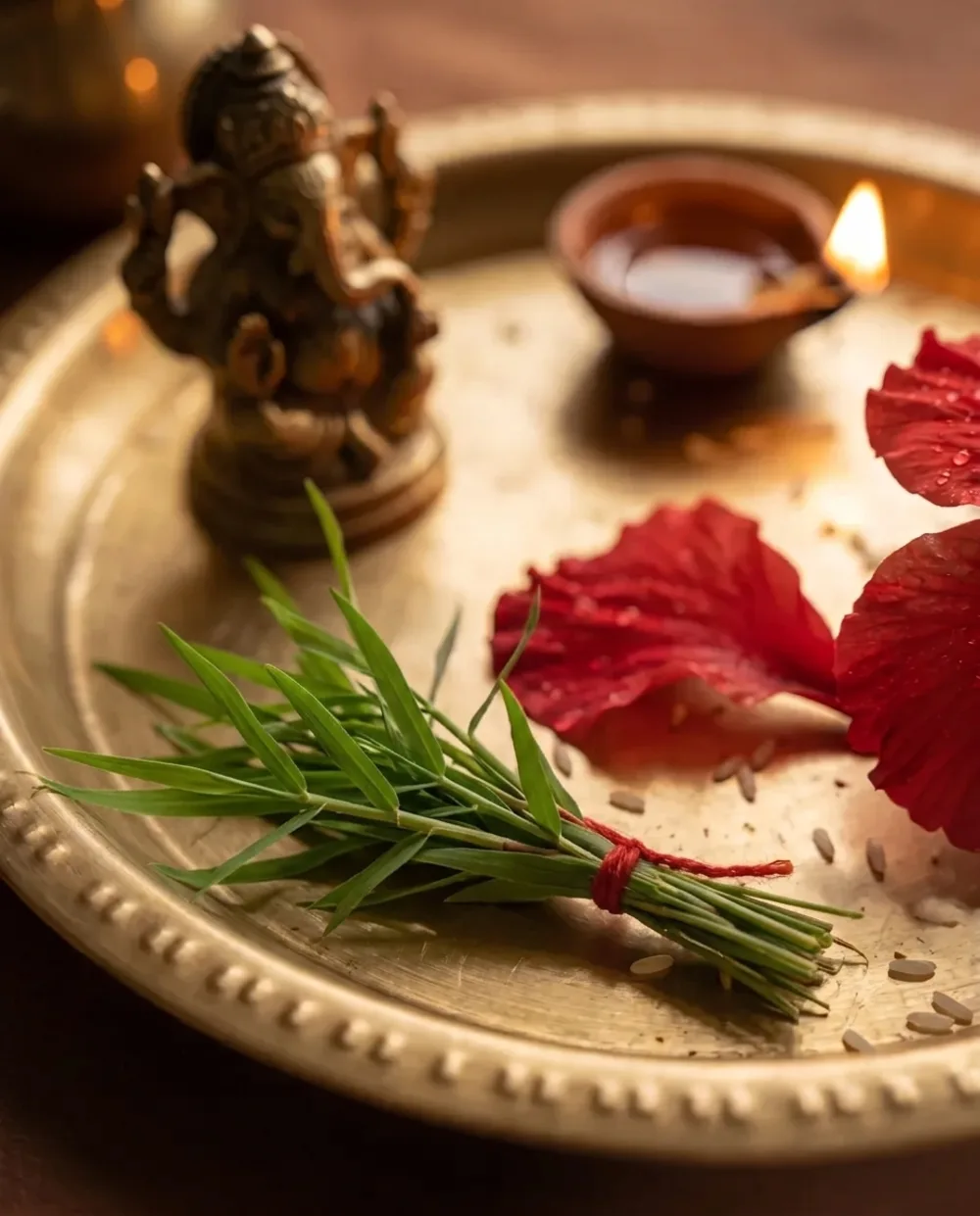
If you searched for a “dhruva flower”, you were most likely looking for dūrvā. It is not a flower at all but a grass, Cynodon dactylon, and it is the offering most closely tied to Gaṇeśa.4,17,18
His pūjā names it in the flower step itself, beside śamī and mandāra. The same pūjā counts its circumambulations as twenty-one or three.4 Many households carry that habit over to the grass and tie dūrvā in odd-numbered bunches, most often twenty-one blades.
Gaṇapati Atharvaśīrṣa · from its closing verses17
यो दूर्वांकुरैर्यजति स वैश्रवणोपमो भवति ॥
yo dūrvāṃkurairyajati sa vaiśravaṇopamo bhavati
Whoever worships with sprouts of dūrvā becomes like Vaiśravaṇa, the lord of wealth.
Hindu sacred flowers at a glance
Regional practice varies, and any flower offered with care is accepted. These are the pairings the texts and the temples agree on most often.
| Flower | Offered to | Note |
|---|---|---|
| कमलLotus | Lakṣmī, Viṣṇu | Lakṣmī’s seat and her flower on Diwali.13 |
| जवाHibiscus | Durgā, Kālī | Red flowers are held sacred to Kālī.12,13 |
| बिल्वBilva leaf | Śiva | Offered in threes; never to Sūrya.13,15 |
| दूर्वाDurva grass | Gaṇeśa | A grass, not a flower; often searched as “dhruva”.17,18 |
| तुलसीTulasi | Viṣṇu, Kṛṣṇa | Never offered to Gaṇeśa.13 |
| पारिजातShiuli | Durgā at Durga Puja | The white autumn flower of Bengal.14 |
| जातीJasmine | Viṣṇu | Ranked first among flowers for Viṣṇu in the Skanda Purāṇa.13 |
| Marigold | Almost every deity | The everyday garland flower. |
The flower Śiva refuses. When Brahmā and Viṣṇu set out to find the top and the bottom of a pillar of fire, Brahmā came back claiming he had seen the top, and a falling ketakī flower backed his lie. Śiva sent the flower away: “Hereafter I have no desire to include you in my worship.”19,20 Ketakī is still kept out of Śiva’s pūjā today.13
On Anukriti Radio · the soundtrack to this page
The music under this page is Anukriti Radio’s Ya Devi Sarvabhuteshu. Its refrain comes from the fifth chapter of the Devī Māhātmya, the same text that gives Durga Puja its third anjali. In it, the gods praise the Goddess who lives in every being: as power, as intelligence, as peace, as faith, as mother.21
Listen for the threefold namastasyai at the end of each line. It works the way the three anjali rounds do: the same offering, given three times.
Devī Māhātmya 5 · as power21
या देवी सर्वभूतेषु शक्तिरूपेण संस्थिता ।
नमस्तस्यै नमस्तस्यै नमस्तस्यै नमो नमः ॥
yā devī sarvabhūteṣu śaktirūpeṇa saṃsthitā namastasyai namastasyai namastasyai namo namaḥ
To the Goddess who dwells in all beings as power: salutation to her, salutation to her, salutation to her, salutation again and again.
Devī Māhātmya 5 · as mother21
या देवी सर्वभूतेषु मातृरूपेण संस्थिता ।
नमस्तस्यै नमस्तस्यै नमस्तस्यै नमो नमः ॥
yā devī sarvabhūteṣu mātṛrūpeṇa saṃsthitā namastasyai namastasyai namastasyai namo namaḥ
To the Goddess who dwells in all beings as mother: salutation to her, again and again.
If one flower has to be named, it is the lotus. Lakṣmī sits on it. The Gītā borrows its leaf for a life that touches the world without being stained by it, “like a lotus leaf untouched by water”.22 The Mantra Puṣpam calls the moon the flower of the waters;5 on earth, the flower of the waters is the lotus. But ask any priest and he will answer with a question: which god, and which morning?
Pushpanjali, briefly
Pushpanjali (पुष्पाञ्जलि) means “a handful of flowers”: puṣpa is a flower, and añjali is the two hands cupped and joined in offering. The worshipper fills the cupped hands with flowers, recites a mantra, and lets the flowers fall at the deity’s feet. At Durga Puja it is offered in three rounds, each with its own verse.
Puṣpaṃ samarpayāmi means “I offer a flower.” Puṣpam is “a flower” and samarpayāmi is “I offer, I hand over completely.” In the plural, puṣpāṇi samarpayāmi, it means “I offer flowers.” In a full pūjā it is said at the flower step of the sixteen services, after sandal paste and before incense.
Bengal offers pushpanjali on the mornings of Saptami, Ashtami and Navami, in three rounds led by a priest. The first round uses “jayantī maṅgalā kālī” from the Argalā Stotram, and the third uses “sarvamaṅgalamāṅgalye” from the Devī Māhātmya (11.10). After each verse, the flowers and a bilva leaf go to the Goddess’s feet.
Lotus to Lakṣmī, red hibiscus to Durgā and Kālī, the bilva leaf to Śiva, dūrvā grass to Gaṇeśa, tulasī to Viṣṇu and Kṛṣṇa, and white shiuli to Durgā at Durga Puja. Marigold is used for almost every deity. Ketakī is not offered to Śiva, and tulasī is not offered to Gaṇeśa.
The lotus. Lakṣmī sits on it and holds it, and the Bhagavad Gītā uses the lotus leaf as its image of action untouched by sin. Each deity still has a favourite flower of its own.
Hear a verse line by line, chant it back, and get expert-level feedback on every syllable, so what you offer on Ashtami morning sounds the way it should.
The soundtrack, Ya Devi Sarvabhuteshu, plays on Anukriti Radio. This guide first appeared as an Instagram carousel during Chaitra Navaratri 2026.
Follow @anukriti.ai