
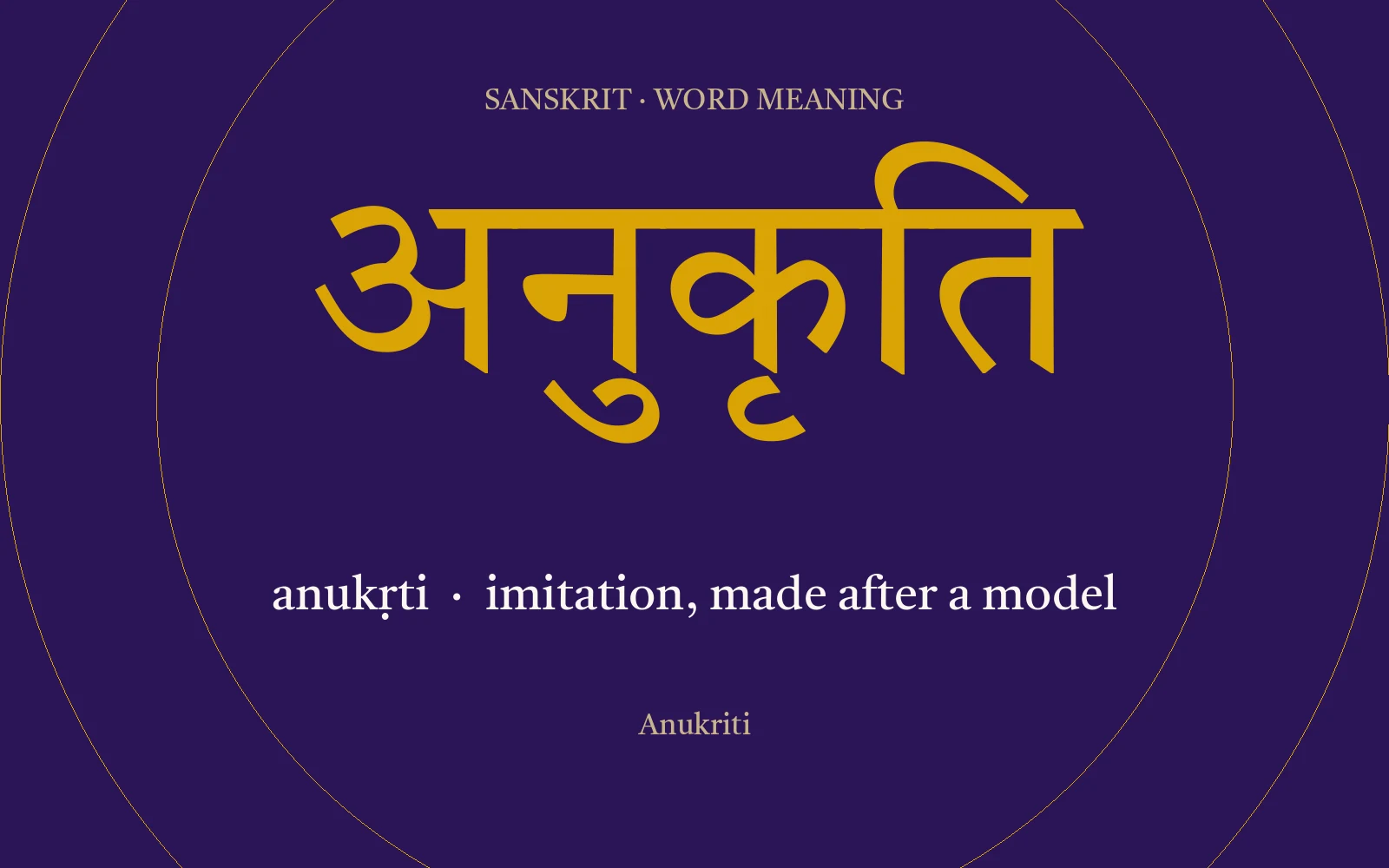
Anukriti means imitation — something made after a model.
अनुकृति (anukṛti) is a Sanskrit feminine noun built from anu, “after,” and kṛ, “to make”: an imitation, a copy, a thing made by following an example. It is also the name of a Sanskrit chanting app, and the reason is the same idea.
Definition
What the Dictionaries Say
Monier-Williams’ Sanskrit-English Dictionary gives anu-kṛti, feminine: “imitation, a copy, compliance.” Its sister noun anu-karaṇa is “the act of imitation or of following an example.” Both come from the verb अनुकृ (anu-kṛ), which Apte’s Practical Sanskrit-English Dictionary defines as “to do after or afterwards; follow; especially to imitate, do after or in imitation of, resemble, equal, copy.”
The prefix carries the meaning. Kṛti on its own is simply a making, a work. Put anu in front of it and the making acquires a model: it comes after something, and follows it. In Hindi and other modern Indian languages the word is used the same way, for a copy, a replica or an imitation.
Usage · Sanskrit poetics
Imitation as an Art
In Sanskrit thought, imitation is not a lesser kind of making. The theatre treatises describe drama itself as an imitation of the world. The Nāṭyaśāstra, the foundational text on performance, presents drama as a re-enactment of the ways of the world (loka-vṛtta-anukaraṇa), and the tenth-century Daśarūpaka of Dhanañjaya puts it in one compact line that uses this very word:
अवस्थानुकृतिर्नाट्यम्
avasthānukṛtir nāṭyam
“Drama is the imitation of a situation.” — Daśarūpaka, chapter 1
The actor playing Rama is not pretending in a trivial sense. By imitating closely enough, he lets the audience see something real. That is the weight the word carries: imitation as a faithful following, done with enough care that the original comes through.
The name
Why the App Is Called Anukriti
Chanting has always been learned by anukṛti. In the guru–śiṣya tradition, the teacher recites a line and the student repeats it, syllable by syllable, until the sound is right. Nobody learns a Vedic hymn or a stotra from a page alone; the page records the words, but the pronunciation, the length of each vowel and the rise and fall of the voice pass from one person to the next by listening and repeating.
Anukriti is built around that same loop. You listen to a verse, you chant it back, and you get guidance on where your recitation follows the model and where it drifts. The name is the method: learning by making your chanting after a model worth following.
Our short interactive film, One Syllable, Heard, follows a single syllable from a reciter’s voice to a listener’s ear, and it closes on this idea.
The learning section
Uccharan (उच्चारण)
उच्चारण (uccāraṇa) means pronunciation or articulation. Monier-Williams glosses it as “pronunciation, articulation, enunciation; making audible.” It comes from ud, “up, out,” and car, “to move”: in Apte, the verb uc-car means to rise, to rise as a voice and be heard, and in its causative, to utter or pronounce. Uccāraṇa is sound brought up and out, made audible.
That is why the site’s learning section is called Uccharan. The articles there are about how Sanskrit is actually said: the meaning of a verse, but also the sounds that carry it. If anukṛti is the method, uccāraṇa is what the method is for.
Where it started
The Story Behind the Name
The app began with a grandmother teaching mantras the old way, one patient repetition at a time. Read the Anukriti origin story for how that became a product.
Sources: Monier-Williams, A Sanskrit-English Dictionary (1899), entries anu-kṛti, anu-karaṇa and uc-cāraṇa; V. S. Apte, The Practical Sanskrit-English Dictionary (1890), entries anu-kṛ and uc-car; both via the Cologne Digital Sanskrit Dictionaries. Dhanañjaya, Daśarūpaka 1.
Learn the Way
It Was Always Learned
Listen, repeat, and get expert-level feedback on every syllable — the guru–śiṣya method, in your pocket.