Anukriti logo
ANUKRITI
Perfect Your Daily Prayer with Anukriti AI
लिंगाष्टकम्

Eight Verses.
One Refrain.
A Bow to Shiva.

The Lingashtakam — and the Sawan Somwar radio medley built around it

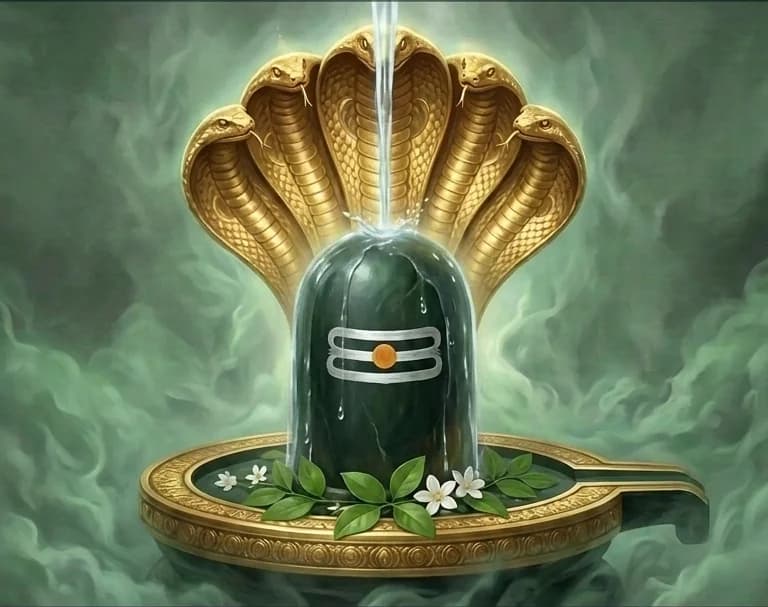
A Shiva lingam draped in a five-hood serpent canopy, wreathed in kailash-green mist

Every Monday inside Sawan — the monsoon month that belongs to Shiva — is a Somwar, and devotional feeds fill accordingly: lingam abhisheka videos, temple bells, ash and bilva leaves. On Monday, 17 August 2026, Anukriti timed its own offering to land on exactly that day — a five-track radio medley called Shiva Medley: 5 Sacred Tracks, One Journey, released as an in-app exclusive. Bol Bam. Om Jai Shiv Omkara. Shiva Shambho Mahadev. Parvati. And doing the most work at the center of it: Lingashtakam.

Lingashtakam is eight verses, plus a closing dedication, built on a single repeating vow. Each verse describes the Shivalinga a different way — unborn, ash-smeared, garlanded in serpents, witness to Ravana’s fall and Daksha’s ruined sacrifice — and each one lands on the exact same line. Popular tradition credits the hymn to Adi Shankaracharya; the text itself carries no signature. What it does carry is that refrain, said nine times across nine verses, until repetition stops being a poetic device and starts being the point. Long before this medley, the hymn was already a fixture of ordinary Shiva worship — recited during abhisheka, when the lingam is bathed in water, milk, and bilva leaves, and heard most often on a Monday, because Monday already belongs to Shiva.


The Refrain, Repeated Eight Times

तत्प्रणमामि सदा शिवलिंगम्

tat praṇamāmi sadā śivaliṅgam

To that eternal Shivalinga, I bow — always. Every one of the eight verses builds toward this exact line, so that by the final verse a devotee has arrived here eight separate times, by eight different roads. It reads less like a chorus than a habit forming in real time.


Water poured in ritual abhisheka over a Shiva lingam beneath a five-hood serpent canopy

Verse 1 · Origin

अजम् अव्ययम्The Unborn, Imperishable

अजम् अव्ययम् ईश्वरम् लिंगम्
ब्रह्म मुरारी सुरार्चित लिंगम्
निर्मल भासित शोभित लिंगम्
जन्मज दुःख विनाशक लिंगम्
तत्प्रणमामि सदा शिवलिंगम्

ajam avyayam īśvaram liṅgam, brahma murāri surārcita liṅgam, nirmala bhāsita śobhita liṅgam, janmaja duḥkha vināśaka liṅgam, tat praṇamāmi sadā śivaliṅgam

“The unborn, imperishable, sovereign Linga — worshipped by Brahma and Vishnu, spotless, radiant, destroyer of the sorrow of birth — to that eternal Shivalinga I bow.”

The hymn opens by clearing away the obvious objection first: this is not a stone. Īśvaram — sovereign, the Lord — is the word doing the real work in the first line, and everything after it is evidence. Brahma the creator and Murari, “the enemy of Mura” (Vishnu), are named as its worshippers — the two most senior names in the pantheon, bowing to a third form. And the promise made in this opening verse is specific: not wealth, not victory, but relief from janmaja duḥkha — the sorrow that comes bundled with being born at all.
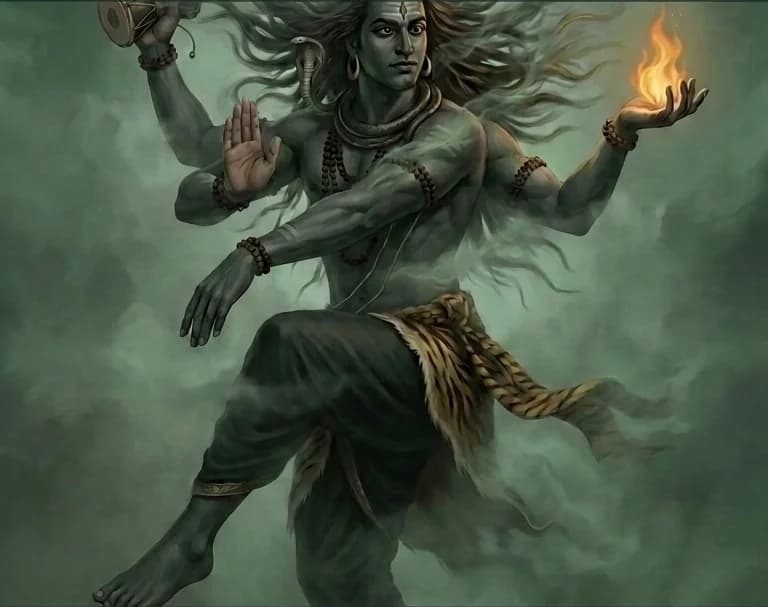
Shiva in a dynamic four-armed dance pose, holding fire and a small drum, hair unbound

Verse 3 · Power

रावण दर्प विनाशकBreaker of Ravana’s Pride

आशु तोष भव हरण लिंगम्
देव मुनि प्रवरार्चित लिंगम्
कामदहं करुणाकर लिंगम्
रावण दर्प विनाशक लिंगम्
तत्प्रणमामि सदा शिवलिंगम्

āśu toṣa bhava haraṇa liṅgam, deva muni pravarārcita liṅgam, kāmadahaṁ karuṇākara liṅgam, rāvaṇa darpa vināśaka liṅgam, tat praṇamāmi sadā śivaliṅgam

“The Linga of the one easily pleased, remover of worldly bondage — worshipped by the finest of gods and sages, compassionate even as it burned desire to ash, destroyer of Ravana’s pride — to that eternal Shivalinga I bow.”

Āśutoṣa — “easily pleased” — is one of Shiva’s oldest epithets, and this verse opens with it before turning fierce. Kāmadahaṁ recalls the story of Kama, the god of desire, burned to ash by Shiva’s opened third eye; rāvaṇa darpa vināśaka recalls the demon-king who tried to lift Kailash itself and was pinned beneath it until his pride broke. Grace and force sit inside the same four lines — both, the verse insists, are the same Linga. It is the verse most often reached for when the ask is bigger than gratitude: not thanks for what already came, but the nerve to face what hasn’t yet.


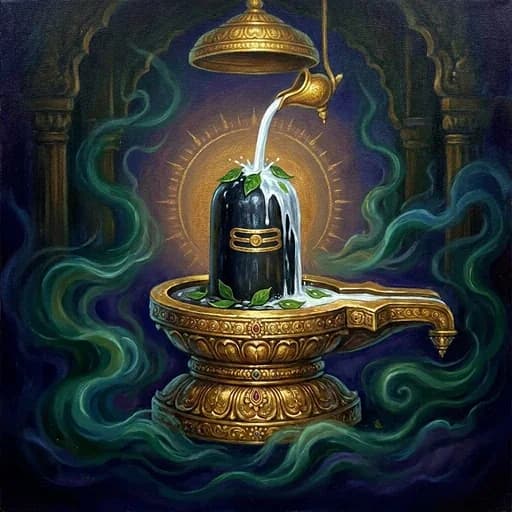
Devotional illustration of a Shiva lingam being bathed beneath a temple arch, wreathed in green mist

Verse 5 · Adornment

भस्म विलेपितSmeared in Sacred Ash

भस्म विलेपित सुंदर लिंगम्
कनक महामणि भूषित लिंगम्
फणि पति वेष्टित शोभित लिंगम्
दक्ष सुयज्ञ विनाशक लिंगम्
तत्प्रणमामि सदा शिवलिंगम्

bhasma vilepita sundara liṅgam, kanaka mahāmaṇi bhūṣita liṅgam, phaṇi pati veṣṭita śobhita liṅgam, dakṣa suyajña vināśaka liṅgam, tat praṇamāmi sadā śivaliṅgam

“Beautiful, smeared with sacred ash, adorned with gold and great jewels, resplendent — encircled by the lord of serpents, destroyer of Daksha’s ruined sacrifice — to that eternal Shivalinga I bow.”

Phaṇi pati veṣṭita — “encircled by the lord of serpents” — is the line worth sitting with here. It is also, almost exactly, the image Anukriti’s own cover art puts on screen: a lingam held inside a five-hood serpent canopy, gold against kailash-green mist. Dakṣa suyajña vināśaka closes the verse on a harder note — Daksha, Shiva’s own father-in-law, held a grand sacrifice and pointedly left Shiva out of it; the yajña did not survive the insult. Between the ash, the gold, and the serpents, this is the most visual of the eight verses — which may be exactly why it was the one the campaign’s artists reached for first.


A Shiva lingam draped in a five-hood serpent canopy, gold against kailash-green mist

The Release · Sawan Somwar 2026

शिव मेडलीFive Tracks, One Radio Drop

Shiva Medley plays as five full tracks back to back in Anukriti’s radio tab — Bol Bam, Om Jai Shiv Omkara, Lingashtakam, Shiva Shambho Mahadev, and Parvati — built on percussion that leans toward the sopana and qawwali traditions: dholak underneath, temple bells cutting through the top, a tanpura drone holding the floor. Lingashtakam carries the medley’s emotional center, its eight-line refrain repeating like a held breath between verses.

The cover art above is the same illustration that introduced the medley on Instagram before it moved into the app — a lingam under a five-hood serpent canopy, kailash-green mist, the word शिव lettered in gold. A companion reel, cut around a volumetric tandava sequence, carried the same artwork into motion. Both were built to land on one day: the Somwar that opened Sawan’s final week — and both point back to the same eight verses, which is the part that outlasts any single release date.


The Closing Vow — Lingashtakam’s Phala-Shruti

लिंगाष्टकमिदं पुण्यं यः पठेत् भक्ति संयुक्तः
शिव लोकमवाप्नोति शिवेन सहानन्दति

liṅgāṣṭakam idaṁ puṇyaṁ yaḥ paṭhet bhakti saṁyuktaḥ, śiva lokam avāpnoti śivena sahānandati

“Whoever recites this sacred Lingashtakam with devotion attains the world of Shiva, and rejoices with him.” A phala-shruti — the “fruit of hearing” — is how most Sanskrit stotras choose to end: a plainly stated promise, naming exactly what the recitation is said to give back to the one who says it. Bhakti saṁyuktaḥ is the condition attached to that promise — “joined with devotion” — which is the same requirement Lingashtakam has been making, quietly, for eight verses already: that the words matter less than the intent carried underneath them.


Chant the Lingashtakam
with Expert-Level Feedback

Anukriti listens to your chanting and offers expert-level feedback — so all eight verses, and that one repeating vow, land the way they were meant to.

Lingashtakam anchors Anukriti’s Shiva Medley — five tracks released in-app for Sawan Somwar 2026, first shared as an Instagram reel.
Follow @anukriti.ai

AnukritiFree on the App Store
Download