Anukriti

चाकर राखो जी

Chakar Rakho Ji Meaning: A Princess Asks to Serve

«स्याम म्हाने चाकर राखो जी» (syām mhāne chākar rākho jī) means “Shyam, keep me as your servant.” It is a pada of Meera, the sixteenth-century poet and devotee of Krishna, in her Rajasthani. चाकर means a servant. Meera was a princess, and in this song she asks Krishna to hire her, then names her own pay: the sight of him, remembering him, devotion.

Meera · A pada in Rajasthani · Anukriti’s 90-second reel

Meera · स्याम म्हाने चाकर राखो जी

The reel opens on a closed door. A woman walks up to it, puts her palms on the wood, and asks to be let in. The song she sings is an application for a job.

The one asking was royal twice over. Meera was born about 1498 into the Rathore house of Merta, in Marwar, and married into the Sisodia house of Mewar, to its crown prince. She would have had servants of her own. Yet the word she chooses for herself here is चाकर: a servant, bound to a master.

The word came into the courts of Rajasthan from Persian. In the chronicles of Meera’s own clan, the Mertiyo Rathors of Merta, a चाकर stands in a bond with a master, a धणी: the master feeds and sustains the servant, and the servant gives him loyalty. To ask to be someone’s चाकर is to choose whose you are.

So the question the song asks is the one a first-time listener asks: why would a princess want to serve? The pada’s answer comes in its own terms, verse by verse, and it ends with her naming the wages.


The refrain · sung at the head and after every verse

स्याम म्हाने चाकर राखो जी
गिरधारी लाला म्हाँने चाकर राखोजी

syām mhāne chākar rākho jī
girdhārī lālā mhāṁne chākar rākho jī

Shyam, keep me as your servant. Girdhari Lala, keep me as your servant.

स्याम is Shyam, the dark one, a name of Krishna. गिरधारी is Girdhari, the one who held up Mount Govardhan, and लाला is a fond word for a boy. The request never changes. Each verse in between adds a term to it.


Verse 1 · The work she offers

A Garden in Vrindavan

Before she asks for anything, she says what she will do. She will stay in service, plant gardens, and rise every morning to see him. The work is ordinary. The place is not: the lanes of Vrindavan, where Krishna grew up.

Verse 1

चाकर रहस्यूँ बाग लगास्यूँ नित उठ दरसण पास्यूँ
बिन्दरावन री कुंज गली में गोविन्द लीला गास्यूँ

chākar rahasyūṁ, bāg lagāsyūṁ, nit uṭh darsaṇ pāsyūṁ
bindrāvan rī kuñj galī meṁ govind līlā gāsyūṁ

As your servant I will stay. I will plant gardens, and rise every day to have your darshan. In the bower-lanes of Vrindavan I will sing Govind’s lila.

Listen to the verbs: रहस्यूँ, लगास्यूँ, पास्यूँ, गास्यूँ. Each ends in -syūṁ, the Rajasthani “I will”. The whole verse is a list of promises in the future tense.
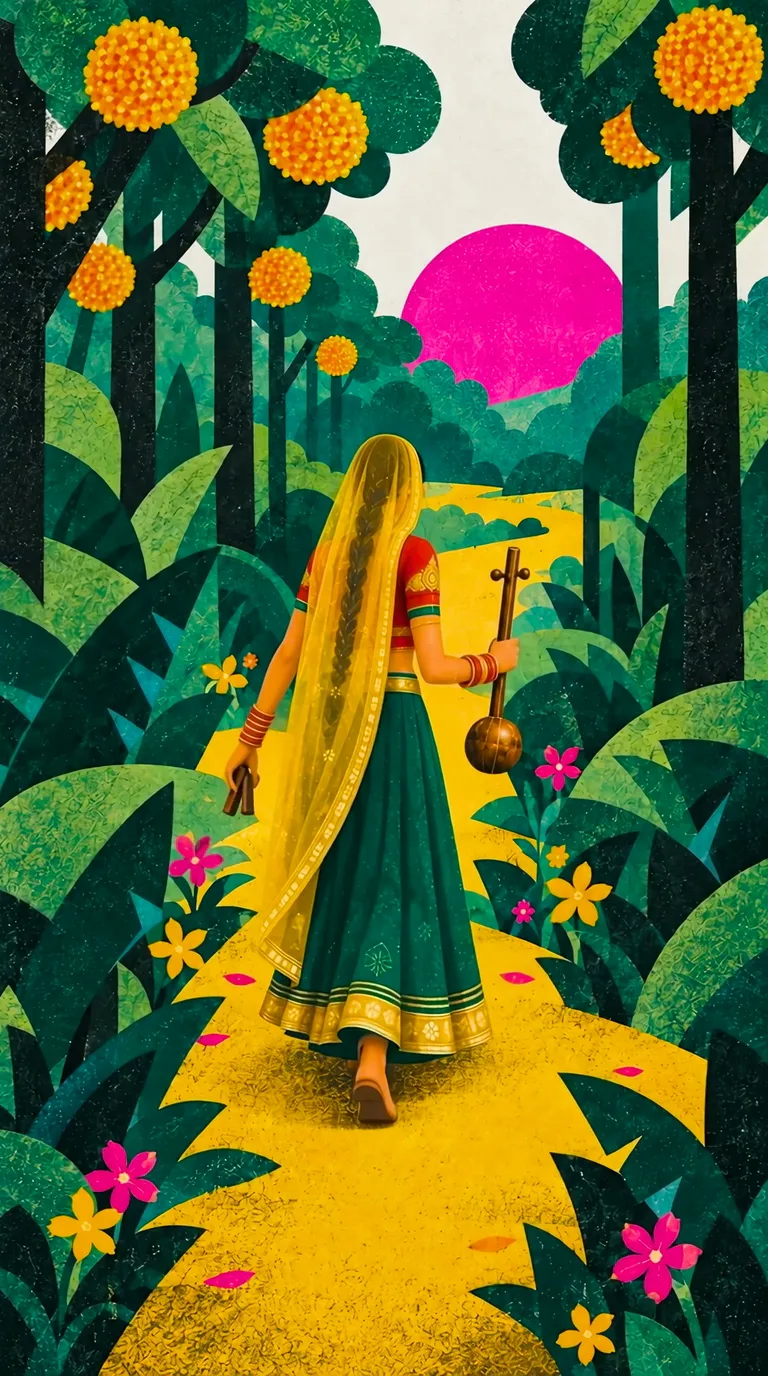
Grain art, seen from behind: a woman in a yellow veil and green skirt walks a sunlit path through a flowering grove, carrying an ektara, under a pink sun

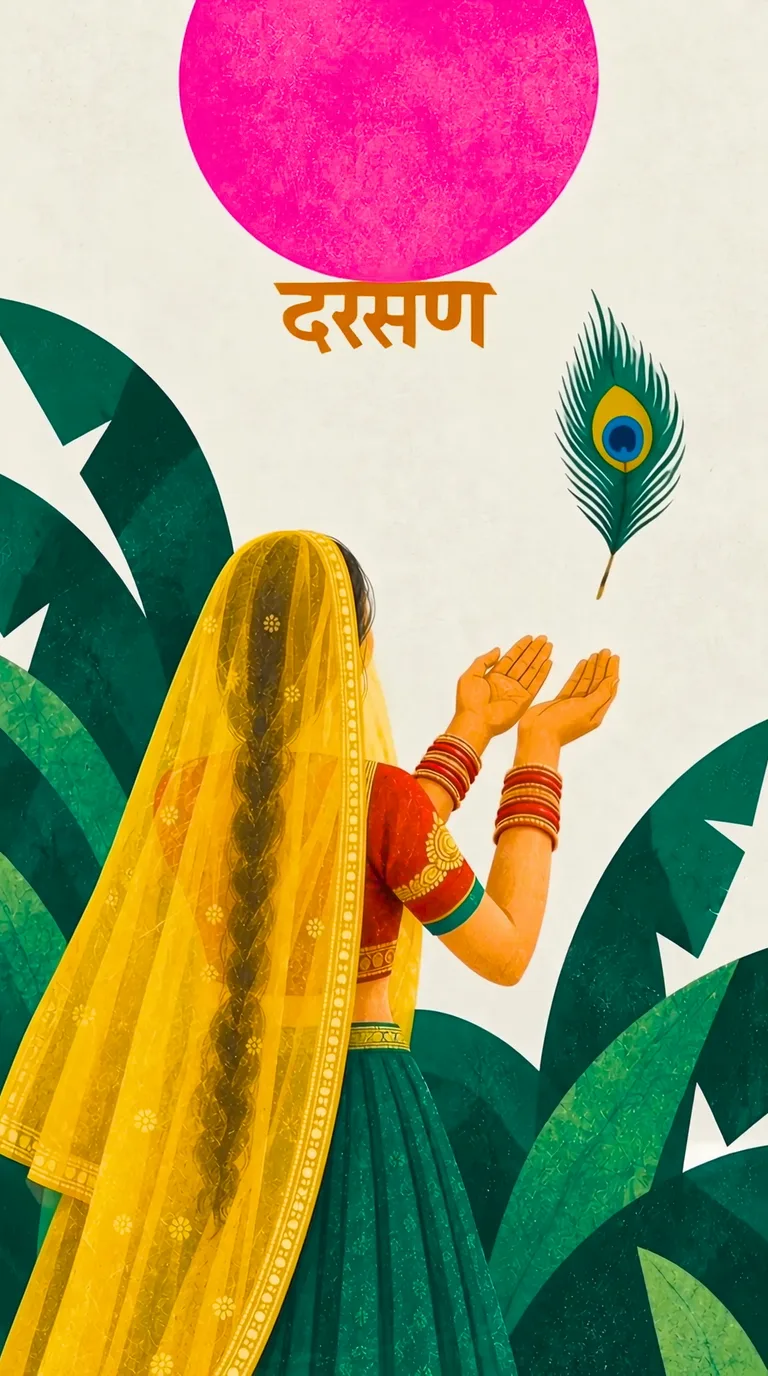
Grain art, seen from behind: a woman holds out cupped palms as a peacock feather falls toward them, the word दरसण painted beneath a pink sun

Verse 2 · The servant’s pay

She Names Her Wages

Then comes the verse the song is built around. A servant is paid, so Meera sets the terms, in the words of a court: salary, allowance, estate.

Verse 2

चाकरी में दरसण पास्यूँ सुमरण पास्यूँ खरची
भाव भगती जागीरी पास्यूँ तीनूं बाताँ सरसी

chākrī meṁ darsaṇ pāsyūṁ, sumraṇ pāsyūṁ kharchī
bhāv bhagtī jāgīrī pāsyūṁ, tīnūṁ bātāṁ sarsī

In your service I will receive darshan. Remembering you will be my allowance. Devotion, felt, will be my estate. All three will be fulfilled.

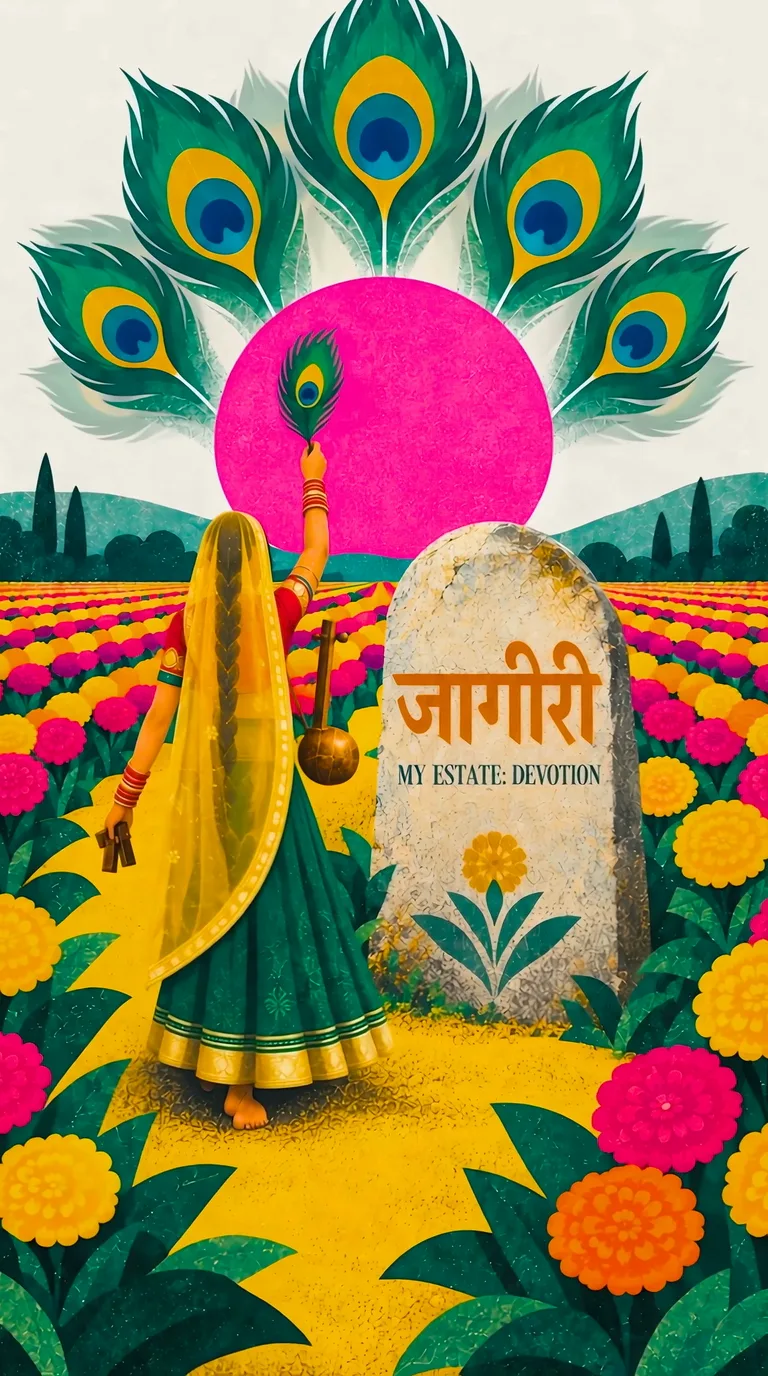
दरसण, the sight of him, is the pay. सुमरण, remembering him, is the खरची, the allowance she lives on. भाव भगती, devotion with feeling, is the जागीरी, the estate granted for service. Nothing she asks for is a coin or a field. Every wage is the Lord himself.


Rajasthani, not misspelt Hindi

The pada’s spellings are the words as Meera’s Rajasthani says them. In the song, दरसण is sung with स, not श. Here are the sung words beside the Hindi ones.

As sungIn HindiMeaning
म्हानेमुझेme
स्यामश्यामShyam, the dark one
दरसणदर्शनdarshan, the sight of him
सुमरणस्मरणremembering
भगतीभक्तिdevotion
पास्यूँपाऊँगीI will receive
हिवड़ोहृदयheart

Verses 3 and 4 · The master, and the palace

The Peacock Crown

A servant describes the master. Meera describes him the way Vrindavan sees him: crowned with peacock feathers, in yellow silk, herding cows.

Verse 3

मोर मुगट पीताम्बर सौहे गल वैजन्ती माला
बिन्दरावन में धेनु चरावे मोहन मुरली वाला

mor mugaṭ pītāmbar sauhe, gal vaijantī mālā
bindrāvan meṁ dhenu charāve mohan murlī vālā

The peacock crown and the yellow silk become him, a Vaijayanti garland at his neck. In Vrindavan he grazes the cows: Mohan, the one with the flute.

Verse 4

ऊँचा ऊँचा महल बणावं बिच बिच राखूँ बारी
साँवरिया रा दरसण पास्यूँ पहर कुसुम्बी साड़ी

ūṁchā ūṁchā mahal baṇāvaṁ, bich bich rākhūṁ bārī
sāṁvriyā rā darsaṇ pāsyūṁ, pahar kusumbī sāṛī

I will build tall palaces and keep windows between them. I will have the Dark One’s darshan, wearing a safflower-red sari.

The palaces are hers to build, and she builds them for one purpose: a place to watch from. बारी here is a window. कुसुम्बी is cloth dyed red with safflower. Tradition says that after Meera was widowed she never wore mourning clothes, because her गिरधर does not die.

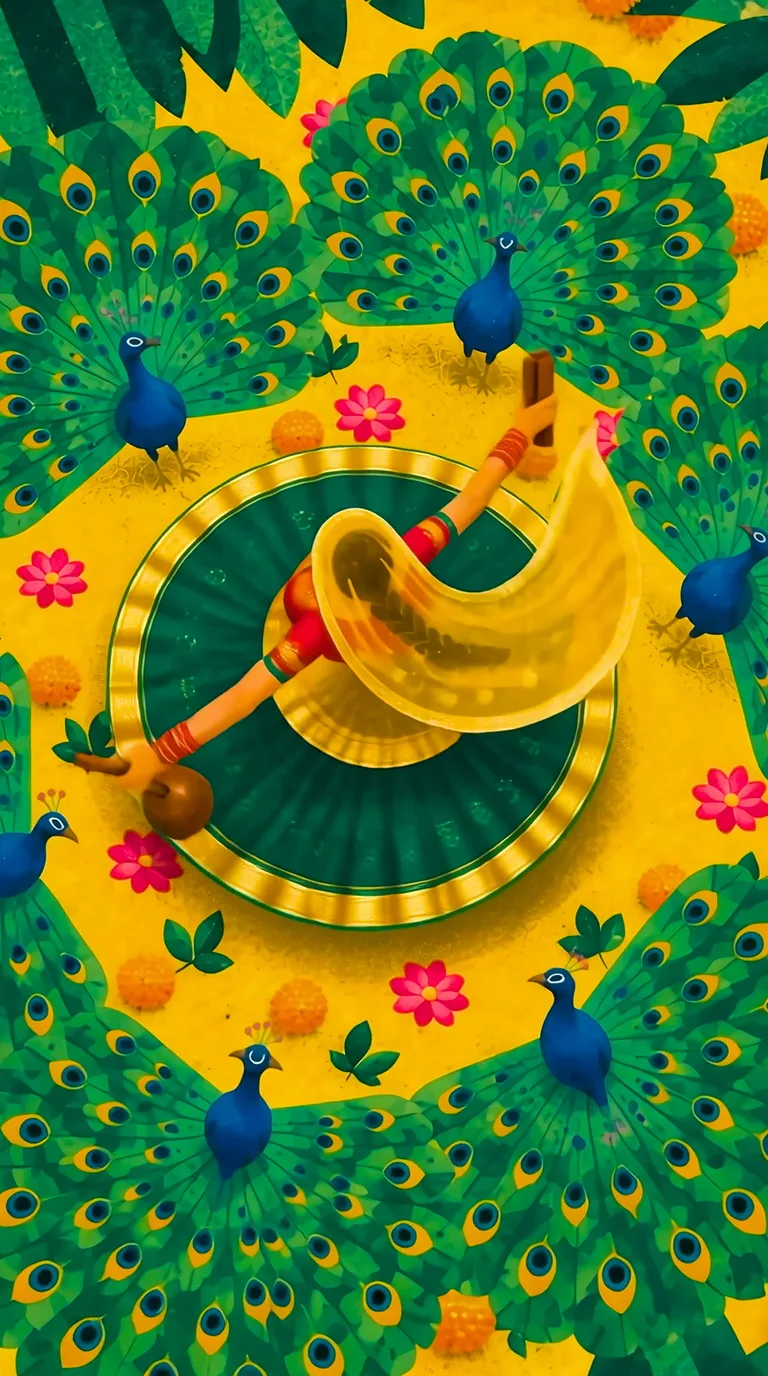
Grain art from above: a woman in a yellow veil turns at the centre of a ring of dancing peacocks, their tails spread around her

Four words, hidden in plain sight

The Pada in Four Words

She chose to serve, and gained everything.

Questions on Chakar Rakho Ji

What does “Mhane Chakar Rakho Ji” mean?

“Keep me as your servant.” म्हाने is Rajasthani for “me”, चाकर is a servant, राखो is “keep”, and जी makes the request respectful. The full refrain is स्याम म्हाने चाकर राखो जी, गिरधारी लाला म्हाँने चाकर राखोजी: “Shyam, keep me as your servant. Girdhari Lala, keep me as your servant.” It is sung at the head of the song and after every verse.

Who wrote Chakar Rakho Ji?

It is a pada (a short devotional song) of Meera, or Mirabai, the sixteenth-century poet and devotee of Krishna. She was born about 1498 into the Rathore royal family of Merta, in Marwar, and married into the royal house of Mewar. Hundreds of padas carry her name. Most were first written down long after her lifetime, so the exact wording of any one of them is a tradition’s wording.

Why does Meera, a princess, ask to be a servant?

Because the word lets her choose. A चाकर is a servant bound by loyalty to a master, and in this pada Meera names hers herself: स्याम, गिरधर, Krishna. She asks to be taken into his service, and then she sets the terms. Every wage she asks for is his presence.

What pay does Meera ask for in Chakar Rakho?

Three things, in the second verse. Darshan, the sight of him, as her pay (चाकरी में दरसण पास्यूँ). Remembering him as her खरची, her allowance (सुमरण पास्यूँ खरची). Devotion as her जागीरी, her estate (भाव भगती जागीरी पास्यूँ). No coin and no field: the whole wage is the Lord.

What does “Teenu Baatan Sarsi” mean?

तीनूं बाताँ सरसी: “all three things will be fulfilled.” तीनूं is “all three”, बाताँ is “things” or “matters”, and सरसी is the Rajasthani future of सरना, “to be accomplished”. The three are the pay she has just named: darshan, remembering, devotion.

What is a kusumbi sari?

A sari dyed कुसुम्बी, red with safflower (कुसुम्भ). In the fourth verse Meera says she will wear one for his darshan. Tradition says that after she was widowed she never wore mourning clothes, because the one she served does not die. That is a story of the tradition, not a recorded fact.

Are there other versions of the lyrics?

Yes. Like most of Meera’s padas, this one survives in several wordings. The text on Kavita Kosh, for one, reads «स्याम मने चाकर राखो जी», «पाऊँ» for «पास्यूँ», «बिच बिच राखूं क्यारी» (flower beds, not windows) and «कुसुम्मी सारी». It adds a couplet about yogis and ascetics, and closes not on गिरधर नागर but on «प्रेमनदी के तीरा», the bank of the river of prem. This page gives the pada as the song sings it, in its Rajasthani form.

Where can I hear the full Chakar Rakho Ji?

The reel on this page is a 90-second cut. The full song, a little over four minutes and sung in Rajasthani, plays in the Anukriti app on the Rama Krishna radio station.

Word meanings: J. T. Platts, A Dictionary of Urdu, Classical Hindi, and English, and R. S. McGregor, The Oxford Hindi-English Dictionary. The master and servant bond: R. D. Saran and N. P. Ziegler, The Mertiyo Rathors of Merto, Rajasthan (2001). The pada is quoted as the song sings it.


Grain art, seen from behind: a woman raises a peacock feather beside a milestone painted जागीरी, MY ESTATE: DEVOTION, in a field of marigolds under a fan of peacock feathers

Inside the reel · 90 seconds

Through the Door

The reel begins in a photographed world: a carved peacock door in a Rajasthani palace. She opens it onto a bright, empty field. Then the world turns to grain art, from the border of her sari inward, and Vrindavan grows around her. Flowers spring up at each step. Six peacocks dance in a ring.

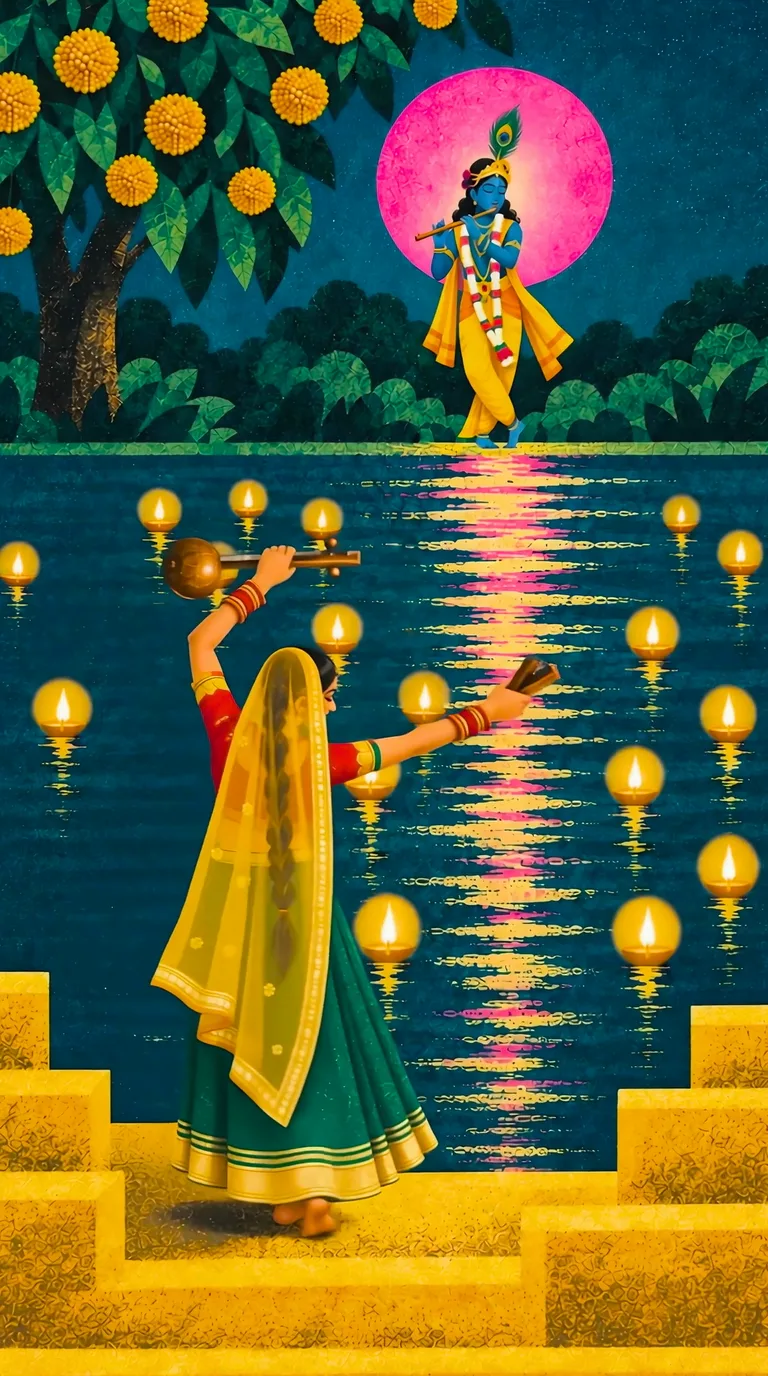
There are no subtitles. The words of the pay are painted into the world instead: दरसण beneath a pink sun, सुमरण, and जागीरी carved on a milestone in a field of marigolds. At dusk she reaches the Yamuna, where Krishna plays the flute on the far bank, and the moon rises among floating diyas.

The reel never shows her face. You see Meera only from behind, the way a listener follows a singer into a song.

The last verse · On the bank of the Yamuna

आधी रात प्रभु दरसण
दीज्यो जमनाजी रे तीरां
मीराँ रा प्रभु गिरधर नागर
हिवड़ो घणो अधीराँ

ādhī rāt prabhu darsaṇ
dījyo jamnājī re tīrāṁ
mīrāṁ rā prabhu girdhar nāgar
hivṛo ghaṇo adhīrāṁ

At midnight, Lord, give me darshan on the bank of the Yamuna. Meera’s Lord is Girdhar Nagar. My heart is very restless.

The song ends where it began, with a request. The servant has stated her work and her wages. Now she asks for the first payment: darshan, at midnight, by the river. मीराँ रा प्रभु गिरधर नागर is her signature line, the one that closes many of her padas. Then the refrain comes back, twice, and the song ends on it.

Grain art at dusk, seen from behind: on the steps of a ghat a woman raises her ektara toward the Yamuna, where Krishna stands with his flute on the far bank before a pink sun, diyas floating on the water

A princess asked to be hired, and named her pay: to see him, to remember him, to be devoted to him. All three, she sang, will be fulfilled. Send this to someone who sings Meera’s bhajans.

Sing It
in Her Words

The full Chakar Rakho Ji plays in the Anukriti app, on the Rama Krishna radio station. Anukriti walks you through each verse at your own pace, with line-by-line guidance that meets you where you are.

New reels from Anukriti on Instagram.
Follow @anukriti.ai

AnukritiDownload on the App Store
Download