Anukriti
ॐ

One Sound,
Two Hands.

Why Om is written ॐ in Devanagari and ஓம் in Tamil, and the dot both of them keep

देवनागरी · Devanagari
தமிழ் · Tamil

Somewhere in Rishikesh, a yoga studio has an Om on its wall: ॐ, gilded at the heart of a carved lotus, one continuous sign with a crescent and a dot floating above it. Somewhere in Madurai, before sunrise, a woman bends over her doorstep and draws Om in rice flour: ஓம், two rounded letters, with Murugan’s spear driven diagonally through them. Neither of them would mistake the other’s drawing for anything else. Both are the syllable the Upaniṣads call all of this.

So why do they look nothing alike? The short answer is that one hand draws Om and the other spells it. The long answer runs through a child god’s question, two kinds of writing surface, a dot that the oldest Tamil grammar insists on, and a single sign that Tamil’s own technologists had to petition to get into the world’s computers.

This is the long answer, told the way the tradition tells it: beginning not with a scribe, but with a question.


Māṇḍūkya Upaniṣad 111

ओमित्येतदक्षरमिदं सर्वं तस्योपव्याख्यानं
भूतं भवद्भविष्यदिति सर्वमोङ्कार एव

omityetadakṣaramidaṃ sarvaṃ tasyopavyākhyānaṃ bhūtaṃ bhavadbhaviṣyaditi sarvamoṅkāra eva

Om: this syllable is all of this. Here is its explanation. What was, what is, what will be, all of it is Om.


Kanda Purāṇam · Utpatti Kāṇḍam1

The Child Who Asked

Kailāsa is crowded that morning. Gods and sages file past to pay their respects to Śiva, and among them walks Brahmā, the creator, who recites the Vedas from four mouths. At the edge of the assembly a boy is playing: Śiva’s son Murugan, six faces, not yet the general he will become. Brahmā does not stop. The boy does.

You make the worlds, the boy says. Then tell me what Om means. It is the first syllable of every Veda Brahmā has ever recited. He begins an answer and cannot finish it. In the Kanda Purāṇam, Kachiyappa Sivachariyar’s great Tamil telling of Skanda’s life, the boy does not argue. He has the creator of the universe locked away. A whole chapter carries the name: அயனைச் சிறைபுரி படலம், the imprisoning of Brahmā. The next is named for his release.

Then Śiva comes to ask for Brahmā’s freedom, and the story turns on its axis. If you know the meaning, Śiva says, tell it. In the telling kept at Swamimalai, the father becomes the student. The lord of the dance sits as a disciple sits, below his son, and bends his head to listen. The temple still keeps the arrangement in stone, Murugan’s shrine high on its hill and Śiva’s at its foot, and calls its god Swāminātha, the lord who became his own father’s guru.2

The story never says what he whispered. It only says that Śiva listened.
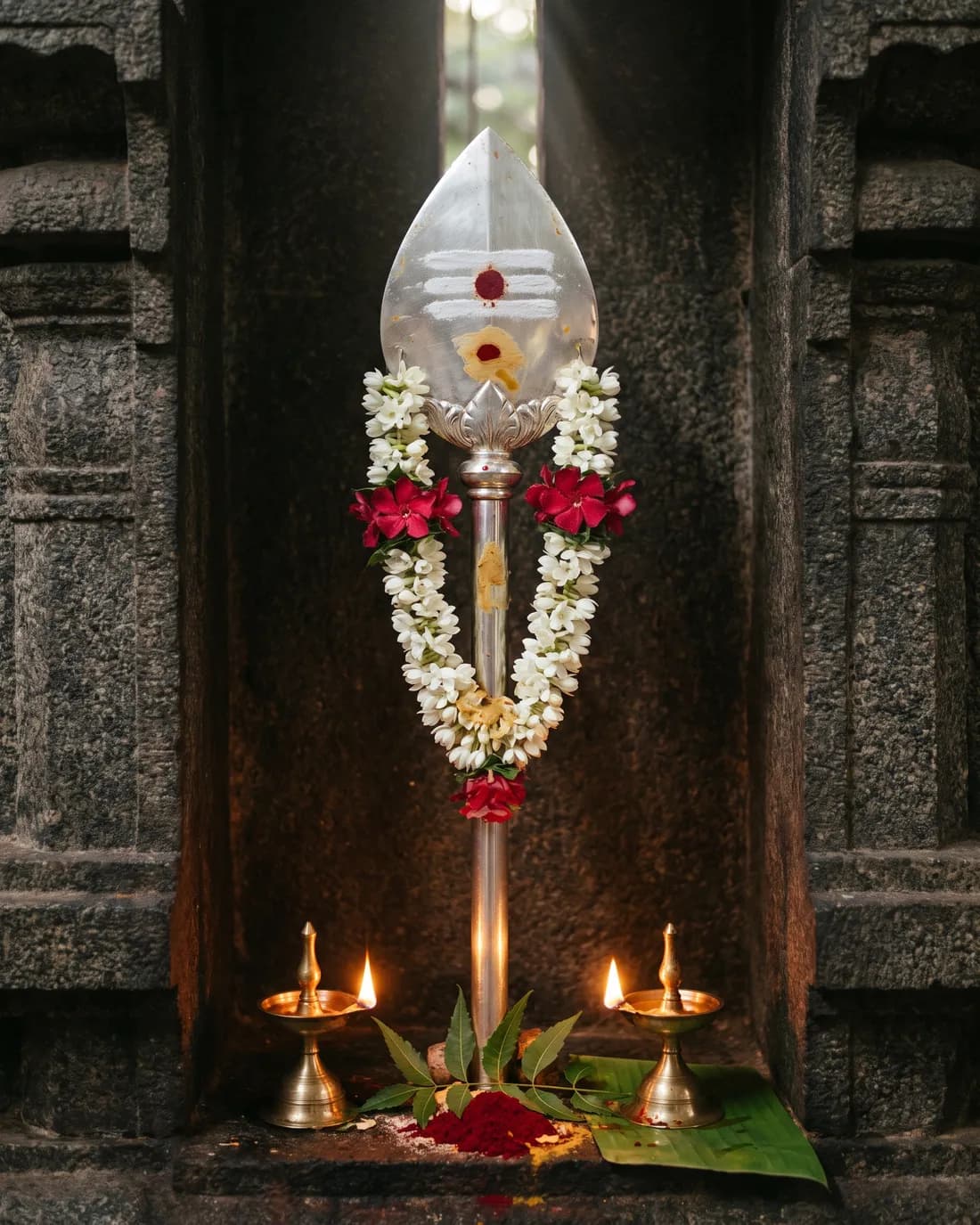
A silver vel, Murugan’s leaf-bladed spear, standing in a granite temple niche, its blade striped with sacred ash and marked with kumkum, garlanded in jasmine and oleander, oil lamps burning at its foot

Tiruppugazh 156 · Arunagirinathar · sung at Palani3

சிவனார் மனங்குளிர உபதேச மந்த்ரமிரு
செவிமீதி லும்பகர்செய் குருநாதா

sivanār manaṅkuḷira upadēsa mantram iru sevimīdhilum pagarsey gurunāthā

O Guru, who spoke the mantra of teaching into both of Śiva’s ears, until his heart grew cool.

Arunagirinathar spent his life walking from temple to temple singing Murugan, and he kept returning to this moment. Here he gives it its most intimate detail: the mantra goes into both ears. In Tamil a glad heart is a cool one, மனம் குளிர. In a hot country, that is what joy feels like.


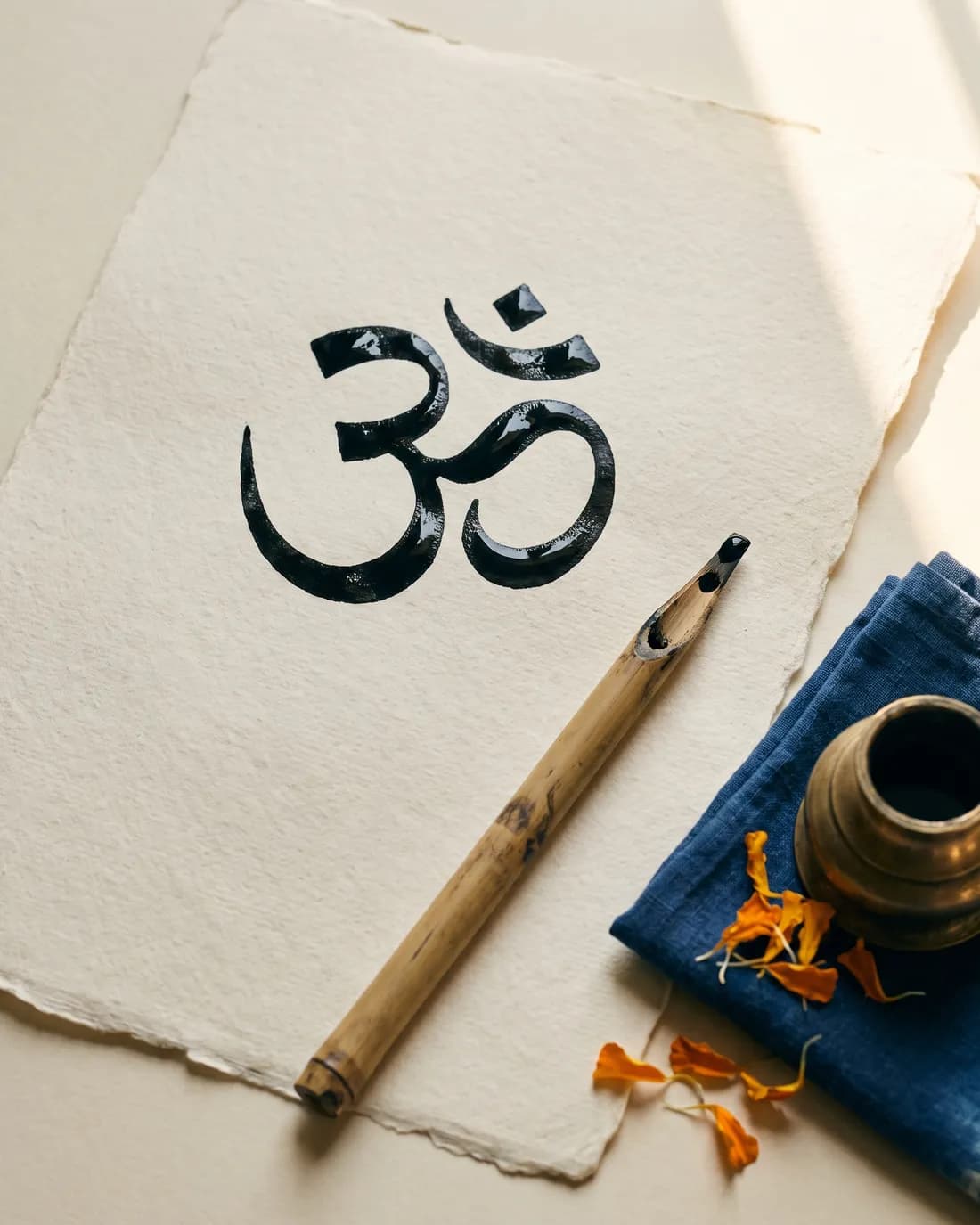
The Devanagari ॐ freshly written in black ink on cream handmade paper, a cut bamboo reed pen beside it, a brass inkwell and marigold petals at the edge

The northern hand · reed pen and ink

A Sign, Not a Spelling

Every script in this story starts in the same place. Brāhmī, the script of Aśoka’s edicts, is the ancestor of nearly every writing system in India, Devanagari in the north and Tamil in the south among them.5,6 They parted the way rivers do: slowly, shaped by the ground they ran over.

In the north the ground was ink. Scribes wrote with cut reed pens on birch bark, cloth and later paper, and the press of the pen left a small wedge at the top of each letter. Over centuries, through the Gupta script and the Siddham that carried mantras as far as Japan, those wedges ran together into the unbroken headline that rides along the top of a Devanagari word.

Om, in this hand, was written so often and at the head of so much that it stopped being spelled. ओम् would have served: the vowel ओ, a full म, a stroke to silence it. Instead the vowel and its nasal hum were folded into a single sign, a curving body, a tail, a crescent moon and a dot, and the sign became the thing itself. In a script built to spell, Om is the word that is drawn.


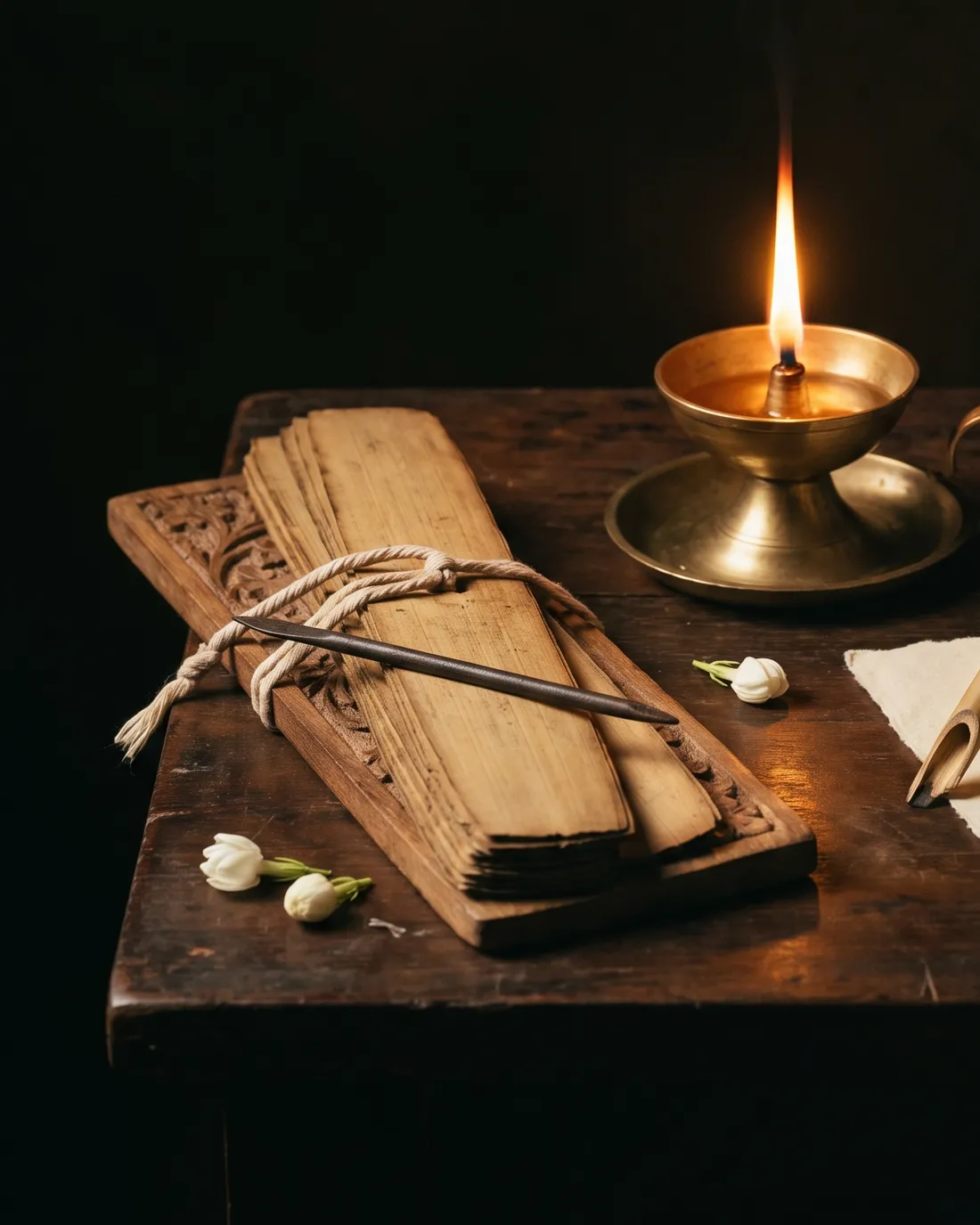
The southern hand · palm leaf and stylus

A Word, Letter by Letter

In the south the ground was leaf. For most of its history Tamil was written on strips of dried palm, scratched with an iron stylus and rubbed with lamp-black so the grooves would show. A leaf has a grain, like wood, and a long straight cut can split it. Whether a script grew angular or round depended on the materials and instruments of the scribes who made it,7 and the southern letters grew round. Tamil has no headline at all.

Tamil also made a different choice about sound. Its own alphabet has no anusvāra and no candrabindu, no small mark that turns a vowel nasal. In Tamil a nasal is a whole letter. So Om cannot be folded up here. It has to be spelled: ஓ, the long vowel ō, then ம, ma, and above it a dot, the puḷḷi, whose whole work is to strip the a away and leave the consonant bare: m, lips closed, humming.

Tamil has taken that dot seriously for a very long time. The Tolkāppiyam, the oldest Tamil grammar to survive, lays it down in four words, as a law of nature.8 Its very next sūtra gives the same dot to the short vowels e and o.

Tolkāppiyam · Eḻuttatikāram 15

மெய்யின் இயற்கை புள்ளியொடு நிலையல்

meyyiṉ iyaṟkai puḷḷiyoṭu nilaiyal

It is the nature of a consonant to stand with a dot.

When a priest in a Tamil temple needed to write Sanskrit itself, verses full of sounds Tamil letters were never made to hold, he used a third script, Grantha, shaped in the same country for exactly that work.5 One priest, two hands: Grantha for the Sanskrit liturgy, Tamil for the hymn.

A bundle of palm-leaf manuscript leaves tied with cotton cord between carved boards, an iron stylus laid across it, a brass oil lamp burning behind on a dark teak table

Two glyphs, taken apart

The anatomy of a breath

Scroll slowly. Each step lights one part of each sign.

ॐDevanagari
ஓம்Tamil
  1. 01 · Two signs

    One syllable, two shapes

    Left, the northern hand: one sign. Right, the southern hand: one word. Both are drawn here from the outlines of two typefaces cut by the same type foundry, so nothing differs but the scripts themselves.

  2. 02 · Devanagari

    Drawn, not spelled

    ॐ has no letters to count. It is a single sign standing for the whole syllable: the vowel o carrying the moon-and-dot that tells the voice to hum, folded into one shape. Unicode gives it a code point of its own.4

  3. 03 · The body

    A vowel that is a sum

    The great curve and its tail carry the vowel. In Sanskrit grammar o is not a simple sound: it is what a and u become when they meet.

    That is how the Māṇḍūkya Upaniṣad can hear three sounds in a syllable that seems to have two, akāra, ukāra, makāra, A, U and M, and give each a state of being: waking, dreaming, deep sleep.11

  4. 04 · Moon and point

    The crescent and the dot

    Above the vowel float the candra and the bindu: the mark of a sound carried up into the nose and held there, a hum.

    Later devotional readings make the crescent the veil of māyā and the dot the fourth state beyond the other three. That reading is a meditation, not a history. But the Upaniṣad does name a fourth.

  5. 05 · Tamil

    Spelled, letter by letter

    Tamil keeps Om inside the alphabet. Two letters, read left to right, with nothing fused and nothing hidden.

  6. 06 · The long vowel

    ஓ, not ஒ

    Tamil has a short ஒ and a long ஓ. Sanskrit’s o is always long, so Tamil reaches for the long one, and the spelling comes out exact.

  7. 07 · The puḷḷi

    The dot that silences

    ம alone is ma. The puḷḷi above it takes the a away and leaves the lips closed on m. “It is the nature of a consonant to stand with a dot,” says the Tolkāppiyam.8

  8. 08 · Two dots

    Both end at a point

    In ॐ the bindu carries the sound on into a hum. In ஓம் the puḷḷi stops the vowel at closed lips. One dot opens, one dot closes, and after each of them nothing more is written.

    The Māṇḍūkya’s name for what comes after the three sounds is amātra: the measureless.12

  9. 09 · A southern sign

    Tamil fused it too

    Tamil has a single sign as well, ௐ, and it is no rarity. When Tamil technologists asked Unicode to encode it in 2006, they noted it was widely used in Hindu religious texts, temple publications, and as neon lamps on shop signboards.9 It arrived in 2008.10 Even fused, it keeps its m inside.


Māṇḍūkya Upaniṣad 1212

अमात्रश्चतुर्थोऽव्यवहार्यः प्रपञ्चोपशमः शिवोऽद्वैत
एवमोङ्कार आत्मैव संविशत्यात्मनाऽऽत्मानं य एवं वेद

amātraś caturtho ’vyavahāryaḥ prapañcopaśamaḥ śivo ’dvaita evam oṅkāra ātmaiva saṃviśaty ātmanā ’tmānaṃ ya evaṃ veda

The fourth has no measure. It cannot be handled or named; in it the spread of the world comes to rest, peaceful, auspicious, not two. So Om is the Self itself. Whoever knows this enters the Self by the Self.

This is the verse behind both dots. A, U and M can be sounded, and so they can be written. The fourth cannot. Each script, in its own way, stops at the edge of what can be written and leaves a single point there.


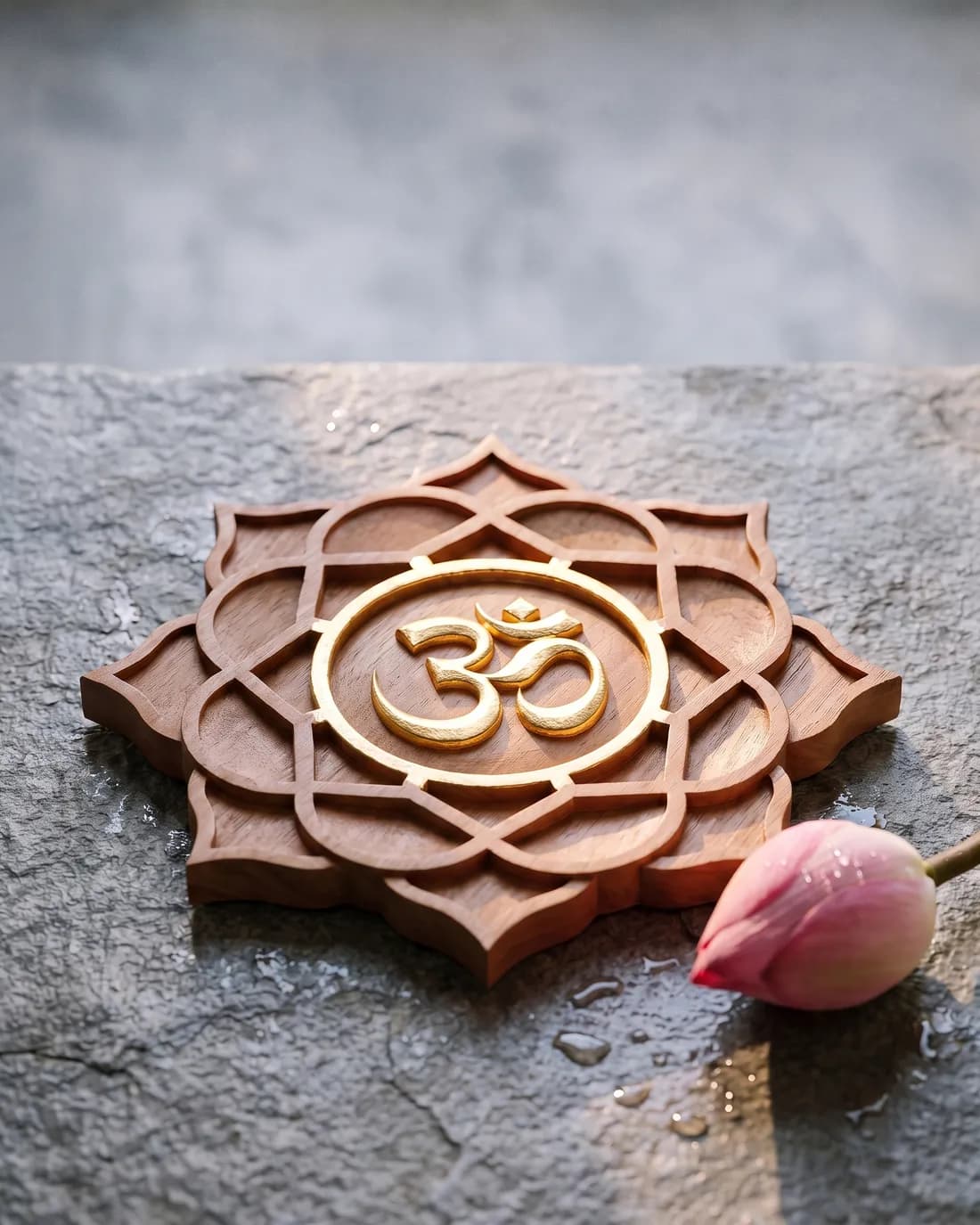
The Devanagari ॐ carved in relief and gilded at the centre of an eight-petalled sandalwood lotus, a pink lotus bud beside it on grey stone
ॐ in the lotus: the northern emblem.
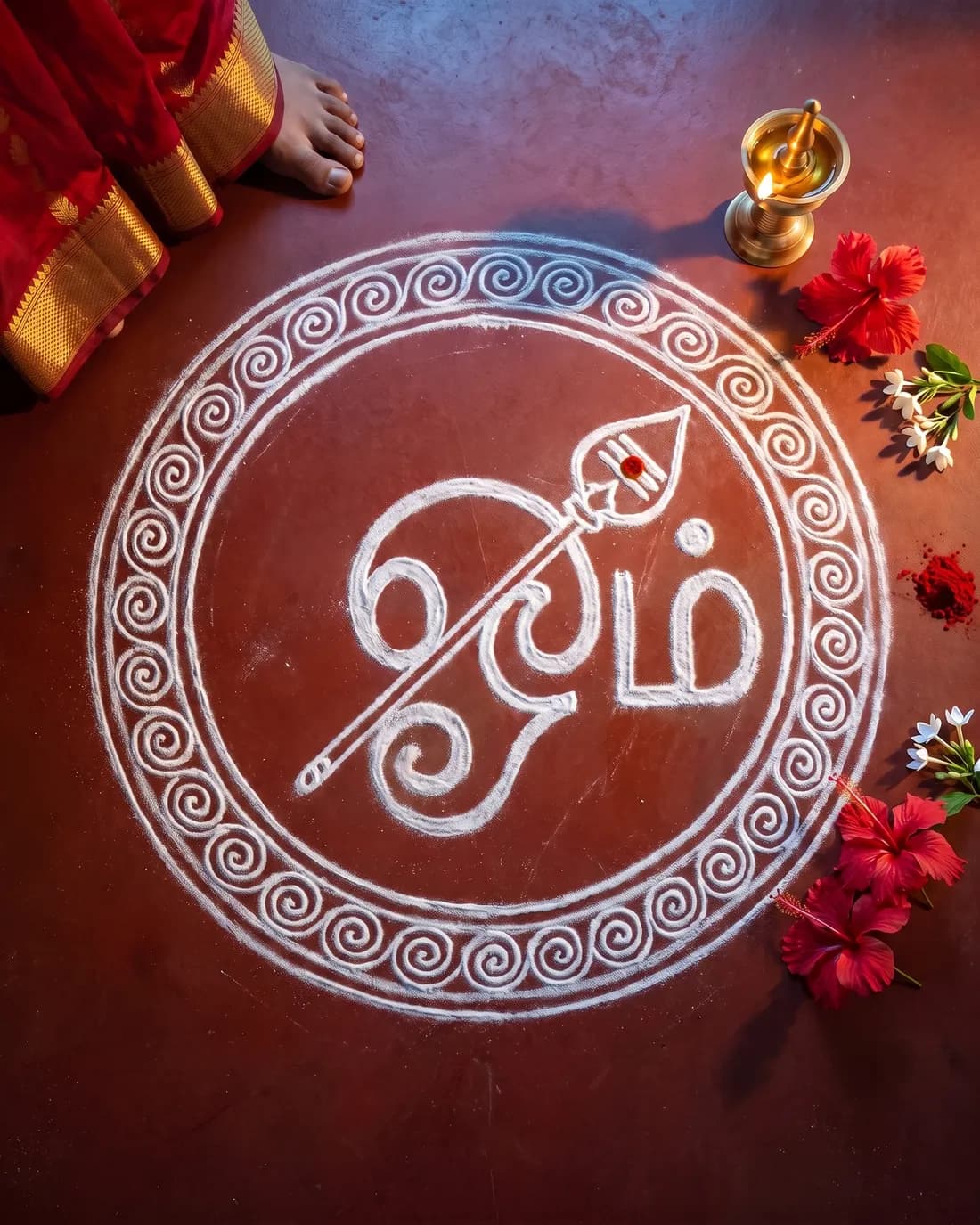
A rice-flour kolam on a red-ochre floor at dawn: the Tamil ஓம் with Murugan’s vel drawn diagonally through it, inside a double circle of spirals, with a brass lamp and red hibiscus
ஓம் and the vel: the Tamil emblem, drawn as a kolam.

Om Sakti · Vel Sakti

The Lotus and the Spear

Look again at the two images we began with. In the north, ॐ is so often set inside a lotus that the pairing feels inevitable: a flower opening on still water, a sound unfolding into silence. In the Tamil south, ஓம் is just as likely to be pierced by a vel, the leaf-bladed spear of Murugan, drawn straight through the letters, its blade striped with ash and marked with kumkum.

The vel is not only a weapon. Tamil devotion calls it the Sakti vel: the spear his mother Pārvatī placed in his hand for the war against Sūrapadman, and with it her own power. To drive the vel through ஓம் is to set the teaching he gave his father beside the strength his mother gave him. Syllable and Sakti, in one emblem.

And there is ஓம் சக்தி, Om Sakti, the two words on the stage that devotees walk around three times before they enter the Adhiparasakthi Siddhar Peetam at Melmaruvathur. There, the devotees who serve are dressed in red, women perform the pūjā in the sanctum itself,16 and people greet one another not with vaṇakkam but with Om Sakti, bowing to the Mother in whoever stands in front of them.17

Neither emblem is the whole truth of its country. Tamil Śaivism has its own deep stillness, and the north has goddesses who carry spears. But the signs people draw on their walls and doorsteps show which part of the story they reach for first: the flower opening on still water, or the boy who asked the question, holding the spear his mother gave him.

How it is chanted

Whichever hand writes it, the mouth makes the same three movements. It opens for a, rounds for u, and the two together give the long, pure o of Sanskrit, one steady vowel and not the gliding “oh-oo” of the English word home. Then the lips close on m and the sound turns inward, into a hum you feel in the bones of the face more than you hear.

The tradition cares how long that lasts. Pāṇini’s grammar has a rule just for it, ओमभ्यादाने, which stretches Om to a prolonged, three-measure pluta when it opens a recitation.13 The Chāndogya Upaniṣad opens on the instruction to meditate on Om as the udgītha,14 and the Gītā says that acts of sacrifice, giving and austerity all begin with it.15

This is the part no script can hold. ॐ will not tell you how long to sustain the vowel, and ஓம் will not tell you where the hum should sit. Only an ear can. It is why Anukriti listens: whichever script you first learned your prayers in, it hears whether the vowel is long and pure and whether the m has closed, and tells you, the way a teacher would.

On Anukriti Radio · the soundtrack to this page

Om Saravana Bhava

The music under this page is Anukriti Radio’s Om Saravana Bhava, built on Murugan’s six-syllable mantra, śa-ra-va-ṇa-bha-va: the one born in the reed pond. The Kanda Purāṇam has a chapter for that pond too, the சரவணப் படலம்,1 where six sparks of Śiva’s fire become six infants on the water, and Pārvatī gathers them into one child with six faces.

Listen for the chorus that answers it, Vel, Sakti, Vel: the spear and the power named in one breath, as if the kolam on the doorstep had been set to music. In the bridge the track turns to a verse of the Subrahmaṇya Bhujaṅgam, the hymn tradition says Śaṅkara sang at Tiruchendur, on the Tamil shore.18 Its second phrase is the one this whole page has been circling: महावाक्यगूढं, hidden in the great sayings. The god who explained Om to his father, hidden inside the Upaniṣads’ great sentences. And the track ends the only way it could: four Oms, and then nothing.

The mantra

ॐ शरवणभव

ஓம் சரவணபவ

oṃ śaravaṇabhava

Om, to the one born in the reed pond.

The chorus

वेल् शक्ति वेल्

வேல் சக்தி வேல்

vel śakti vel

Spear, power, spear.

The bridge · Subrahmaṇya Bhujaṅgam

मयूराधिरूढं महावाक्यगूढं
मनोहारिदेहं महच्चित्तगेहम्
महीदेवदेवं महावेदभावं
महादेवबालं भजे लोकपालम्

mayūrādhirūḍhaṃ mahāvākyagūḍhaṃ manohārideham mahaccittageham mahīdevadevaṃ mahāvedabhāvaṃ mahādevabālaṃ bhaje lokapālam

Riding the peacock, hidden in the great sayings, lovely in form, at home in great hearts; god of the gods of the earth, the very meaning of the Veda, child of Mahādeva, guardian of the worlds: him I worship.

From one ancestor script

One Sound, Many Hands

Every script that descends from Brāhmī had to decide how to write Om. Most kept the long o and added a nasal mark. A few, like Devanagari, folded it into one sign.

ॐDevanagarione sign · U+0950
ஓம்Tamilō + m + puḷḷi
ௐTamil signone sign · U+0BD0
ఓంTeluguō + anusvāra
ಓಂKannadaō + anusvāra
ഓംMalayalamō + anusvāra
ওঁBengalio + candrabindu
ଓଁOdiao + candrabindu
ૐGujaratione sign · U+0AD0
ༀTibetanone sign · U+0F00

Two hands, then. One folded the syllable into a single sign; the other wrote out every sound and let none of them go unrecorded. And between them, a boy on a hill at Swamimalai, leaning toward his father’s ear. What he whispered was never written in either script. It did not need to be. It was a sound, and a sound is made to be heard.

Our film One Syllable, Heard follows a single syllable, त, from a reciter’s lips to a neuron in a listener’s ear. Om makes that journey every time it is chanted, in every script, and arrives as the same sound.

Watch the film

Sources

  1. Kachiyappa Sivachariyar, Kanda Purāṇam, Utpatti Kāṇḍam: chapter list, incl. சரவணப் படலம் (13), அயனைச் சிறைபுரி படலம் (16) and அயனைச் சிறைநீக்கு படலம் (17). Kaumaram.
  2. Swaminatha Swamy Temple, Swamimalai: one of Murugan’s six abodes; the hilltop shrine, Śiva’s shrine at its foot, Murugan as guru to Śiva. Wikipedia.
  3. Arunagirinathar, Tiruppugazh 156, “சிவனார் மனங்குளிர” (Palani), text and translation. Kaumaram.
  4. The Unicode Standard, Devanagari block chart: U+0950 DEVANAGARI OM.
  5. Richard Salomon, Indian Epigraphy: A Guide to the Study of Inscriptions in Sanskrit, Prakrit, and the Other Indo-Aryan Languages (Oxford University Press, 1998) — Brahmi and its descendants, the Gupta and Siddhamātṛkā stages, Grantha.
  6. Iravatham Mahadevan, Early Tamil Epigraphy: From the Earliest Times to the Sixth Century A.D. (Harvard Oriental Series, 2003) — Tamil-Brahmi and the early Tamil script.
  7. Folios of palm leaf manuscripts: on palm leaf, brass stylus, and why some scripts grew angular and others round. Google Arts & Culture.
  8. Tolkāppiyam, Eḻuttatikāram, Nūl Marapu, sūtras 15–16. Project Madurai.
  9. INFITT, “Proposal to add TAMIL OM”, Unicode document L2/06-184, 28 April 2006.
  10. The Unicode Standard, Tamil block chart: U+0BD0 TAMIL OM (added in Unicode 5.1, 2008).
  11. Māṇḍūkya Upaniṣad, mantras 1 and 8, Devanagari and transliteration. Shlokam.
  12. Māṇḍūkya Upaniṣad, mantra 12, with Śaṅkara’s commentary. Wisdom Library.
  13. Pāṇini, Aṣṭādhyāyī 8.2.87, ओमभ्यादाने; tr. Srisa Chandra Vasu, The Ashtadhyayi of Panini, vols. 5–8. Internet Archive.
  14. Chāndogya Upaniṣad 1.1.1. Wisdom Library.
  15. Bhagavad Gītā 17.24. Holy Bhagavad Gita.
  16. Adhiparasakthi Siddhar Peetam, Melmaruvathur: the Om Sakthi stage, red-clad devotees, women performing pūjā in the sanctum. Wikipedia.
  17. “Why do we greet everyone with Om Sakthi?” Sakthi Temple.
  18. Śrī Subrahmaṇya Bhujaṅgam, attributed to Ādi Śaṅkara. Sanskrit Documents.

Whichever Hand
You Learned It In

Anukriti listens to your chanting and offers expert-level feedback, so every syllable, ॐ or ஓம், resonates with tradition.

The soundtrack, Om Saravana Bhava, plays on Anukriti Radio.
Follow @anukriti.ai

AnukritiDownload on the App Store
Download