Anukriti

महालक्ष्म्यष्टकम्

Mahalakshmi Ashtakam Lyrics & Meaning: Eight Verses, One Bow

The Mahalakshmi Ashtakam is a Sanskrit hymn of eight verses to the goddess Lakshmi, given in tradition to Indra, king of the gods. It begins «नमस्तेऽस्तु महामाये» (namaste’stu mahāmāye), “Salutations to you, great Māyā”, and every verse ends on one line: «महालक्ष्मि नमोऽस्तु ते», “Great Lakshmi, I bow to you.”

Indra’s hymn · Sanskrit · Anukriti’s 90-second reel, Part 1 · The full lyrics

Part 1 · महालक्ष्मि नमोऽस्तु ते

Also in Tamil script: the same reel on Instagram

The reel opens on a single word, श्री, in gold. Śrī is fortune, grace, radiance, and it is also her name. Then she is there: seated on a lotus on a milk-white sea at sunrise, four arms, red and gold silk.

In the hymn, the one who sings to her is a king. It opens with इन्द्र उवाच, “Indra said”: Indra, the ruler of the gods, the one who has everything a king can have. What he does with eight verses is bow. He asks her for nothing. He only names her, again and again, and bows.

Every verse is built the same way. Three lines of names, each one a way of seeing her, and then the fourth line, which never changes. Learn that one line and you can sing the hymn with anyone who knows it.

Mahalakshmi Ashtakam Lyrics

The whole hymn in Sanskrit, with English transliteration: the speaker line, the eight verses, and the three closing verses on what reciting it brings. The meaning of each verse follows below.

  1. Indra speaks

    इन्द्र उवाच ।

    indra uvāca

  2. Verse 1

    नमस्तेऽस्तु महामाये श्रीपीठे सुरपूजिते ।
    शङ्खचक्रगदाहस्ते महालक्ष्मि नमोऽस्तु ते ॥

    namaste’stu mahāmāye śrīpīṭhe surapūjite
    śaṅkhacakragadāhaste mahālakṣmi namo’stu te

  3. Verse 2

    नमस्ते गरुडारूढे कोलासुरभयङ्करि ।
    सर्वपापहरे देवि महालक्ष्मि नमोऽस्तु ते ॥

    namaste garuḍārūḍhe kolāsurabhayaṅkari
    sarvapāpahare devi mahālakṣmi namo’stu te

  4. Verse 3

    सर्वज्ञे सर्ववरदे सर्वदुष्टभयङ्करि ।
    सर्वदुःखहरे देवि महालक्ष्मि नमोऽस्तु ते ॥

    sarvajñe sarvavarade sarvaduṣṭabhayaṅkari
    sarvaduḥkhahare devi mahālakṣmi namo’stu te

  5. Verse 4

    सिद्धिबुद्धिप्रदे देवि भुक्तिमुक्तिप्रदायिनि ।
    मन्त्रमूर्ते सदा देवि महालक्ष्मि नमोऽस्तु ते ॥

    siddhibuddhiprade devi bhuktimuktipradāyini
    mantramūrte sadā devi mahālakṣmi namo’stu te

  6. Verse 5

    आद्यन्तरहिते देवि आद्यशक्तिमहेश्वरि ।
    योगजे योगसम्भूते महालक्ष्मि नमोऽस्तु ते ॥

    ādyantarahite devi ādyaśaktimaheśvari
    yogaje yogasambhūte mahālakṣmi namo’stu te

  7. Verse 6

    स्थूलसूक्ष्ममहारौद्रे महाशक्तिमहोदरे ।
    महापापहरे देवि महालक्ष्मि नमोऽस्तु ते ॥

    sthūlasūkṣmamahāraudre mahāśaktimahodare
    mahāpāpahare devi mahālakṣmi namo’stu te

  8. Verse 7

    पद्मासनस्थिते देवि परब्रह्मस्वरूपिणि ।
    परमेशि जगन्मातर्महालक्ष्मि नमोऽस्तु ते ॥

    padmāsanasthite devi parabrahmasvarūpiṇi
    parameśi jaganmātar mahālakṣmi namo’stu te

  9. Verse 8

    श्वेताम्बरधरे देवि नानालङ्कारभूषिते ।
    जगत्स्थिते जगन्मातर्महालक्ष्मि नमोऽस्तु ते ॥

    śvetāmbaradhare devi nānālaṅkārabhūṣite
    jagatsthite jaganmātar mahālakṣmi namo’stu te

  10. Verse 9

    महालक्ष्म्यष्टकं स्तोत्रं यः पठेद्भक्तिमान्नरः ।
    सर्वसिद्धिमवाप्नोति राज्यं प्राप्नोति सर्वदा ॥

    mahālakṣmyaṣṭakaṃ stotraṃ yaḥ paṭhed bhaktimān naraḥ
    sarvasiddhim avāpnoti rājyaṃ prāpnoti sarvadā

  11. Verses 10 and 11

    एककाले पठेन्नित्यं महापापविनाशनम् ।
    द्विकालं यः पठेन्नित्यं धनधान्यसमन्वितः ॥
    त्रिकालं यः पठेन्नित्यं महाशत्रुविनाशनम् ।
    महालक्ष्मीर्भवेन्नित्यं प्रसन्ना वरदा शुभा ॥

    ekakāle paṭhen nityaṃ mahāpāpavināśanam
    dvikālaṃ yaḥ paṭhen nityaṃ dhanadhānyasamanvitaḥ
    trikālaṃ yaḥ paṭhen nityaṃ mahāśatruvināśanam
    mahālakṣmīr bhaven nityaṃ prasannā varadā śubhā


The refrain · the last line of every verse

महालक्ष्मि नमोऽस्तु ते

mahālakṣmi namo’stu te

Great Lakshmi, I bow to you.

नमः is a bow, अस्तु is “let there be”, ते is “to you”. The ऽ sign marks a vowel that has merged away: नमः + अस्तु becomes नमोऽस्तु. Sung, it is one smooth word, namo’stu.


Verse 1 · The throne and the three emblems

Namastestu Mahamaye

The first verse sets her on a throne and puts three things in her hands. They are Vishnu’s own emblems, and she holds them as his consort.

Verse 1

नमस्तेऽस्तु महामाये श्रीपीठे सुरपूजिते ।
शङ्खचक्रगदाहस्ते महालक्ष्मि नमोऽस्तु ते ॥

namaste’stu mahāmāye śrīpīṭhe surapūjite
śaṅkhacakragadāhaste mahālakṣmi namo’stu te

Salutations to you, great Māyā, seated on the throne of Śrī, worshipped by the gods. You who hold the conch, the discus and the mace in your hands: Great Lakshmi, I bow to you.

महामाये: Māyā is the power that veils the world and also shows it. सुरपूजिते: the gods, सुर, worship her, so the king of the gods is not the first to bow. शङ्खचक्रगदाहस्ते is one long word: conch, discus, mace, hand.
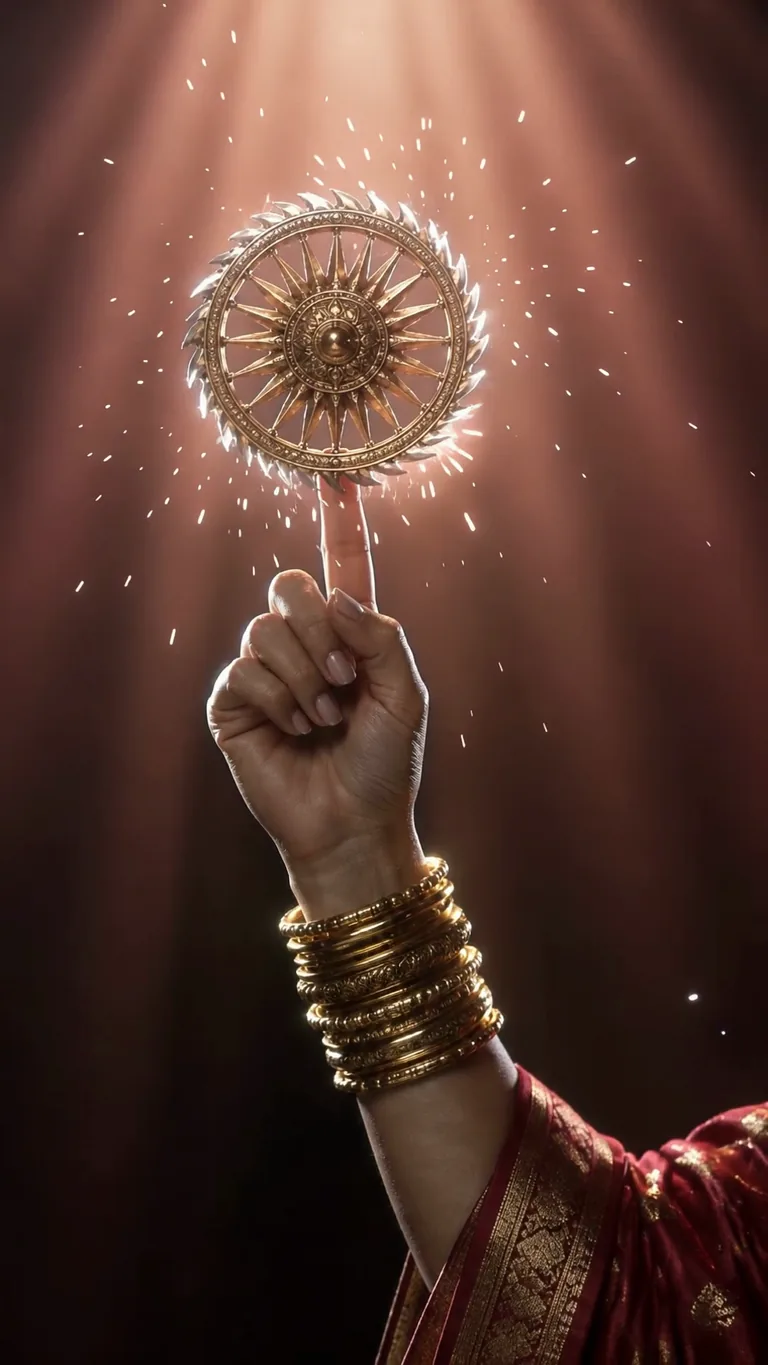
A hand in gold bangles raises a golden discus, a chakra, into a shaft of rose light with sparks around it

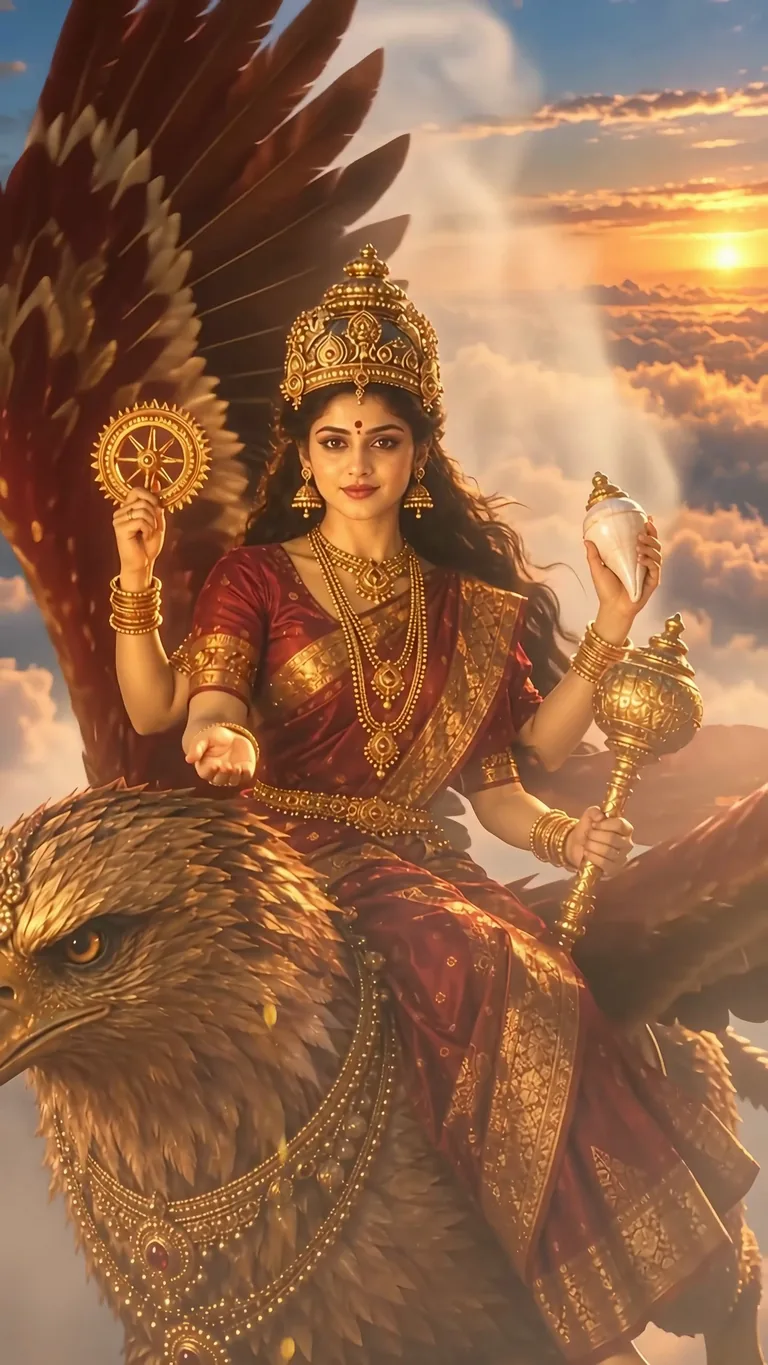
Four-armed Lakshmi in red and gold silk rides on the back of Garuda, the great eagle, above the clouds at sunrise, holding the discus, conch and mace

Verse 2 · The rider of Garuda

Terror of the Demon Kola

The second verse puts her in motion. The gentle goddess of the lotus is also a warrior, and the hymn says so plainly.

Verse 2

नमस्ते गरुडारूढे कोलासुरभयङ्करि ।
सर्वपापहरे देवि महालक्ष्मि नमोऽस्तु ते ॥

namaste garuḍārūḍhe kolāsurabhayaṅkari
sarvapāpahare devi mahālakṣmi namo’stu te

Salutations to you who ride Garuda, terror of the demon Kola. Remover of every sin, O Devi: Great Lakshmi, I bow to you.

गरुडारूढे is “mounted on Garuda”, the great eagle who carries Vishnu. भयङ्करि is “the one who causes fear”, here to the demon Kola. The hymn tells no story about him. The Mahalakshmi temple at Kolhapur, in Maharashtra, has its own story of a demon, Kolhasur, slain there; the hymn does not say they are one.

Verse 3 · Four times “all”

Giver of Every Boon

The third verse is easy to hear: four of its words begin with सर्व, “all”. All-knowing, all boons, all the wicked, all sorrow. Nothing is left outside her reach.

Verse 3

सर्वज्ञे सर्ववरदे सर्वदुष्टभयङ्करि ।
सर्वदुःखहरे देवि महालक्ष्मि नमोऽस्तु ते ॥

sarvajñe sarvavarade sarvaduṣṭabhayaṅkari
sarvaduḥkhahare devi mahālakṣmi namo’stu te

All-knowing one, giver of every boon, terror of all the wicked, remover of all sorrow, O Devi: Great Lakshmi, I bow to you.

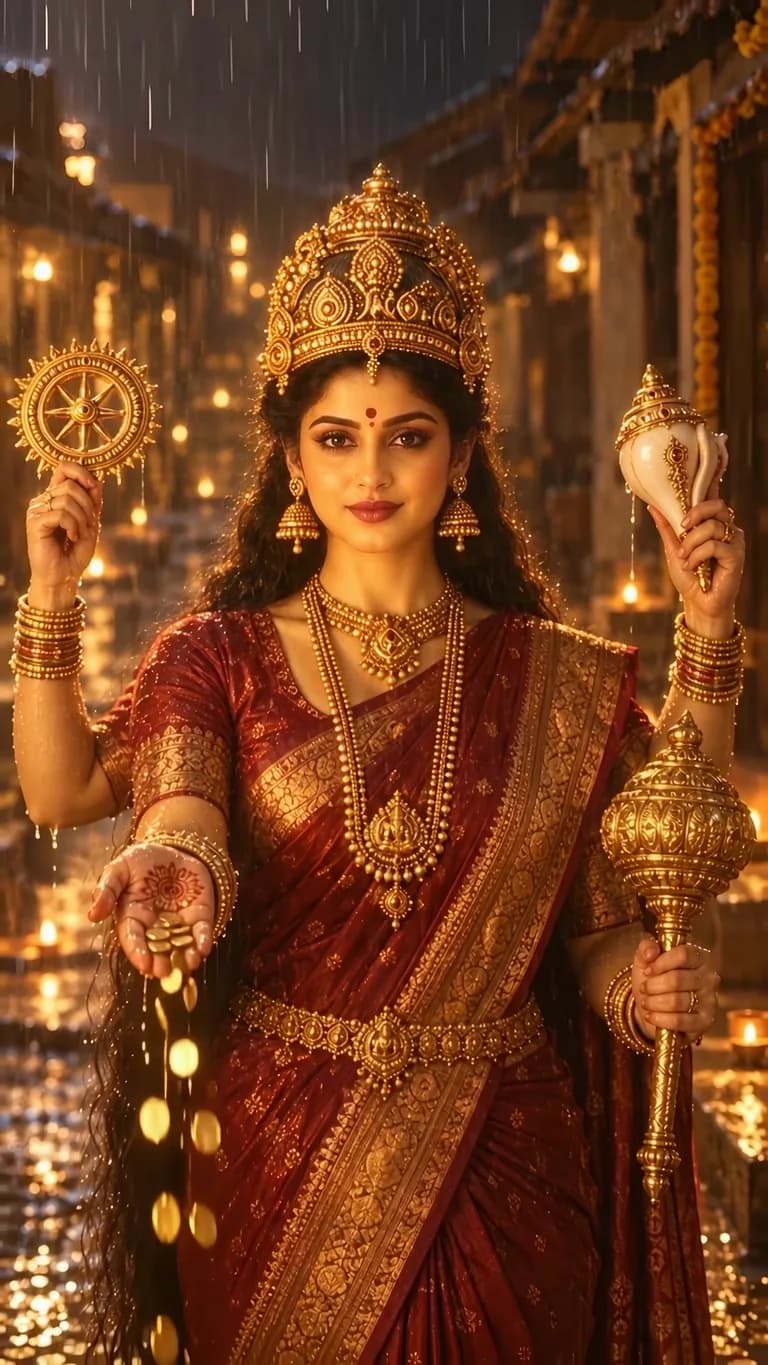
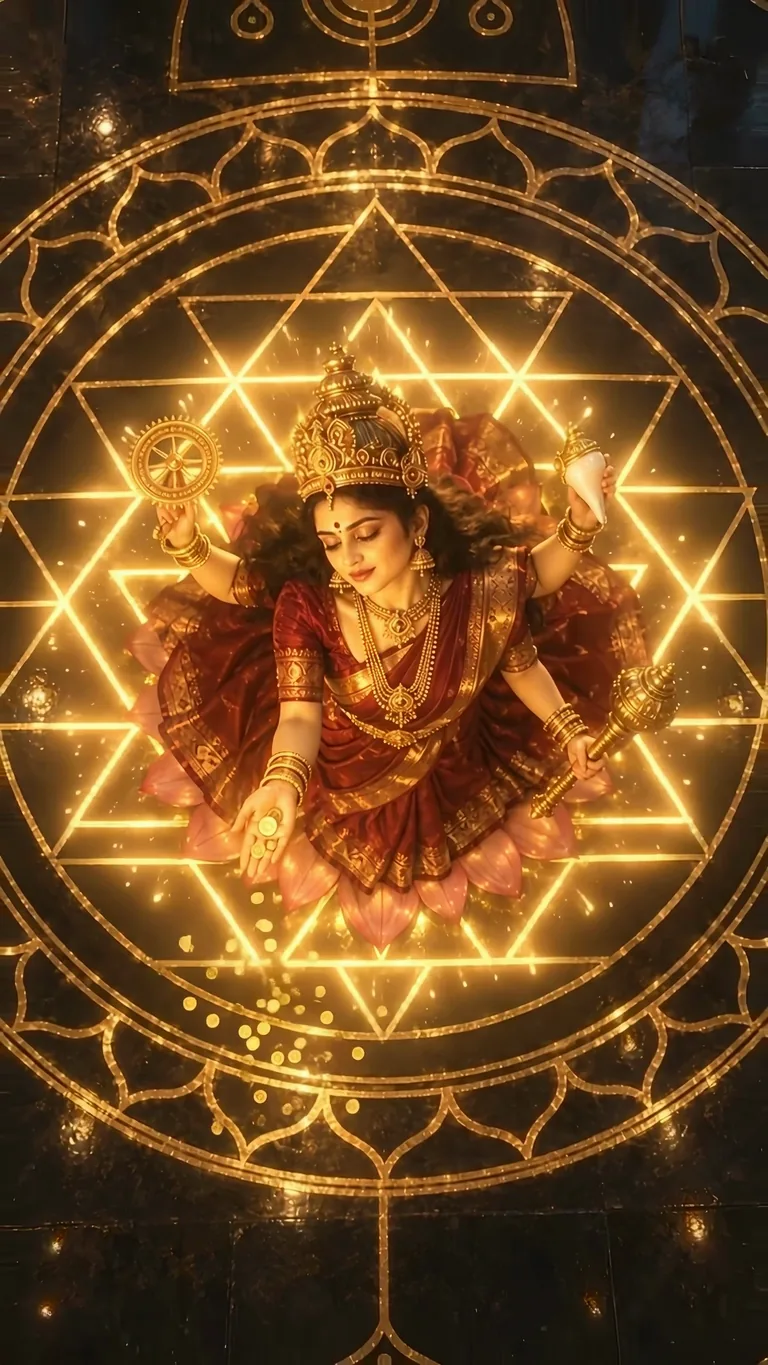
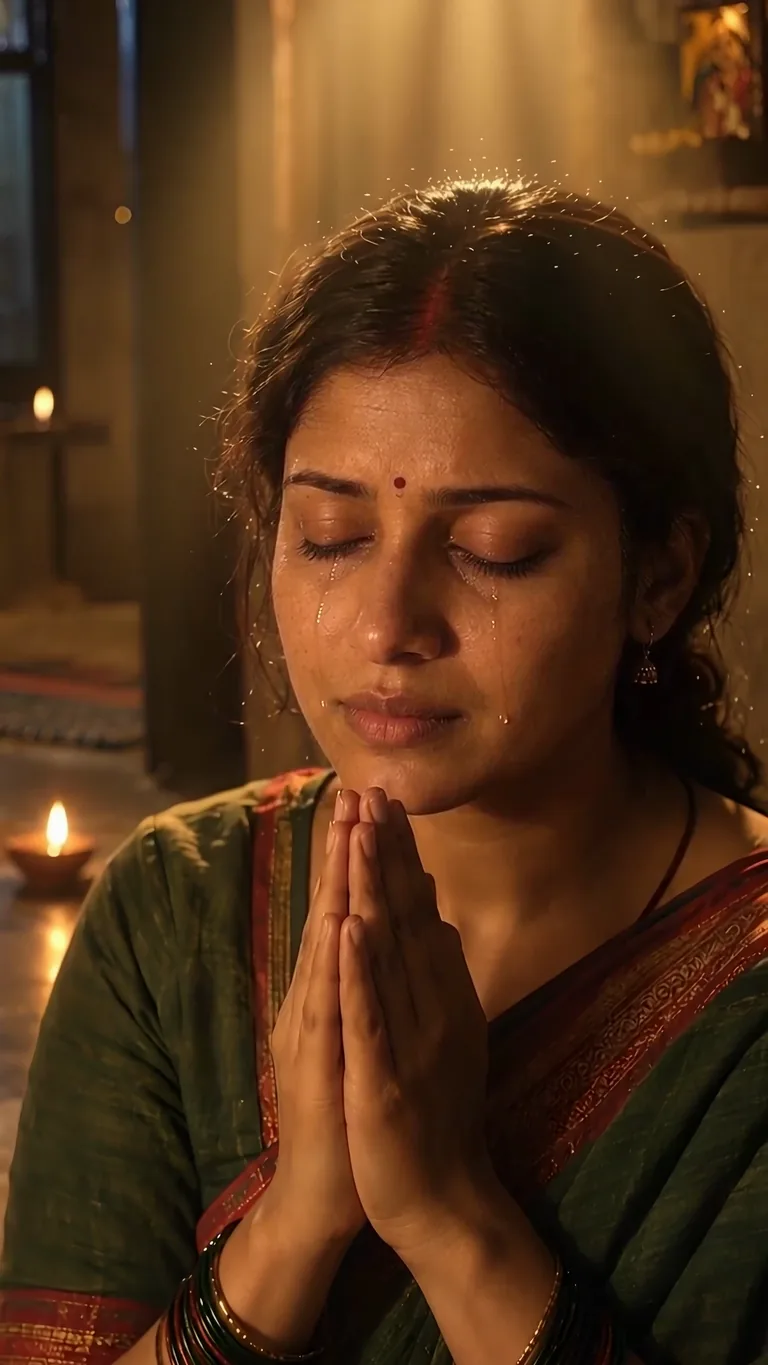
The reel gives each name a picture. For सर्ववरदे her lower hand opens and gold pours out of it. For सर्वदुःखहरे, it leaves her altogether and comes to a woman with her palms joined, and a tear that catches the light. Those are the reel’s pictures; the words are the hymn’s.

Lakshmi stands in a lamp-lit street in the rain, gold coins pouring from her open lower hand, the discus and conch raised in her upper hands

Lakshmi seated at the centre of a yantra drawn in golden light, its triangles and circles glowing around her

Verse 4 · Both worlds

The Form of the Mantra

The fourth verse pairs things a reader might expect to pull apart: success and wisdom, the joys of this life and freedom from it. She gives both halves of each pair.

Verse 4

सिद्धिबुद्धिप्रदे देवि भुक्तिमुक्तिप्रदायिनि ।
मन्त्रमूर्ते सदा देवि महालक्ष्मि नमोऽस्तु ते ॥

siddhibuddhiprade devi bhuktimuktipradāyini
mantramūrte sadā devi mahālakṣmi namo’stu te

Giver of success and understanding, O Devi, giver of worldly joy and of liberation. You whose form is mantra, always, O Devi: Great Lakshmi, I bow to you.

भुक्ति is enjoyment, the good things of a life in the world. मुक्ति is release from that world. A single word, भुक्तिमुक्तिप्रदायिनि, holds both. मन्त्रमूर्ते says her body is made of sacred sound, which is why the hymn is a way to meet her.

Verse 5 · Before the beginning

Without Beginning or End

By the fifth verse the names have grown past any one picture. She is no longer only the goddess of fortune. She is the first power of all.

Verse 5

आद्यन्तरहिते देवि आद्यशक्तिमहेश्वरि ।
योगजे योगसम्भूते महालक्ष्मि नमोऽस्तु ते ॥

ādyantarahite devi ādyaśaktimaheśvari
yogaje yogasambhūte mahālakṣmi namo’stu te

You who are without beginning or end, O Devi, primal power, great sovereign. Born of yoga, arisen from yoga: Great Lakshmi, I bow to you.

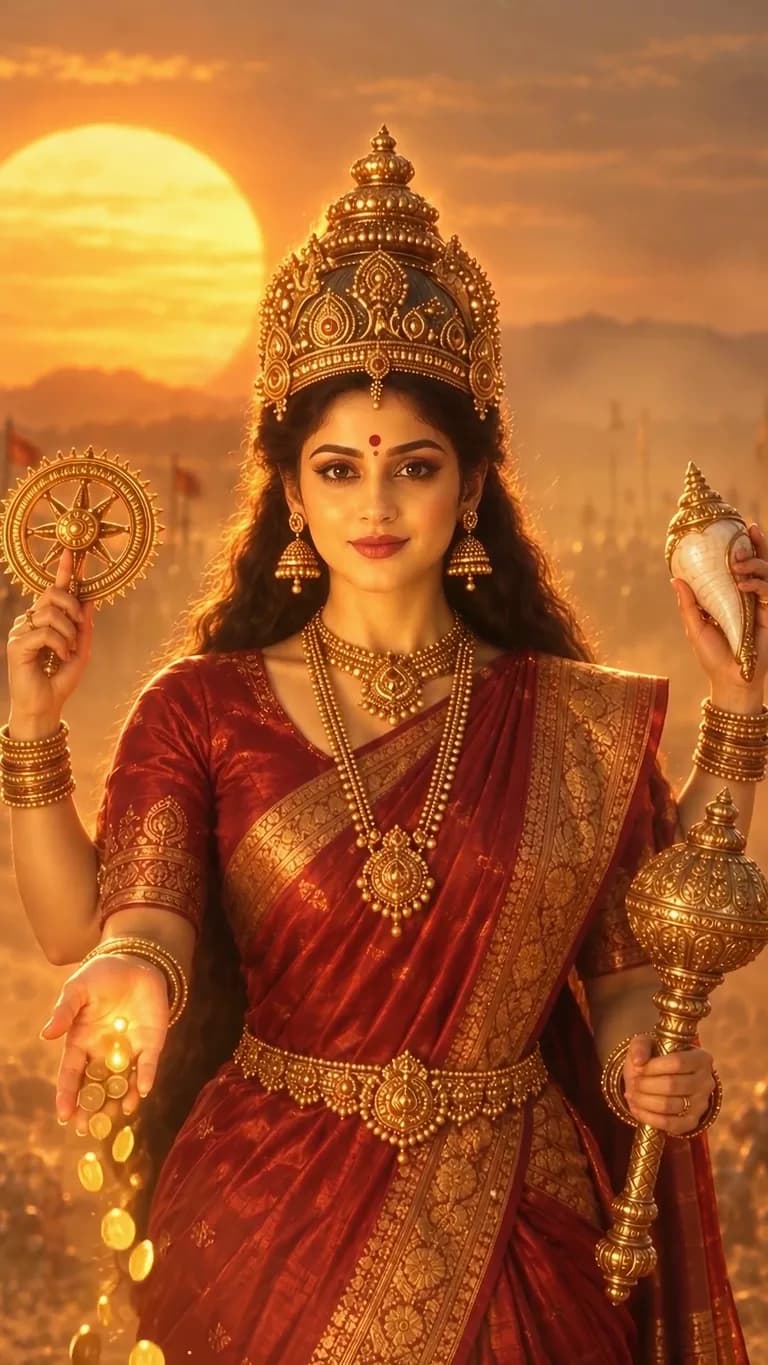
आदि is the beginning, अन्त the end, and रहित “free of”: one word, आद्यन्तरहिते. महेश्वरि is the great sovereign. Part 1 of the reel ends here, on the refrain, with her standing on the lotus on the milk-white sea.

Lakshmi in red and gold silk before a vast golden sun-disc, her open hand pouring coins, the discus and conch raised

Verses 6, 7 and 8 · the rest of the eight

स्थूलसूक्ष्ममहारौद्रे महाशक्तिमहोदरे ।
महापापहरे देवि महालक्ष्मि नमोऽस्तु ते ॥

sthūlasūkṣmamahāraudre mahāśaktimahodare
mahāpāpahare devi mahālakṣmi namo’stu te

You who are gross and subtle, the great fierce one; great power, vast-bellied, holding all within. Remover of great sins, O Devi: Great Lakshmi, I bow to you.

पद्मासनस्थिते देवि परब्रह्मस्वरूपिणि ।
परमेशि जगन्मातर्महालक्ष्मि नमोऽस्तु ते ॥

padmāsanasthite devi parabrahmasvarūpiṇi
parameśi jaganmātar mahālakṣmi namo’stu te

You who are seated on the lotus, O Devi, whose own form is the supreme Brahman. Supreme goddess, mother of the world: Great Lakshmi, I bow to you.

श्वेताम्बरधरे देवि नानालङ्कारभूषिते ।
जगत्स्थिते जगन्मातर्महालक्ष्मि नमोऽस्तु ते ॥

śvetāmbaradhare devi nānālaṅkārabhūṣite
jagatsthite jaganmātar mahālakṣmi namo’stu te

You who wear white, O Devi, adorned with many ornaments. You who abide in the world, mother of the world: Great Lakshmi, I bow to you.

The last three verses travel from the fierce to the still: the storm of महारौद्रे, the lotus seat, and, last of all, white cloth and ornaments, a mother present in the world. The reel’s Part 1 holds verses 1 to 5; the full song sings all eight.


A woman in a green sari at home, eyes closed and palms joined in prayer, lit by the warm glow of a lamp

Verses 9 to 11 · The phalaśruti

Once, Twice, Three Times a Day

After the eight verses, the hymn turns to the one who sings it. This closing section is called the phalaśruti, “the hearing of the fruit”. Many stotras end with one. The full song sings it; the reel’s Part 1 does not.

Verse 9

महालक्ष्म्यष्टकं स्तोत्रं यः पठेद्भक्तिमान्नरः ।
सर्वसिद्धिमवाप्नोति राज्यं प्राप्नोति सर्वदा ॥

mahālakṣmyaṣṭakaṃ stotraṃ yaḥ paṭhed bhaktimān naraḥ
sarvasiddhim avāpnoti rājyaṃ prāpnoti sarvadā

Whoever recites this hymn, the Mahalakshmi Ashtakam, with devotion attains every accomplishment and always gains sovereignty.

Verses 10 and 11

एककाले पठेन्नित्यं महापापविनाशनम् ।
द्विकालं यः पठेन्नित्यं धनधान्यसमन्वितः ॥
त्रिकालं यः पठेन्नित्यं महाशत्रुविनाशनम् ।
महालक्ष्मीर्भवेन्नित्यं प्रसन्ना वरदा शुभा ॥

ekakāle paṭhen nityaṃ mahāpāpavināśanam
dvikālaṃ yaḥ paṭhen nityaṃ dhanadhānyasamanvitaḥ
trikālaṃ yaḥ paṭhen nityaṃ mahāśatruvināśanam
mahālakṣmīr bhaven nityaṃ prasannā varadā śubhā

Recited once each day, it destroys great sins. Whoever recites it twice each day is blessed with wealth and grain. Whoever recites it three times each day overcomes great enemies, and Mahālakṣmī is ever pleased with them, gracious and giving boons.

Read these as the hymn’s own praise of itself, in the language every stotra uses, not as a promise of a result. What they ask of the singer is simple: devotion, and doing it every day.

Listen for the -e: every name is a call

Eight Names, Eight Ways of Seeing Her

Almost every name in the hymn ends in -e or -i. That is Sanskrit’s calling form, the vocative: the hymn never talks about her, only to her.

Questions on the Mahalakshmi Ashtakam

What are the Mahalakshmi Ashtakam lyrics in English?

The hymn is in Sanskrit, so “English lyrics” usually means the Sanskrit written in English letters. The full lyrics are on this page in Devanagari with that transliteration: the line इन्द्र उवाच, “Indra said”, then eight verses, each ending महालक्ष्मि नमोऽस्तु ते (mahālakṣmi namo’stu te), then three closing verses. The meaning of every verse, in plain English, follows below.

What does “Mahalakshmi Namostute” mean?

“Great Lakshmi, I bow to you.” महालक्ष्मि calls her by name, Mahālakṣmī, the great Lakshmi. नमः is a bow, अस्तु is “let there be”, and ते is “to you”: नमोऽस्तु ते, “let my bow be to you.” The line closes every one of the eight verses.

What is the Mahalakshmi Ashtakam?

A hymn of praise (a stotra) to the goddess Lakshmi, in eight verses (an aṣṭakam), followed by three verses on what its recitation brings. It is short, regular and easy to memorise, so it is one of the most widely sung Lakshmi hymns, and it is often recited at Diwali’s Lakshmi Puja.

Who wrote the Mahalakshmi Ashtakam?

Tradition gives it to Indra, king of the gods. The text opens with इन्द्र उवाच, “Indra said”, and its closing line names it इन्द्रकृतम्, “made by Indra”. It is also traditionally attributed to the Padma Purana, though the printed editions we read name no Purana. Like most stotras, it has no author in the modern sense: in the text Indra speaks, and the voice is anyone who sings it.

What is the meaning of “Namastestu Mahamaye”?

नमस्तेऽस्तु महामाये is the first line: “Salutations to you, Mahāmāyā.” The full verse reads: “Salutations to you, great Māyā, seated on the throne of Śrī, worshipped by the gods. You who hold the conch, the discus and the mace: Mahālakṣmī, I bow to you.”

Who is Kolasura in the Mahalakshmi Ashtakam?

The second verse calls Lakshmi कोलासुरभयङ्करि, “terror of the demon Kola”. The hymn says no more about him. Separately, the tradition of the Mahalakshmi temple at Kolhapur, in Maharashtra, holds that she appeared there to slay a demon named Kolhasur. Whether he is the hymn’s Kola, the hymn does not say.

What are the benefits of the Mahalakshmi Ashtakam?

The hymn names them itself, in its last three verses (the phalaśruti, “the hearing of the fruit”). Whoever recites it with devotion attains every accomplishment. Recited once a day it destroys great sins; twice a day, it brings wealth and grain; three times a day, it overcomes great enemies, and Mahālakṣmī is always pleased. These are the hymn’s own words of praise, as every stotra closes, not a promise of a result.

When should the Mahalakshmi Ashtakam be recited?

Any time, with devotion: the hymn itself only counts how many times a day. It is often sung at Lakshmi Puja on the night of Diwali, which falls on 8 November 2026.

Where can I hear the full Mahalakshmi Ashtakam?

The reel on this page is Part 1, the opening and verses 1 to 5, in 90 seconds. The full song, a little under four minutes, with all eight verses and the three closing verses, is free on Anukriti Radio, on the Prangan station in the Anukriti app.

The text is as sung in the reel, checked against the Mahalakshmi Ashtakam at sanskritdocuments.org and at Stotra Nidhi (from Prabhat Stotranidhi), which also give the phalaśruti and the speaker line इन्द्र उवाच. The Kolhapur tradition: Wikipedia, “Mahalakshmi Temple, Kolhapur”. For the Diwali puja itself, see Diwali Lakshmi Puja mantras.


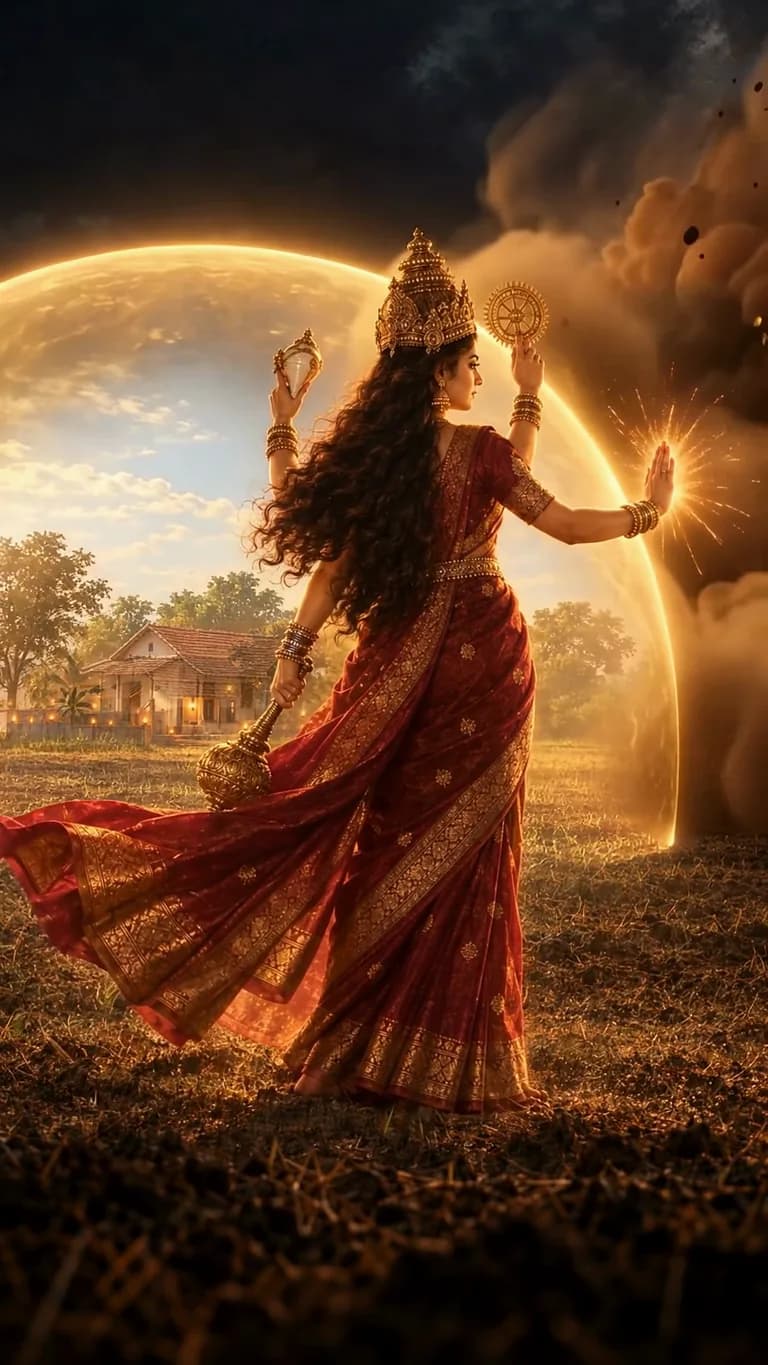
Seen from behind, Lakshmi in red silk raises her palm toward a wall of dust, a dome of golden light between it and a small farmhouse

Inside the reel · 90 seconds

One Picture for Every Line

The reel gives every sung line its own shot, and cuts on the line. A shaft of light lifts the discus for शङ्खचक्रगदाहस्ते. She rides Garuda out of the clouds for गरुडारूढे. For सर्वदुष्टभयङ्करि she stands between a wall of dust and a small farmhouse, with a dome of her own light between them, and for मन्त्रमूर्ते a yantra of light turns around her.

Each time the refrain comes round, the reel comes home to her, seated on a lotus, with a new world behind her each verse. The words are on screen as they are sung, in Devanagari, in transliteration and in English.

The first verse, once more · On a lake of lamps

नमस्तेऽस्तु महामाये
श्रीपीठे सुरपूजिते
शङ्खचक्रगदाहस्ते
महालक्ष्मि नमोऽस्तु ते

namaste’stu mahāmāye
śrīpīṭhe surapūjite
śaṅkhacakragadāhaste
mahālakṣmi namo’stu te

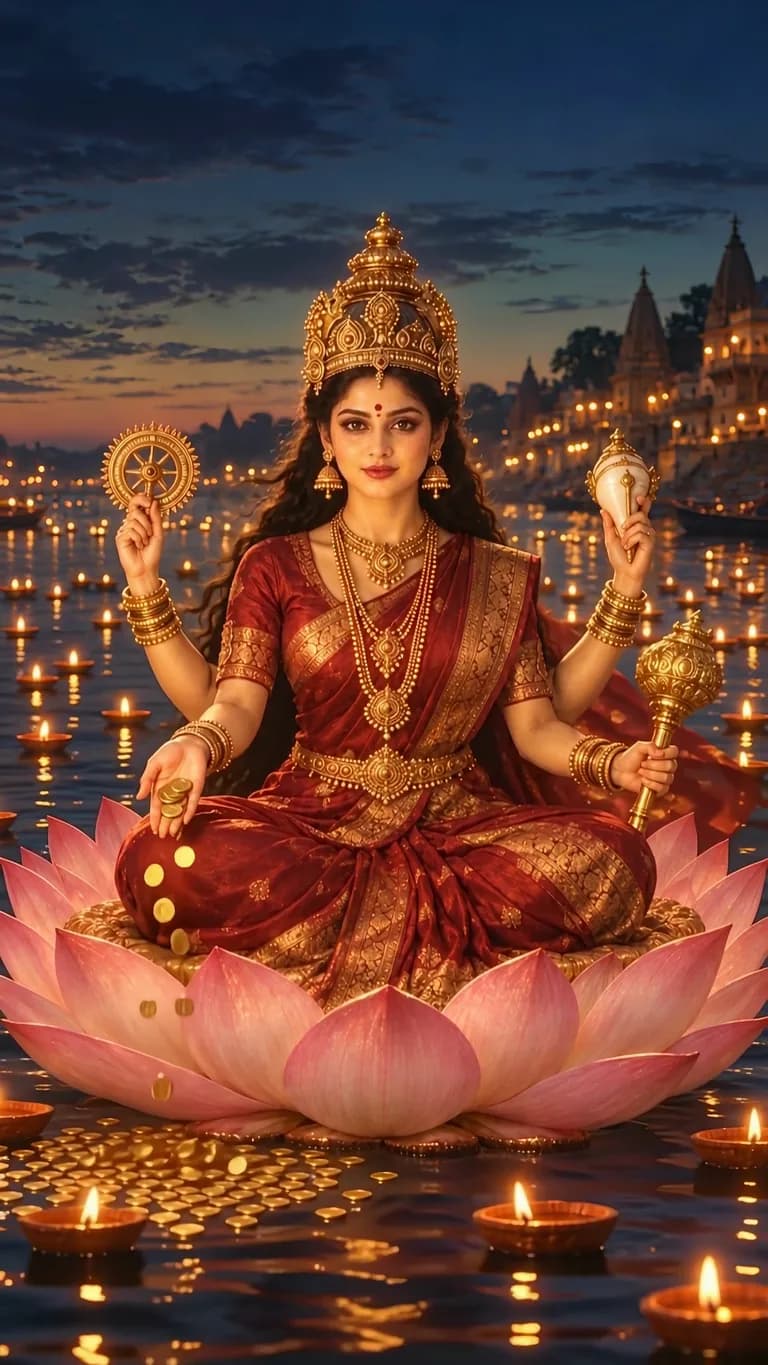
On the night of Diwali, homes are lit with rows of lamps. The reel sets her on a lotus on a lake of floating lamps, at dusk, with a riverside city lit behind her.

If you learn one verse for Lakshmi Puja this year, learn the first. It names her, seats her, puts the emblems in her hands, and bows. Then the fourth line, महालक्ष्मि नमोऽस्तु ते, is the one everyone in the room can sing with you.

At dusk, Lakshmi sits on a pink lotus on a lake covered with floating lamps, gold coins at her feet, a riverside city with temple spires lit behind her

In the hymn, the king of the gods has eight verses, and he spends every one of them bowing. This Diwali, send the hymn to someone whose home will hold a Lakshmi Puja.

Sing It
for Lakshmi Puja

The full Mahalakshmi Ashtakam, all eight verses, is free on Anukriti Radio, on the Prangan station. Anukriti walks you through each verse at your own pace, with line-by-line guidance that meets you where you are.

New reels from Anukriti on Instagram.
Follow @anukriti.ai

AnukritiDownload on the App Store
Download