Anukriti
लक्ष्मी पूजा

Lakshmi Puja Mantras for Diwali: Ganesha, Lakshmi, Kubera

The altar in a common order of worship for Diwali night, Sunday 8 November 2026: each verse from a named text, each name-mantra marked as the standard form, in Devanagari, transliteration and plain English

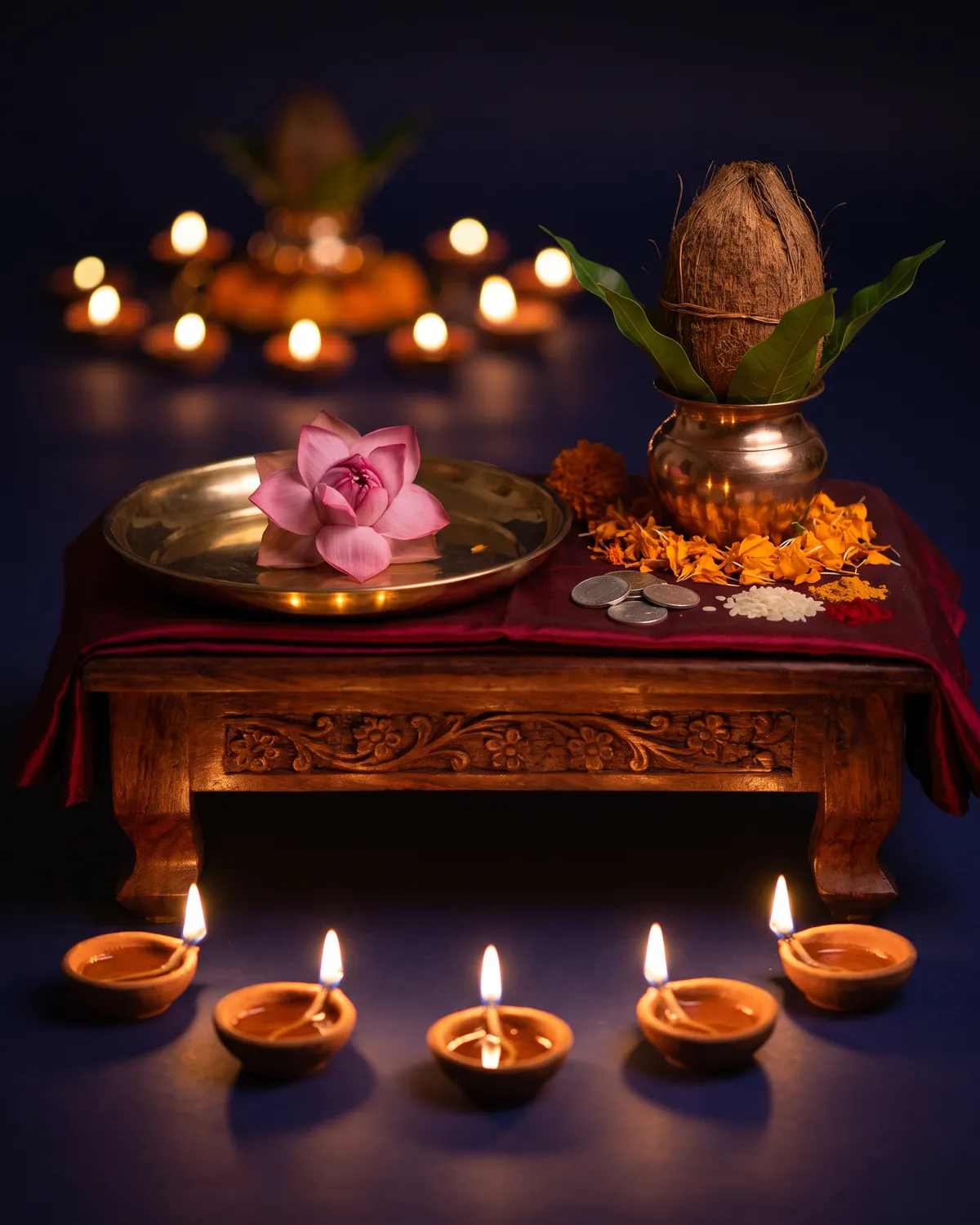
A Lakshmi Puja altar on Diwali night: a pink lotus on a brass plate on a carved wooden stand draped in red silk, a brass kalash with mango leaves and coconut, marigold, silver coins and rice, five clay lamps burning in front

The short answer

Diwali Lakshmi Puja is on Sunday, 8 November 2026, the new-moon evening of Kārttika. Dhanteras falls two days earlier, on Friday, 6 November.1,2

In Delhi the new moon’s tithi begins late on the morning of the 8th and runs past noon on the 9th, so the evening it covers is the 8th; panchangs computed for New York give the same evening.1,3 The puja is done after sunset, and the exact window changes from city to city. We do not print one here; look up your own city on a panchang. The mantras, in a common order of worship:

The core mantras of Diwali night
Ganeshaॐ गं गणपतये नमःoṃ gaṃ gaṇapataye namaḥGaṇapati Atharvaśīrṣa 76
Lakshmiॐ श्री महालक्ष्म्यै नमःoṃ śrī mahālakṣmyai namaḥName-mantra (standard form)
Kuberaराजाधिराजाय प्रसह्यसाहिनेrājādhirājāya prasahyasāhineTaittirīya Āraṇyaka 1.31.612
Saraswatiॐ सरस्वत्यै नमःoṃ sarasvatyai namaḥName-mantra (standard form)
The lampशुभं करोति कल्याणंśubhaṃ karoti kalyāṇaṃTraditional evening lamp verse16

By evening the house has been cleaned to the corners, because Lakshmi is said to visit the cleanest house first.5 A low stand by the wall is draped in red cloth. On it a lotus, a brass pot crowned with mango leaves and a coconut, a few coins, a heap of rice, and the account books if the family keeps any. Outside, the first lamps are already burning along the step.

What follows has a shape. Ganesha is honoured first, as he is at the start of everything. Then Lakshmi. Then Kubera, who keeps the treasury she fills. Saraswati is honoured in the ledgers and the ink. The evening closes with the āratī, the lamp waved before the goddess. Regions differ in the details, and many households add or leave out a deity,5 but this is a common order, and the one this page follows.

Every verse below is lifted from a named text. The short name-mantras for Lakshmi and Saraswati are the standard form, Om, the name and namaḥ, and belong to no single text; where a line has no single source, we say so.

01 · Gaṇapati Atharvaśīrṣa

Ganesha First

No puja begins anywhere else. Ganesha is worshipped at the opening of every auspicious act as Vighneśvara, the lord of obstacles,5 and on Diwali night his image sits on the altar beside Lakshmi’s. Before anything is asked of her, the way is cleared.

The Ganesha mantra

ॐ गं गणपतये नमः

oṃ gaṃ gaṇapataye namaḥ

Om. Gaṃ. Salutation to Gaṇapati, lord of the hosts.

The short mantra has a long pedigree. The Gaṇapati Atharvaśīrṣa does not simply state it: it builds it, sound by sound, and only then writes it out whole at the end of its seventh verse.6 The syllable gaṃ is a recipe. Take the first sound of gaṇa, g. Add the first of all the letters, a. Close with the nasal hum. Then crown it with the tāra, an old name for Om.7
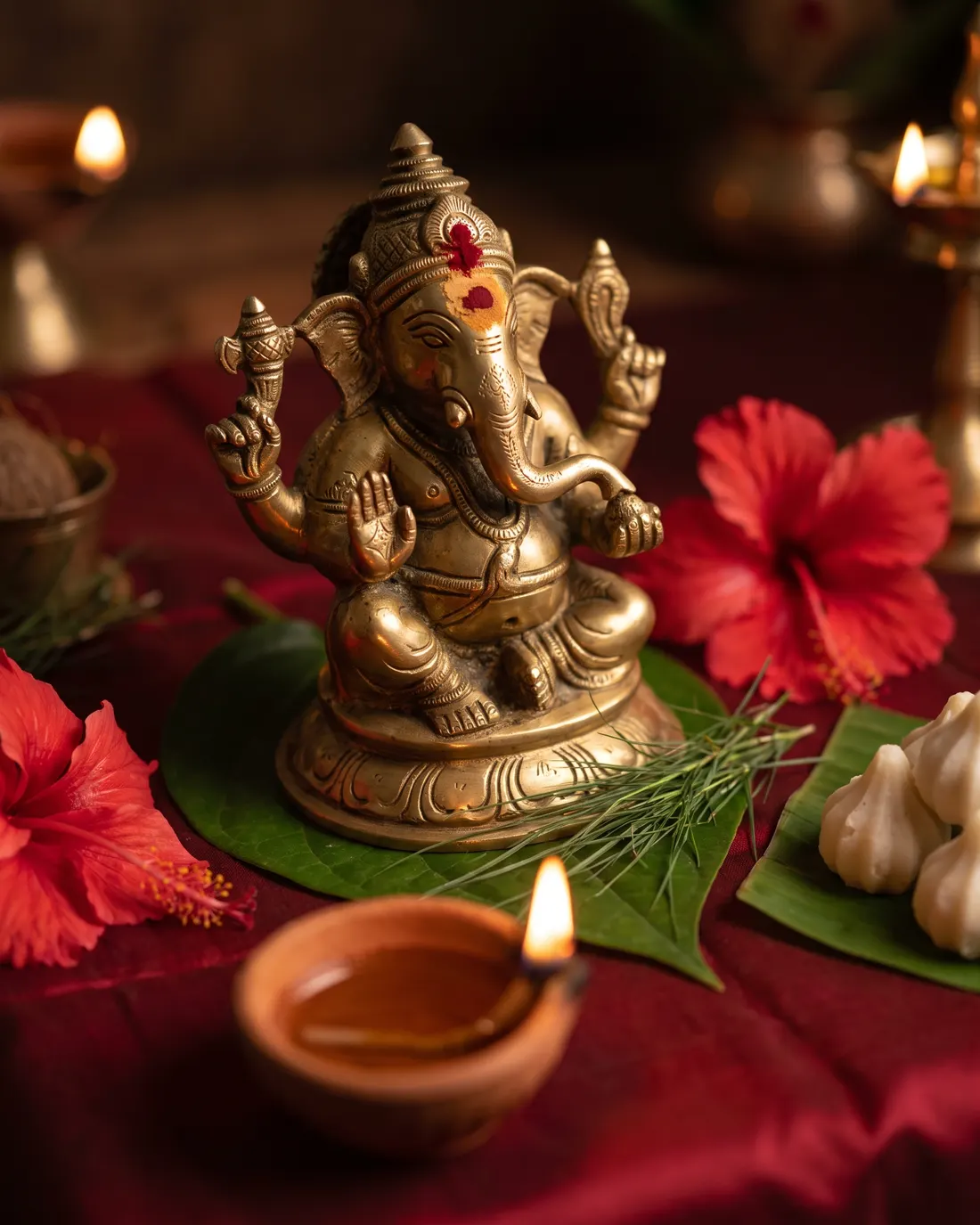
A small brass Ganesha seated on a betel leaf on red cloth, a lit clay lamp in front, red hibiscus, durva grass and modak sweets beside him

Gaṇapati Atharvaśīrṣa 7 · the Gaṇeśa mantra6

गणादिं पूर्वमुच्चार्य वर्णादिं तदनंतरम् ॥
अनुस्वारः परतरः ॥ अर्धेन्दुलसितम् ॥
तारेण ऋद्धम् ॥ एतत्तव मनुस्वरूपम् ॥

gaṇādiṃ pūrvam uccārya varṇādiṃ tadanantaram · anusvāraḥ parataraḥ · ardhendulasitam · tāreṇa ṛddham · etat tava manusvarūpam

First say the first sound of gaṇa, then the first of the letters. After it, the nasal hum, shining with the half-moon. Made full by the tāra. This is the form of your mantra.

The verse goes on to take the syllable apart, g as its first form, a its middle, the hum its last, and to name its seer, Gaṇaka, and its metre, before it ends on the words everyone knows: ॐ गं गणपतये नमः. The text calls the whole thing a vidyā, a piece of knowledge. It is, in effect, a pronunciation lesson.


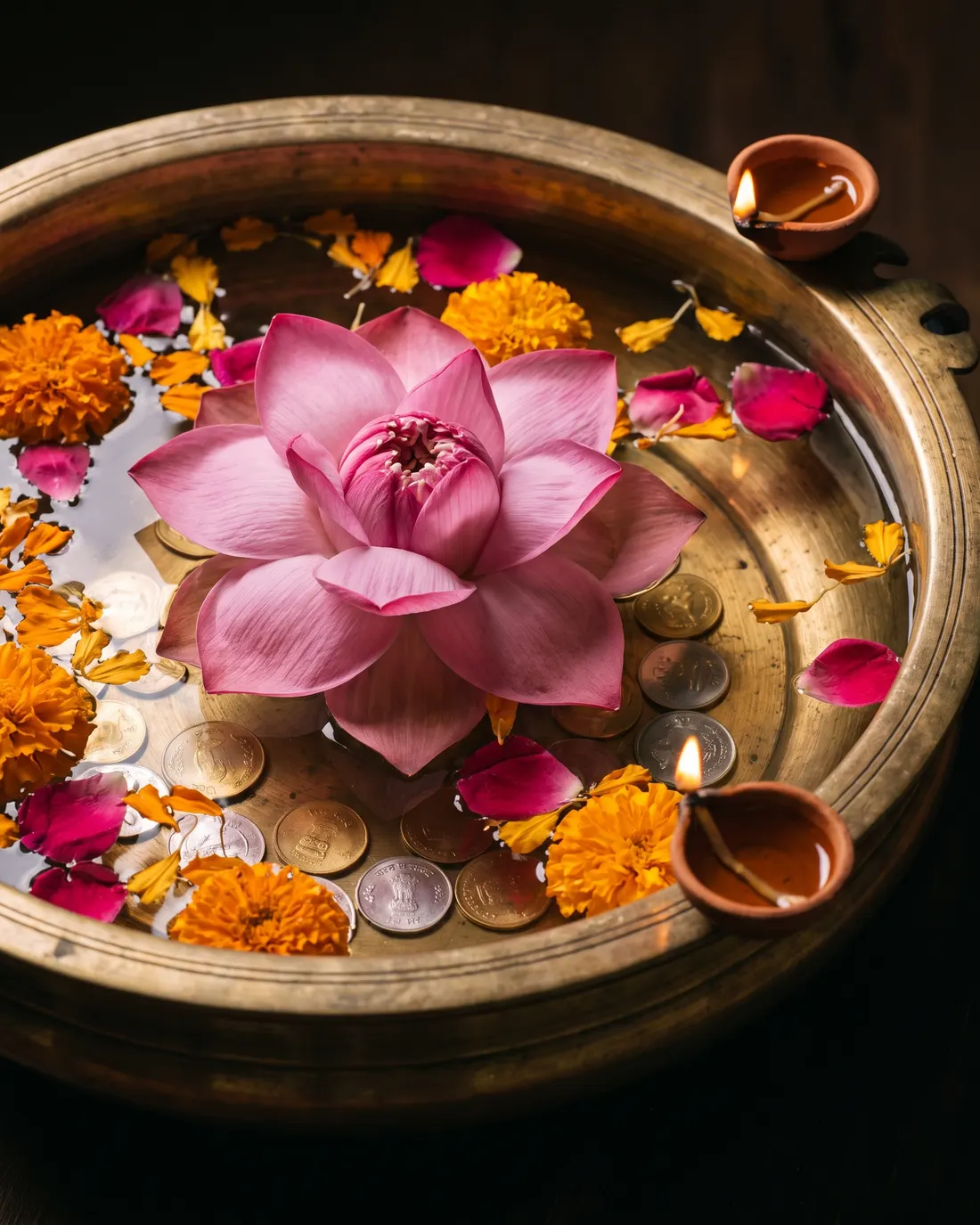
A pink lotus in full bloom floating in a wide brass urli of water, marigold and rose petals around it, coins on the bottom of the vessel, two clay lamps burning on the rim

02 · The goddess of the evening

Lakshmi

The plainest Lakshmi mantra is the one most families start with, and the one the soundtrack of this page opens on. It has four parts: Om; the honorific śrī; her name with the ending that means “to”; and namaḥ, “salutation.” It is the standard form of a name-mantra, not a line from any one text.

The name-mantra

ॐ श्री महालक्ष्म्यै नमः

oṃ śrī mahālakṣmyai namaḥ

Om. Salutation to the great Lakshmi.

For the oldest words addressed to her, families turn to the Śrī Sūktam, a hymn kept in the khilas, the appendices of the Ṛgveda, usually placed after its fifth book.8,9 Its first verse does something unexpected: it does not speak to Lakshmi at all. It speaks to the fire. Jātavedas is Agni, the knower of all that is born, and the verse asks him to bring her. On a night when every surface holds a flame, that is worth noticing.

In its fourth verse, the hymn calls her the one who stands in the lotus and has its colour, पद्मे स्थितां पद्मवर्णां.8 That is why the lotus sits at the centre of the altar. For the flower offering that ends so many pujas, see our guide to Pushpanjali and the sacred flowers.


Śrī Sūktam 1 · Ṛgveda khila8,9

हिरण्यवर्णां हरिणीं सुवर्णरजतस्रजाम् ।
चन्द्रां हिरण्मयीं लक्ष्मीं जातवेदो म आवह ॥

hiraṇyavarṇāṃ hariṇīṃ suvarṇarajatasrajām · candrāṃ hiraṇmayīṃ lakṣmīṃ jātavedo ma āvaha

Golden in colour, the doe, garlanded in gold and silver, radiant as the moon, made of gold: bring me that Lakshmi, O Jātavedas.

Hariṇī is a doe, and also the tawny one, the colour of a doe. Āvaha is a single verb: bring her here. The next verse asks for a Lakshmi who will not leave, anapagāminī, which is the whole hope of the evening in one word.


The hymn of eight verses

The other Lakshmi text heard most often on Diwali is the Mahālakṣmyaṣṭakam, eight verses and a closing promise. Its own colophon names the speaker: it is indrakṛtam, made by Indra.10 The first verse is the one most people know by heart.

Mahālakṣmyaṣṭakam 1 · Indra speaks10

नमस्तेऽस्तु महामाये श्रीपीठे सुरपूजिते ।
शङ्खचक्रगदाहस्ते महालक्ष्मि नमोऽस्तु ते ॥

namaste’stu mahāmāye śrīpīṭhe surapūjite · śaṅkhacakragadāhaste mahālakṣmi namo’stu te

Salutation to you, Mahāmāyā, seated on the throne of fortune, worshipped by the gods; conch, discus and mace in your hands: Mahālakṣmī, salutation to you.

Conch, discus and mace are Viṣṇu’s emblems, and here they are in her hands. The seventh verse returns to the lotus, पद्मासनस्थिते, seated on the lotus.10 In Telugu homes the same goddess is welcomed at Varalakshmi Vratam with a song of its own, which we translate in Raave Maa Intiki.

03 · Dhanteras and Diwali night

Kubera, Keeper of the Treasury

Lakshmi brings wealth. Kubera keeps it. He is Vaiśravaṇa, the son of Viśravas, treasurer of the gods, king of the yakṣas who guard the jewels of the earth.13 Two nights before Diwali, on Dhanteras, he is worshipped in his own right, on the thirteenth day of the dark fortnight;4 on Lakshmi Puja night many families mark the safe or the cash box as his place on the altar.5

His oldest mantra is Vedic. It sits in the Taittirīya Āraṇyaka,11 and it is familiar to far more people than know its source. It is the closing verse of the Mantra Puṣpam, the “flower of mantras” recited as flowers are offered,18 and it returns in the Mantrapuṣpāñjali sung at the end of āratī.12 If you have stood in a temple as the lamp was waved, you have probably heard it.

Taittirīya Āraṇyaka 1.31.611,12

राजाधिराजाय प्रसह्यसाहिने ।
नमो वयं वैश्रवणाय कुर्महे ।
स मे कामान्कामकामाय मह्यम् ।
कामेश्वरो वैश्रवणो ददातु ।
कुबेराय वैश्रवणाय । महाराजाय नमः ।

rājādhirājāya prasahyasāhine · namo vayaṃ vaiśravaṇāya kurmahe · sa me kāmān kāmakāmāya mahyam · kāmeśvaro vaiśravaṇo dadātu · kuberāya vaiśravaṇāya · mahārājāya namaḥ

To the king of kings, who overcomes by force, to Vaiśravaṇa, we offer our homage. May he, the lord of desires, grant me, who desire them, my desires. To Kubera Vaiśravaṇa, the great king, salutation.

The verse is candid about what it wants. It does not ask for detachment from wealth; it asks the lord of wishes for wishes, and it names him again and again: Vaiśravaṇa, Kāmeśvara, Kubera, the great king.

The popular Kubera line · a later formula

यक्षाय कुबेराय वैश्रवणाय

yakṣāya kuberāya vaiśravaṇāya

To the yakṣa, to Kubera, to Vaiśravaṇa.

These three names open the Kubera mantra printed on many Dhanteras posters, and they close the soundtrack of this page. The longer formula they begin, asking Kubera as lord of wealth and grain for abundance, is a later devotional line. We could not trace it to a single canonical text, so we give only the names here. The last two of them are exactly the words of the Vedic verse above.

04 · Chopda pujan

Saraswati in the Account Books

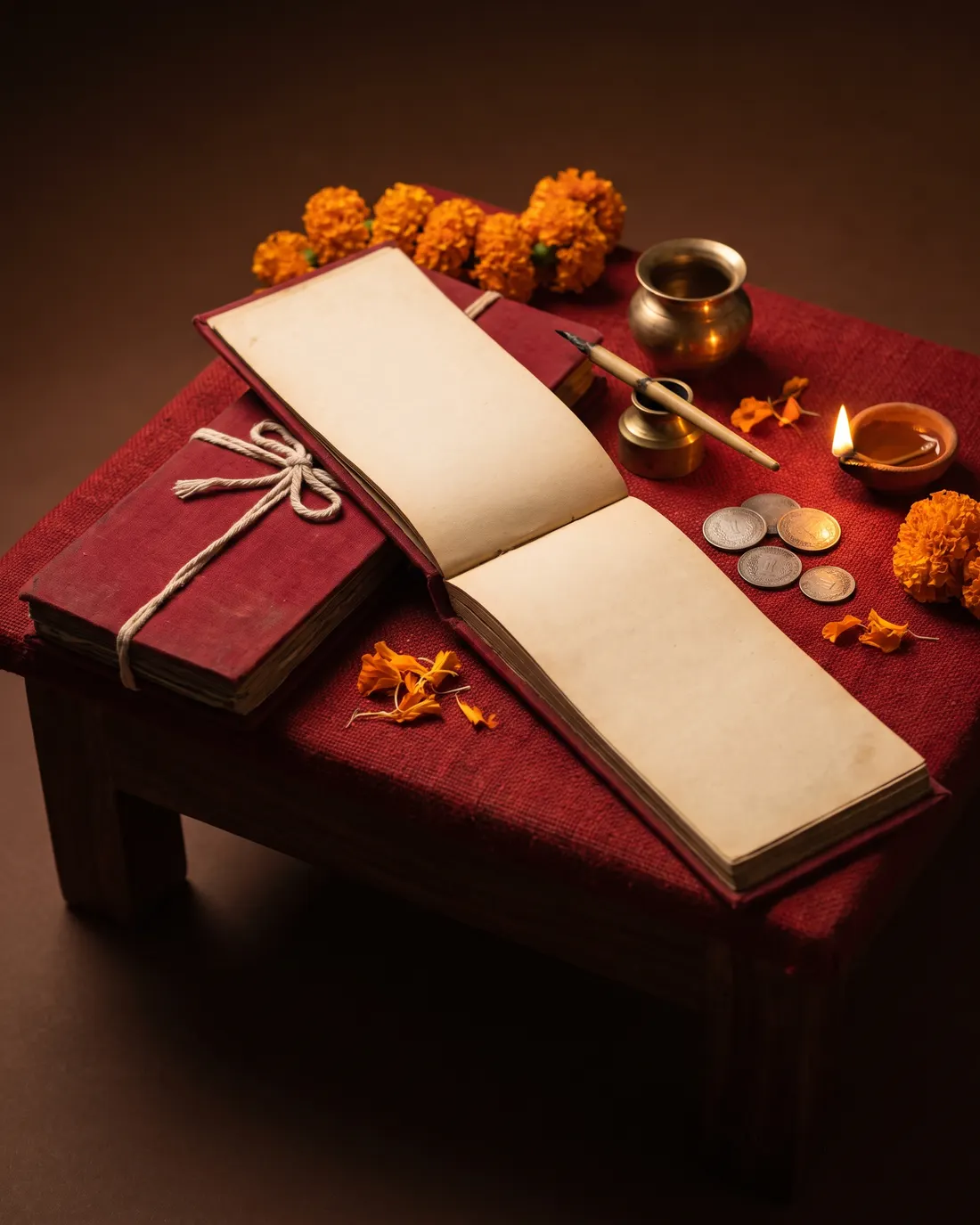
In trading families the altar holds one object no temple has: the ledgers. In Gujarat, where Diwali marks the turn of the year,14 new account books are opened and worshipped on Lakshmi Puja night. The rite is called chopda pujan, after the chopda, the bound ledger.15 Elsewhere, too, the account books sit on the altar with the ink beside it.5

Merchant families honour Saraswati that night, as well as Lakshmi and Kubera.14 The logic is plain once you see the desk. Lakshmi is the money; Kubera is the vault; Saraswati is the writing that keeps them honest. Her mantra is the same simple form as Lakshmi’s, Om and her name and salutation, said over the new books.

The Saraswati name-mantra

ॐ सरस्वत्यै नमः

oṃ sarasvatyai namaḥ

Om. Salutation to Saraswati.

Red cloth-bound merchant ledgers tied with cotton string, one open to blank cream pages, on a low desk with a brass inkpot, a reed pen, silver coins, marigolds and a lit clay lamp

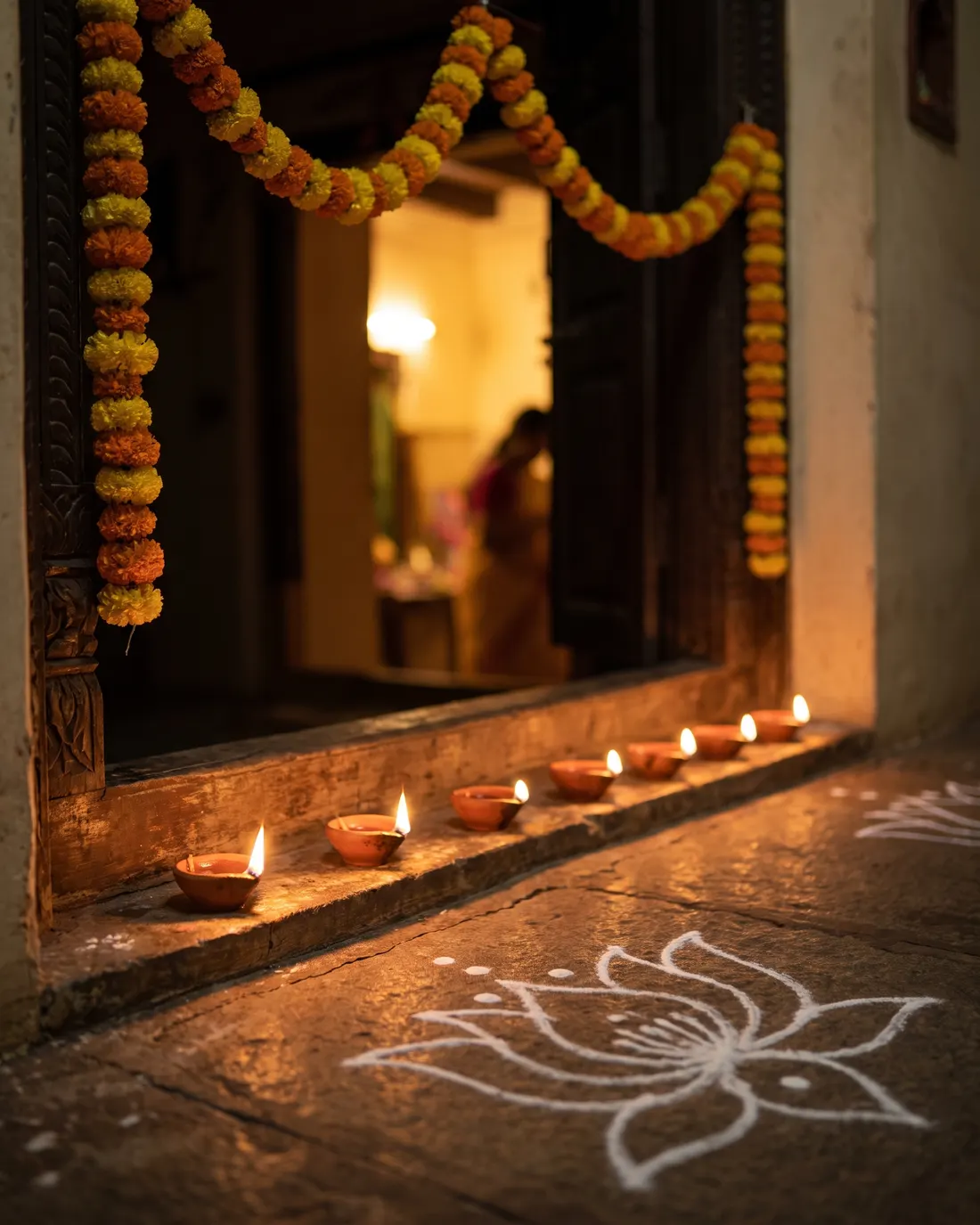
A row of clay lamps burning along the stone doorstep of a home on Diwali night, a rice-flour lotus kolam on the floor, a marigold garland across the open doorway

05 · Dīpa-jyoti

The Lamp

Every other act of the evening happens by lamplight, and the lamp has a verse of its own. Many children learn it early: the verse said at dusk, when the evening lamp is lit and looked at. It has no single scriptural home. It belongs to the household, and anthologies of daily verses keep it under the heading sandhyā dīpa darśana, seeing the lamp at twilight.16

The evening lamp verse16

शुभं करोति कल्याणं आरोग्यं धनसंपदः ।
शत्रुबुद्धिविनाशाय दीपज्योतिर्नमोऽस्तुते ॥

śubhaṃ karoti kalyāṇaṃ ārogyaṃ dhanasampadaḥ · śatrubuddhivināśāya dīpajyotir namo’stu te

It brings what is good and auspicious, health and wealth. To end the mind’s hostility: light of the lamp, I bow to you.

Many homes say dhanasampadā in the first line; the meaning does not change. Notice what the verse lists. Wealth is there, but it comes after health, and the last thing the light is asked to destroy is not poverty but enmity.

Lakshmi has a morning verse too, said on waking, looking into your own palms: Karāgre vasate Lakṣmīḥ, Lakshmi lives at the tips of the fingers. Between that verse at dawn and this one at dusk sits a whole day of practice; we write about keeping it in daily mantra practice.

At a glance

The Order of the Evening

A common sequence for Lakshmi Puja night. It describes the order only; for the timing in your city, use a panchang.1,5

  1. Light the lampThe lamps are lit at dusk, on the altar and along the threshold, with शुभं करोति कल्याणं.
  2. GaneshaRemover of obstacles, honoured first: ॐ गं गणपतये नमः.
  3. Lakshmiॐ श्री महालक्ष्म्यै नमः, then the Śrī Sūktam or the Mahālakṣmyaṣṭakam, with lotus, flowers and coins.
  4. KuberaKeeper of the treasury, at the safe or cash box: राजाधिराजाय प्रसह्यसाहिने.
  5. SaraswatiOver the ledgers and the ink: ॐ सरस्वत्यै नमः.
  6. ĀratīThe lamp is waved before Lakshmi, with a small bell, and the evening is complete.5

On Anukriti Radio · the soundtrack to this page

Mahalakshmi

The music under this page is Anukriti Radio’s Mahalakshmi. It is short and patient: an instrumental opening, then five names, each given room to settle before the next. It opens with Lakshmi rather than Ganesha, and between her and the rest of the altar it places one more name, Vāsudeva: Viṣṇu, whom, in one popular telling, she chooses as her husband on Diwali night.14,17

  • Lakshmiॐ श्री महालक्ष्म्यै नमःoṃ śrī mahālakṣmyai namaḥ
  • Viṣṇu as Vāsudevaॐ नमो भगवते वासुदेवायoṃ namo bhagavate vāsudevāya
  • Saraswatiॐ सरस्वत्यै नमःoṃ sarasvatyai namaḥ
  • Ganeshaॐ गं गणपतये नमःoṃ gaṃ gaṇapataye namaḥ
  • Kuberaयक्षाय कुबेराय वैश्रवणायyakṣāya kuberāya vaiśravaṇāya

Questions

Lakshmi Puja, Briefly

Which mantra is chanted for Lakshmi Puja on Diwali?

The simplest is the name-mantra ॐ श्री महालक्ष्म्यै नमः (oṃ śrī mahālakṣmyai namaḥ), “Om, salutation to the great Lakshmi,” the standard Om-name-namaḥ form rather than a line from one text. Many families add the first verse of the Śrī Sūktam from the Ṛgveda’s appendices, or the first verse of the Mahālakṣmyaṣṭakam. The puja opens with Ganesha, ॐ गं गणपतये नमः, and usually honours Kubera and Saraswati as well.

When is Lakshmi Puja in 2026?

Diwali Lakshmi Puja falls on Sunday, 8 November 2026, the new-moon evening of Kārttika. Dhanteras is two days earlier, on Friday, 6 November. The puja is performed in the evening after sunset; the exact window depends on your city, so check a panchang for your location.

What is the Kubera mantra for Dhanteras?

The oldest is a Vedic verse from the Taittirīya Āraṇyaka (1.31.6): राजाधिराजाय प्रसह्यसाहिने नमो वयं वैश्रवणाय कुर्महे, “To the king of kings, who overcomes by force, to Vaiśravaṇa, we offer our homage.” It is the closing verse of the Mantra Puṣpam, recited as flowers are offered at the end of many pujas. The popular line beginning yakṣāya kuberāya vaiśravaṇāya is a later devotional formula; we could not trace it to a single canonical text, so this page gives only its opening names.

What does the first verse of the Shri Suktam mean?

हिरण्यवर्णां हरिणीं सुवर्णरजतस्रजाम् । चन्द्रां हिरण्मयीं लक्ष्मीं जातवेदो म आवह — “Golden in colour, the doe, garlanded in gold and silver, radiant as the moon, made of gold: bring me that Lakshmi, O Jātavedas.” Jātavedas is Agni, the fire; the verse asks the fire to bring her.

What is the meaning of the Mahalakshmi Ashtakam’s first verse?

नमस्तेऽस्तु महामाये श्रीपीठे सुरपूजिते । शङ्खचक्रगदाहस्ते महालक्ष्मि नमोऽस्तु ते — “Salutation to you, Mahāmāyā, seated on the throne of fortune, worshipped by the gods; conch, discus and mace in your hands: Mahālakṣmī, salutation to you.” The hymn names Indra as its speaker.

The coins go back in the box, the ledgers are put away with their first page blessed, and the lamps on the step burn down one by one. What stays is the sound of the evening: a few syllables, said in order, the way they have been said in that house for longer than anyone remembers.

Sources

  1. Drik Panchang, 2026 Diwali Puja: Lakshmi Puja timings for New Delhi (Sunday, 8 November 2026; Amāvasyā tithi 11:27 AM, 8 Nov to 12:31 PM, 9 Nov; Pradosh Kāla 5:31–8:09 PM).
  2. Prokerala, Diwali 2026: the five days (Dhanteras 6 Nov; Lakshmi Pūjā 8 Nov; Amāvasyā 11:28 AM, 8 Nov to 12:32 PM, 9 Nov).
  3. Drik Panchang, 2026 Lakshmi Puja timings for Manhattan, New York (also Sunday, 8 November 2026).
  4. Drik Panchang, 2026 Dhantrayodashi: Dhanteras Puja timings for New Delhi (Friday, 6 November 2026; Kubera worshipped on Trayodaśī).
  5. Lakshmi Puja: the Diwali procedure (Ganesha worshipped first as Vighneśvara; account books and ink on the altar; Kubera; the lamp; the closing āratī). Wikipedia.
  6. Śrī Gaṇapatyatharvaśīrṣa, verse 7 (the Gaṇeśa mantra). Sanskrit Documents.
  7. Monier-Williams, A Sanskrit-English Dictionary, s.v. tāra: “a mystical monosyllable (as om)”. Cologne Digital Sanskrit Dictionaries.
  8. Śrī Sūkta (Ṛgveda), verses 1–15. Sanskrit Documents.
  9. Sri Suktam: a khila (appendix) of the Ṛgveda, found in the Bāṣkala śākhā and usually appended to the fifth maṇḍala. Wikipedia.
  10. Mahālakṣmyaṣṭakam, “indrakṛtam” (spoken by Indra), with English translation. Sanskrit Documents.
  11. Taittirīya Āraṇyaka, Prapāṭhaka 1 (Aruṇa Praśna), the Vaiśravaṇa verse. Sanskrit Documents.
  12. Mantrapushpanjali: verse 2 (rājādhirājāya … namaḥ) is Taittirīya Āraṇyaka 1.31.6, citing R. Mitra, ed., The Taittiriya Aranyaka of the Black Yajur Veda with the Commentary of Sayanacharya (Calcutta, 1872), p. 187. Wikipedia.
  13. Kubera: Vaiśravaṇa, son of Viśravas; treasurer of the gods; Rājarāja, Dhanādhipati; Kāmeśvara. Wikipedia.
  14. Diwali: Lakshmi and Ganesha; merchant families also pray to Saraswati and to Kubera, “who symbolises book-keeping, treasury and wealth management”; Diwali as new year in Gujarat; the night Lakshmi chooses Viṣṇu. Wikipedia.
  15. Chopda Pujan 2026: new account books opened and worshipped on Diwali by the mercantile community. mPanchang.
  16. Nitya Pārāyaṇa Ślokāḥ: sandhyā dīpa darśana ślokaḥ (the evening lamp verses). Vaidika Vignanam.
  17. Om Namo Bhagavate Vāsudevāya: the twelve-syllable (dvādaśākṣarī) mantra of Viṣṇu. Wikipedia.
  18. Mantrapuṣpam (Taittirīya Āraṇyaka, Prapāṭhaka 1), closing with the Vaiśravaṇa verse. Sanskrit Documents.

Chant Them with
Confidence This Diwali

Anukriti listens as you chant and offers expert-level feedback, so every syllable of गं, श्री and वैश्रवणाय lands the way the tradition intends.

The soundtrack, Mahalakshmi, plays on Anukriti Radio.
Follow @anukriti.ai

AnukritiDownload on the App Store
Download