Anukriti

दृष्टा सीता

Drishta Sita Meaning: The Word That Comes Home

दृष्टा सीता (dṛṣṭā sītā) means “Sita has been seen.” It is the refrain of the Sundara Kanda, the fifth book of the Valmiki Ramayana, and the chorus of every part of Anukriti’s seven-part Sundara Kanda series. Part VII, the return, covers the book’s last twelve sargas, 57 to 68: Hanuman carries the word back across the ocean, Rama hears it, and the book ends on one line about Sita. She found peace.

Sundara Kanda, Part VII · Sargas 57–68 · The last part of the series

Sundara Kanda · Part VII · The Return

By the time Hanuman reaches Rama, Rama already knows. The news has been travelling for seven sargas. Hanuman’s roar over Mount Mahendra reaches the vanaras before he lands, and Jambavan reads it: the roar of one who had failed would not sound like this (5.57.23). On landing, Hanuman tells them in two words, दृष्टा देवीति, “seen, the Devi” (5.57.35). The vanaras celebrate by wrecking Sugriva’s honey-grove, and the wrecked grove tells Sugriva. Sugriva tells Rama to take heart: the Devi is seen, there is no doubt (5.64.24).

Then Hanuman arrives on Mount Prasravana, bows his head to the ground, and says it again. Valmiki gives this telling a word he gave none of the others: अमृतोपमम् (amṛtopamam), “like nectar.” The news is the same. The voice is not. Part VII is about why the second telling lands harder than the first.

Part I of Anukriti’s series opened on Hanuman’s report, sung at second zero. Part VII carries that one word, दृष्टा, “seen”, to the end of the book: across the ocean, into Rama’s hands as a jewel, and finally into Rama’s own mouth.


Sundara Kanda 5.64.37 · Valmiki Ramayana

दृष्टा देवीति हनुमद्वदनादमृतोपमम्
आकर्ण्य वचनं रामो हर्षमाप सलक्ष्मणः

dṛṣṭā devīti hanumad-vadanād amṛtopamam
ākarṇya vacanaṁ rāmo harṣam āpa sa-lakṣmaṇaḥ

“Seen, the Devi”: hearing those words from Hanuman’s mouth, like nectar, Rama rejoiced, with Lakshmana.

The इति (iti) fused onto देवी is the quotative particle. It works like quotation marks: the verse quotes Hanuman’s two words exactly, then tells you what they did to the man who heard them. The source of the nectar is named too: हनुमद्वदनात्, from Hanuman’s mouth.


The news travels · Sundara Kanda, sargas 57–64

Told Before It Is Told

Count the carriers. A roar, read by Jambavan. Hanuman’s two words to the vanaras. Angada’s three exclamations: aho for his devotion to the master, aho for his valour, aho for his resolve (5.57.46). Then Madhuvana, the honey-grove, where the vanaras sing, bow, dance, laugh, fall, wander, leap and babble (5.61.14), until its keeper runs to complain.

Sugriva hears the complaint and understands it at once. He turns to Lakshmana: दृष्टा सीता, “Sita has been seen, son of Sumitra; see how they all drink the honey” (5.63.22). It is the only verse in the book that says दृष्टा सीता word for word, and the speaker is not Hanuman. It is a king reading a wrecked garden.

So the news reaches Rama secondhand, through Sugriva. Then Hanuman kneels before him, reports her steadfast and unharmed (5.64.36), and Rama hears it as nectar. The poem has already delivered the information over and over. It keeps its strongest word for the telling done face to face, by the one who saw her.
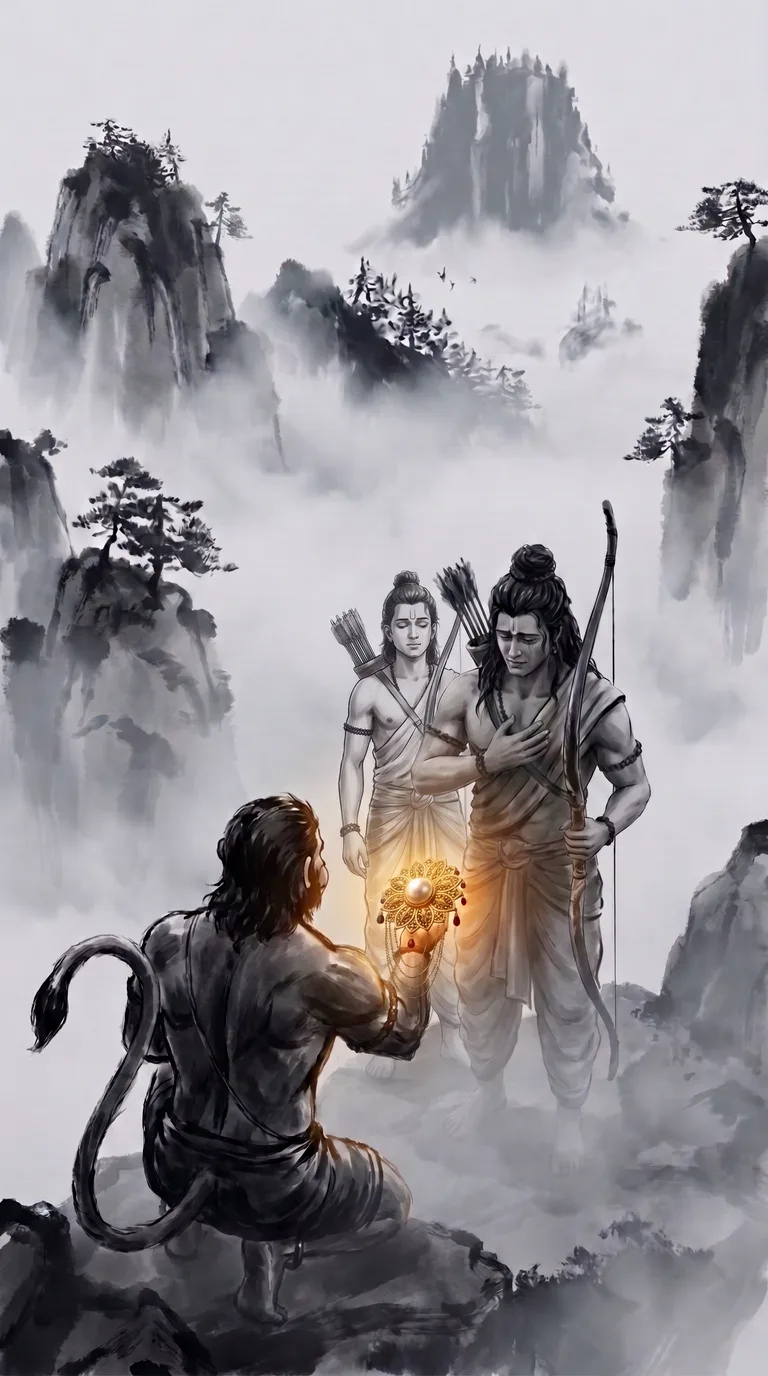
Grey ink-wash: Hanuman kneeling on a misty ledge, holding up the glowing gold crest-jewel to Rama and Lakshmana

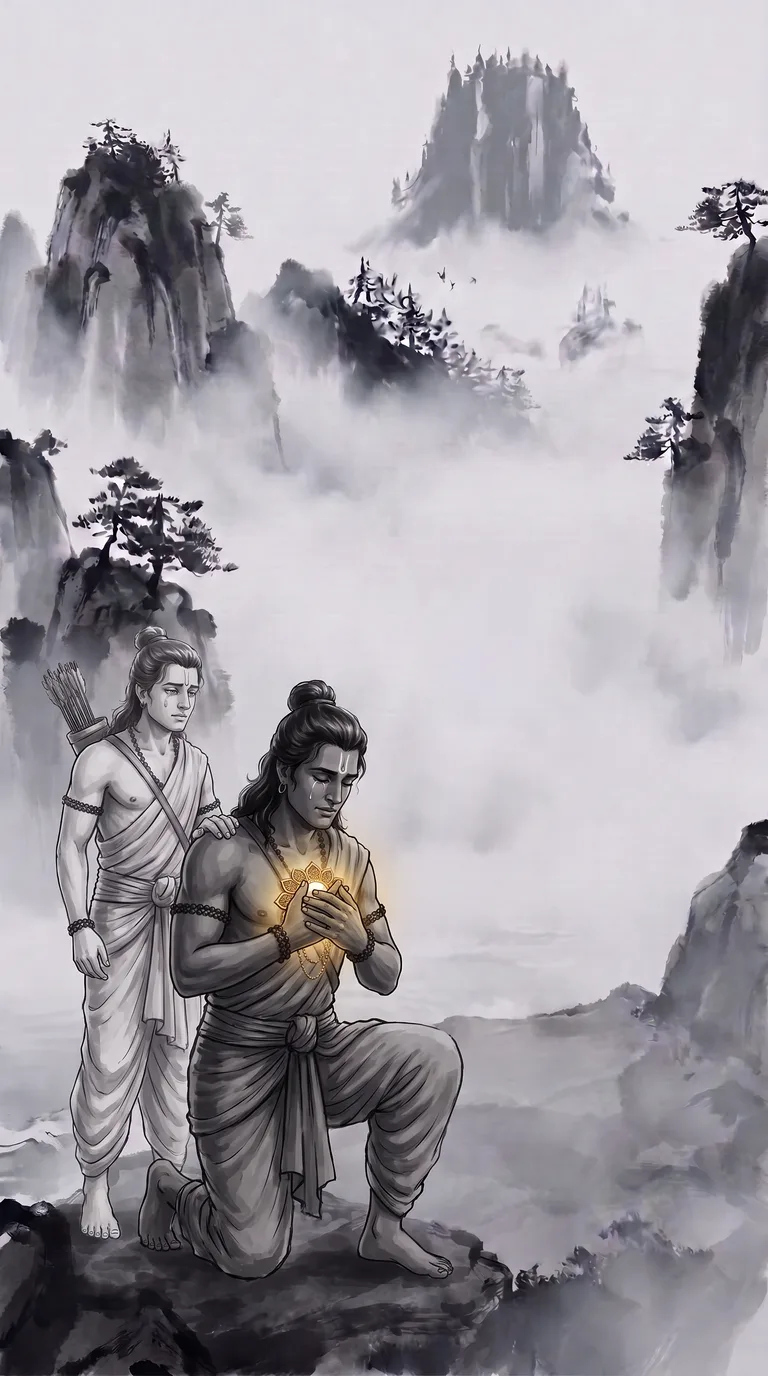
Grey ink-wash: Rama kneeling on the ledge with the gold lotus crest-jewel pressed to his heart, Lakshmana standing behind him

The chudamani · Sundara Kanda, sarga 66

The Jewel at His Heart

Hanuman hands Rama the chudamani, the crest-jewel Sita untied from a knot in her garment in Part IV: a gold filigree lotus with a pearl. Rama places it on his heart and weeps, and Lakshmana weeps with him (5.66.1). Then the prince of Ayodhya reaches for the least heroic image in the book.

Sundara Kanda 5.66.3

यथैव धेनुः स्रवति स्नेहाद्वत्सस्य वत्सला
तथा ममापि हृदयं मणिरत्नस्य दर्शनात्

yathaiva dhenuḥ sravati snehād vatsasya vatsalā
tathā mamāpi hṛdayaṁ maṇi-ratnasya darśanāt

As a loving cow lets down her milk out of love for her calf, so does my heart at the sight of this jewel.

It is a bodily, helpless simile. Milk is not chosen; it comes. Rama is not describing a decision. He is describing what one small ornament does to him, and he says it in front of his brother.


Sundara Kanda 5.65.24 · Sita’s message, carried by Hanuman

जीवितं धारयिष्यामि मासं दशरथात्मज
ऊर्ध्वं मासान्न जीवेयं रक्षसां वशमागता

jīvitaṁ dhārayiṣyāmi māsaṁ daśarathātmaja
ūrdhvaṁ māsān na jīveyaṁ rakṣasāṁ vaśam āgatā

I will hold on to my life for a month, son of Dasharatha. Beyond a month I will not live, in the rakshasas’ power.

Sundara Kanda 5.66.10 · Rama’s answer

चिरं जीवति वैदेही यदि मासं धरिष्यति
क्षणं सौम्य न जीवेयं विना तामसितेक्षणाम्

ciraṁ jīvati vaidehī yadi māsaṁ dhariṣyati
kṣaṇaṁ saumya na jīveyaṁ vinā tām asitekṣaṇām

Vaidehi lives long if she can hold on a month. I could not live a moment, gentle one, without the dark-eyed one.

Sita measures what she can bear in months: one, and no more. Rama measures it in moments, and cannot bear one. Valmiki sets the two numbers a sarga apart, her month in Hanuman’s mouth and his moment in Rama’s, and the whole separation fits between them.


Take me to the place · Sundara Kanda 5.66.11

The Word Changes Hands

Then Rama asks for something. Not an army, not a plan of attack. He asks to be taken to a place, and he names the place with Hanuman’s word.

Sundara Kanda 5.66.11

नय मामपि तं देशं यत्र दृष्टा मम प्रिया
न तिष्ठेयं क्षणमपि प्रवृत्तिमुपलभ्य च

naya mām api taṁ deśaṁ yatra dṛṣṭā mama priyā
na tiṣṭheyaṁ kṣaṇam api pravṛttim upalabhya ca

Take me too to the place where my beloved was seen. Now that I have word of her, I cannot stay a moment.

यत्र दृष्टा मम प्रिया: “where my beloved was seen.” Part I gave दृष्टा to Hanuman, as a report. Six parts later it comes back as a request, and within this series it is the first time the word is Rama’s. He does not ask for Lanka by name. He asks for the spot where someone saw her.

प्रवृत्ति (pravṛtti) in the second line means news, word of someone. Rama has the news now, and that is exactly why he cannot stay. Without word of her, he could wait. With it, a moment is too long.

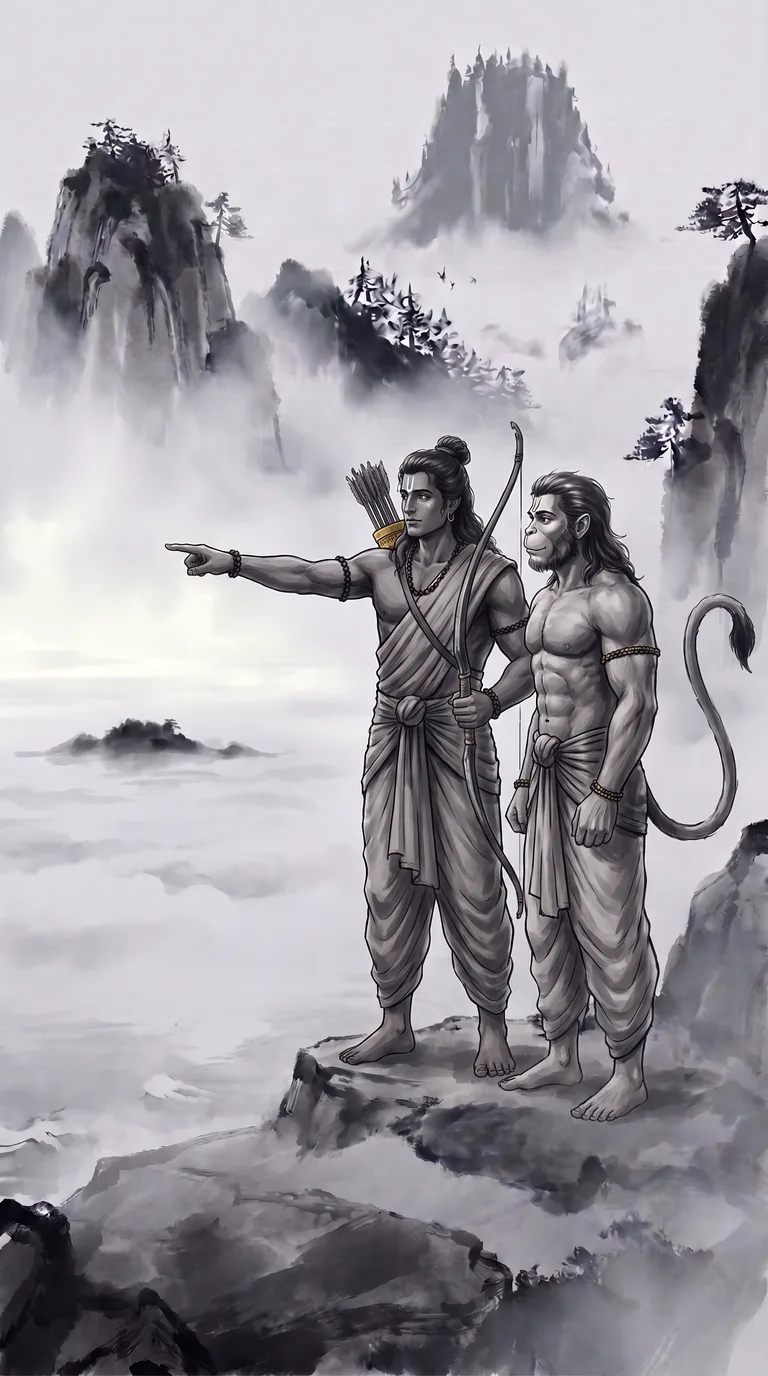
Grey ink-wash: Rama on a mountain ledge pointing south over a sea of mist, Hanuman standing beside him

Questions on Part VII

What does दृष्टा सीता (drishta sita) mean?

“Sita has been seen.” दृष्टा is the past participle of the verb दृश्, to see, in the feminine to agree with Sita. In the chorus, दृष्टा सीतेति विक्रान्तः संक्षेपेण न्यवेदयत्, the इति marks the words as quoted speech: “Sita has been seen,” the valiant one reported in brief.

Who says “drishta sita” in the Sundara Kanda?

Hanuman, on landing, says it to Jambavan, Angada and the vanaras, as दृष्टा देवीति, “seen, the Devi” (5.57.35). He says it to Rama later, on Mount Prasravana (5.64.37). The exact words दृष्टा सीता appear once, in Sugriva’s mouth, speaking to Lakshmana (5.63.22). The popular chorus sings दृष्टा सीतेति. The telling in which Hanuman’s first word to Rama is “seen”, so that Rama does not doubt for a moment, is Kamban’s, from his Tamil Ramayanam (கண்டனென், “I saw”), not Valmiki’s.

What is the last verse of the Sundara Kanda?

Sundara Kanda 5.68.29. Hanuman tells Rama that his kind, auspicious words comforted Sita, “who never speaks in despair”, and that she found peace (जगाम शान्तिं), though pained by grief for Rama. The book ends on her peace, not on a war cry. The march to Lanka belongs to the next book, the Yuddha Kanda.

Where does Hanuman give Rama the chudamani?

On Mount Prasravana, in the Kishkindha country, where Rama and Lakshmana are waiting with Sugriva. Hanuman bows his head to the ground, reports Sita steadfast and unharmed (5.64.36), and hands over the crest-jewel she untied from her garment. Rama places it on his heart and weeps (5.66.1). The chudamani is a gold filigree lotus with a pearl.

Which sargas does Part VII cover?

Sargas 57 to 68, the last twelve of the Sundara Kanda: the return. In a seven-day (sapta-ahnika) parayana of the book, they fall on the seventh day, the day the reading ends.


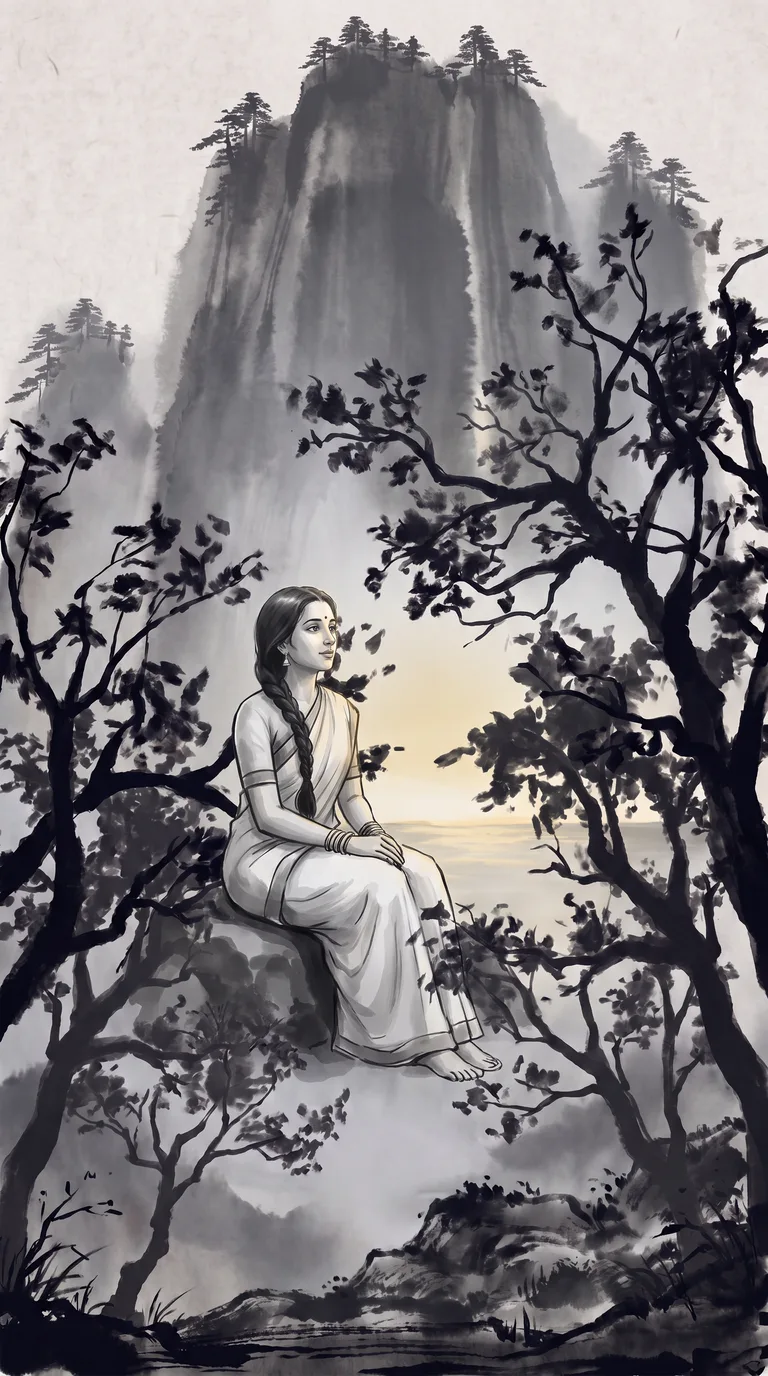
Grey ink-wash: Sita seated beneath dark branches by the water, the first warm light of dawn on the sea behind her

Inside the reel · Part VII of VII

Back to the Ink

Part VII’s reel returns to Part I’s world: grey ink treated as three-dimensional space, mist for depth, the same pine-topped peaks. Most shots answer a frame from Part I, so the series closes on its own opening images. Gold is the only colour, and it belongs to the jewel.

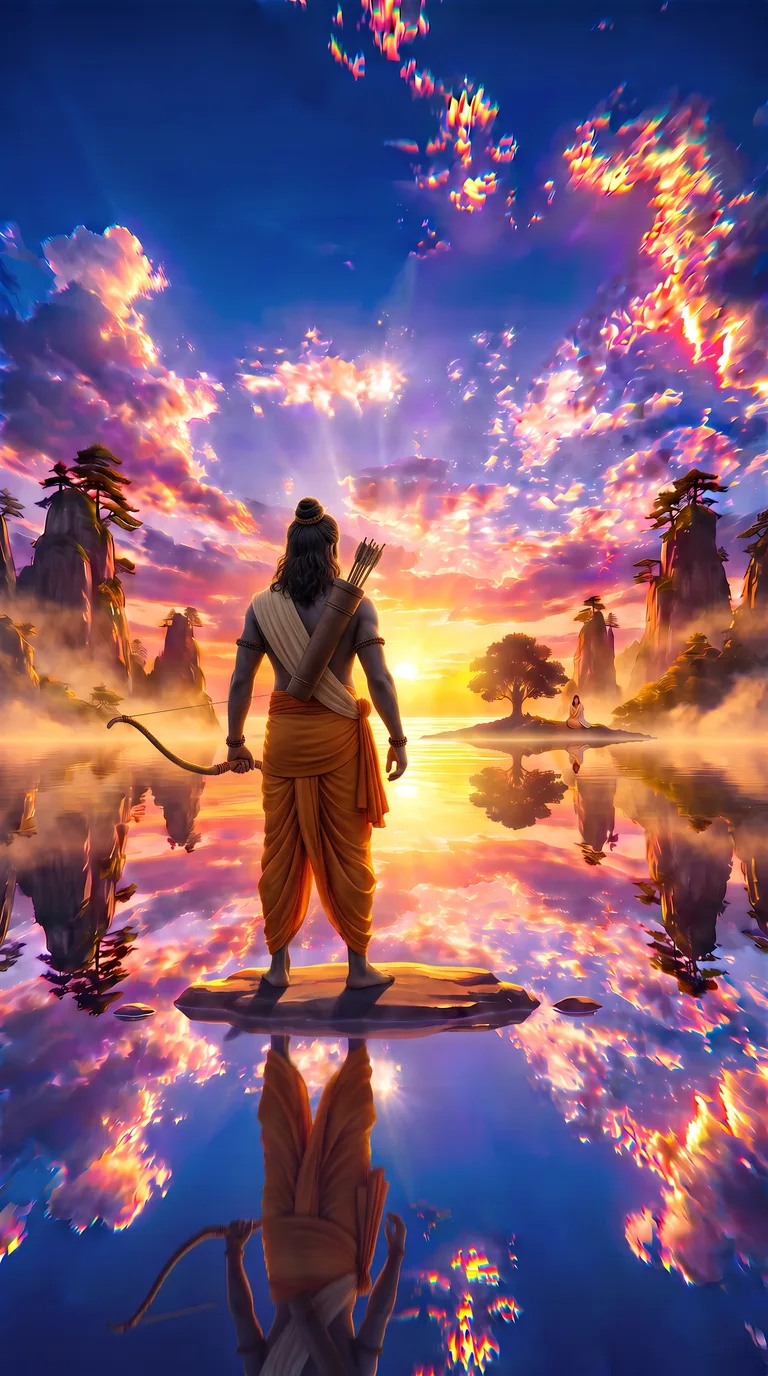
The sung order follows Rama’s side of the story: the chorus over the roar and the report, the cow and her calf, Sita’s month, Rama’s moment, take me to the place, Hanuman’s promise that she will see Rama crowned in Ayodhya (5.68.28), and the book’s last verse. On जगाम शान्तिं, at 1:16, the ink gives way. By 1:22 the world is in full colour, a sunrise over the sea. Every earlier part kept to a narrow palette: ink, indigo, ash, copper, gilt fire. This is the first time the series opens to the full spectrum.

The reel leaves out the roar, Jambavan, Angada, Madhuvana, Sugriva and the nectar line. The full-length song in the app carries them in five and a half minutes, and closes on the traditional verse यत्र यत्र रघुनाथकीर्तनं: wherever Rama’s story is sung, Hanuman is there.

Chorus, sung in every part of the series

दृष्टा सीता दृष्टा सीता
दृष्टा सीतेति विक्रान्तः
संक्षेपेण न्यवेदयत्

dṛṣṭā sītā, dṛṣṭā sītā
dṛṣṭā sīteti vikrāntaḥ
saṁkṣepeṇa nyavedayat

Sita has been seen, Sita has been seen: the valiant one reported it in brief.

Sundara Kanda 5.68.29 · The last verse of the book

ततो मया वाग्भिरदीनभाषिणी
शिवाभिरिष्टाभिरभिप्रसादिता
जगाम शान्तिं मम मैथिलात्मजा
तवापि शोकेन तथाभिपीडिता

tato mayā vāgbhir adīna-bhāṣiṇī
śivābhir iṣṭābhir abhiprasāditā
jagāma śāntiṁ mama maithilātmajā
tavāpi śokena tathābhipīḍitā

Comforted by my kind, auspicious words, Maithili, who never speaks in despair, found peace, though so pained by grief for you.

After sixty-eight sargas of search, fear, fire and flight, the last thing the book reports is that she was calm. अदीनभाषिणी (adīna-bhāṣiṇī), “one who does not speak in despair”, is Valmiki’s last word for Sita, and it describes how she talks. जगाम means “went”: she went to peace, as if it were a place. Some manuscripts read उवाह शान्तिं, “she carried peace.”

Full colour: Rama with his bow standing on a rock at the water's edge, facing a sunrise over a still sea that mirrors the clouds and peaks

Part I began with a word sung at second zero and a leap in grey ink. Part VII brings the word home, puts it in Rama’s mouth, and lets the book end on her peace. Seven parts, one word, carried across the ocean and back: दृष्टा. Seen. To close the circle, go back to Part I, the reel that opens the Sundara Kanda guide.

Where She
Was Seen

Anukriti walks you through each verse at your own pace, with line-by-line guidance that meets you where you are.

Released on 11 October 2026 as Part VII, the last part of Anukriti’s Sundara Kanda reel series.
Follow @anukriti.ai

AnukritiDownload on the App Store
Download