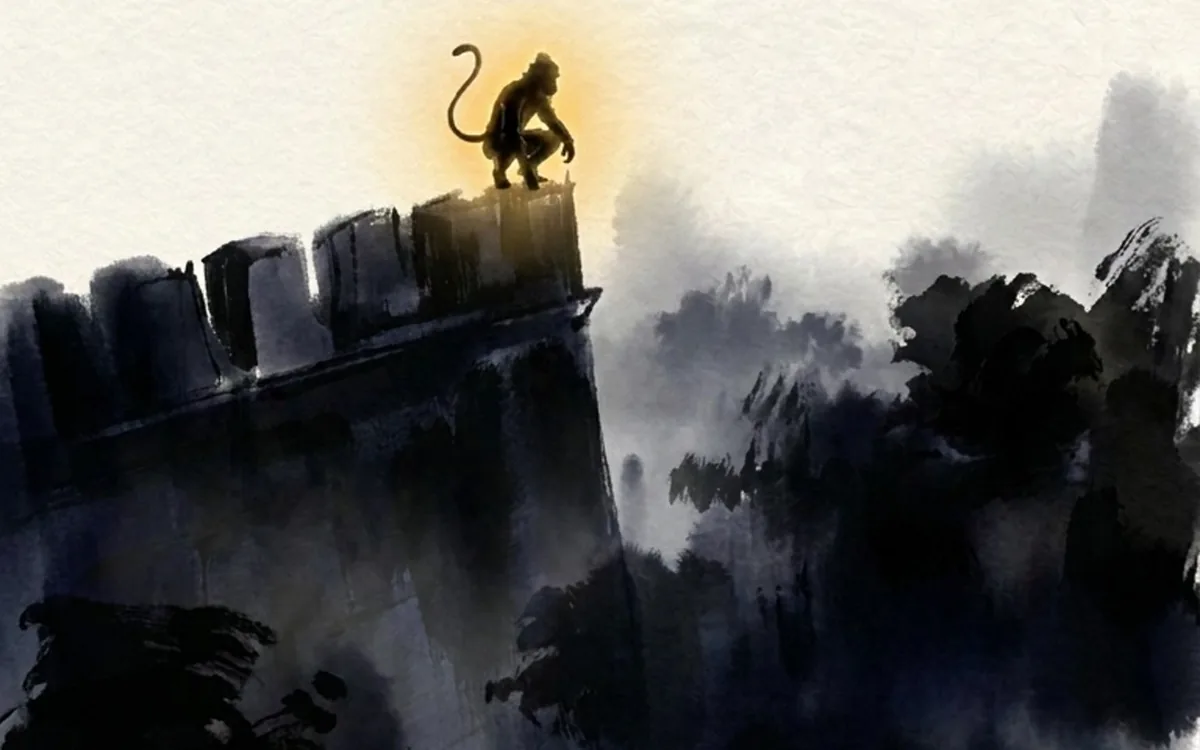
The Sundara Kanda (सुन्दरकाण्ड, “the beautiful book”) is the fifth of the seven books of the Valmiki Ramayana. In the commonly recited text it runs to 68 sargas (chapters), and it tells one continuous story: Hanuman’s leap across the ocean to Lanka, his search for Sita, their meeting in the Ashoka grove, and his return to Rama with her message.
Book 5 of 7 · 68 sargas · Hanuman, Sita, Ravana
It is the one book of the Ramayana most often read on its own. A full recitation, a parayana, is traditionally taken up in hard seasons — an illness, an exam, a long wait — because the whole book is the story of a search that does not give up. Why “beautiful”? The tradition answers with a verse recited at the close of a reading: everything in it is beautiful — Rama, Sita, the grove, the telling itself.
Below, the book is grouped into its ten story arcs. Each arc gives its sarga range, what happens in it, and, where the text is well attested, one verse in Devanagari with transliteration. Two arcs have their own long-form pages in Anukriti’s Sundara Kanda series.
Sarga and verse numbers follow the widely printed southern recension text (the Gita Press, Gorakhpur numbering, 68 sargas). The Baroda critical edition has fewer sargas and numbers many chapters and verses differently, so ranges here are approximate outside that text.
01Sarga 1
The leap
The book opens with Hanuman on Mount Mahendra, gathering himself to cross a hundred yojanas of ocean in one bound. On the way he is tested three times — by the mountain Mainaka, who rises from the sea to offer him rest; by Surasa, mother of serpents, who demands to swallow him; and by Simhika, who seizes his shadow — and he lands on the far shore near the Trikuta hills, outside Lanka.
tato rāvaṇa-nītāyāḥ sītāyāḥ śatru-karśanaḥ iyeṣa padam anveṣṭuṁ cāraṇācarite pathi
Then the subduer of enemies resolved to seek out the trace of Sita, carried off by Ravana, along the sky-path the Charanas travel.
02Sargas 2–13
Into Lanka, and the night search
Hanuman studies the walled city, waits for dark, and shrinks to the size of a cat to slip in. At the gate he overpowers Lanka’s own guardian spirit. Then comes the long search through Ravana’s palace by moonlight — the Pushpaka chariot, the drinking hall, the sleeping women, the one radiant queen he mistakes for Sita until he reasons that she cannot be. By sarga 12 he has found nothing, and despair takes hold; the verse he answers it with is one of the most quoted lines in the whole epic.
Sundara Kanda 5.12.10
अनिर्वेदः श्रियो मूलमनिर्वेदः परं सुखम् अनिर्वेदो हि सततं सर्वार्थेषु प्रवर्तकः
Turning from the palace, Hanuman climbs into the Ashoka grove and hides in a shimshapa tree. Beneath it, thin, unadorned and ringed by rakshasi guards, sits a woman who matches everything Rama told him. The book’s turning point is quiet: he recognises her, and weeps, and stays hidden.
04Sargas 18–29
Ravana's threats and Trijata's dream
At dawn Ravana comes to the grove, alternately courting and threatening, and gives Sita a deadline of two months. She answers him with contempt. The guards close in with threats of their own, and Sita, at the edge of endurance, resolves to give up her life — until the old rakshasi Trijata wakes and tells the others her dream: Rama victorious, Lanka fallen. Good omens begin to stir in Sita’s own body as the arc closes.
05Sargas 30–36
Hanuman speaks, and the ring
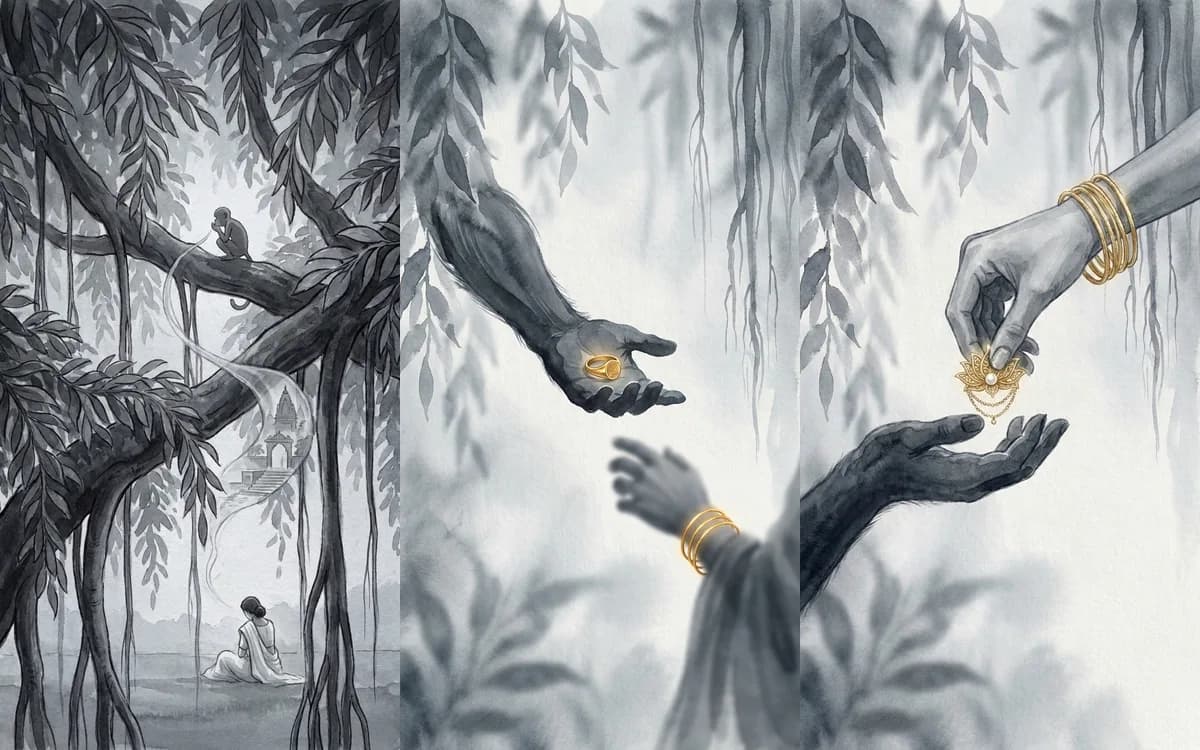
Hanuman spends a whole sarga deciding how to speak without frightening her — a monkey using refined Sanskrit might sound like Ravana in disguise. He chooses to begin with a story she already knows, softly, from the branches. Sita doubts him, questions him, asks him to describe Rama; only then does he hold out Rama’s signet ring.
Sundara Kanda 5.31.2
राजा दशरथो नाम रथकुञ्जरवाजिनाम् पुण्यशीलो महाकीर्तिर्ऋजुरासीन्महायशाः
Hanuman offers to carry Sita back on his shoulders; she refuses — it must be Rama who comes for her. Instead she gives him two proofs of her own: a private memory of a crow at Chitrakuta that only Rama would know, and the crest-jewel she has kept tied in the cloth of her garment. Part IV of Anukriti’s series follows this exchange.
Then, untying the radiant, divine crest-jewel kept in her garment, Sita gave it to Hanuman — “to be given to Raghava.”
07Sargas 41–48
The grove destroyed
Rather than slip away, Hanuman decides to test Ravana’s strength. He tears up the pleasure grove and a temple hall, and defeats wave after wave of the forces sent against him — Jambumali, the sons of Ravana’s ministers, five generals, and Ravana’s young son Aksha — until Indrajit binds him with a divine weapon and he lets himself be taken.
08Sargas 49–52
Ravana's court
Brought before the throne, Hanuman is struck by Ravana’s splendour, then speaks as Rama’s envoy and Sugriva’s, urging him to return Sita. Ravana orders him killed; Vibhishana objects that an envoy may be punished but never put to death, and Ravana settles on setting his tail alight instead.
09Sargas 53–56
Lanka burned
Paraded through the streets with his tail ablaze, Hanuman finds the fire does not burn him — Sita has prayed to Agni for his safety. He breaks free and sets the city alight roof by roof, then is seized by fear that Sita herself has perished. Reassured, he returns to the grove to see her one last time before the leap home.
10Sargas 57–68
The return
Hanuman leaps back to the mainland, where Angada, Jambavan and the others are waiting, and tells them everything. The jubilant monkeys raid Sugriva’s honey garden, Madhuvana, on the way home. In Kishkindha, Hanuman gives Rama the chudamani and repeats Sita’s words, the crow story among them. The book closes on that report; the march to Lanka and the war belong to the next book, the Yuddha Kanda.
Traditional closing verse of a Sundara Kanda reading